Fuse Minerals drilled its Mt Sydney Project not knowing exactly what they would find. Turns out, most holes point to VHMS.
Fuse Minerals is an Australian exploration company dedicated to uncovering the critical mineral resources needed to power our future economy. In the second half of 2024, the team commenced drilling at the Mt Sydney Project, located on the eastern margin of the Archaean-aged Pilbara Craton in Western Australia.
Initial exploration considered several possible mineralisation styles, but it wasn’t until drilling results were analysed that the true potential began to emerge – a potential pointing toward a significant Volcanic-Hosted Massive Sulphide (VHMS) discovery.
Earlier exploration efforts in the area focused on widespread quartz veining, which returned encouraging copper, silver, lead, and zinc results. However, the absence of gold led early explorers to dismiss the area when testing models like the nearby Telfer or iron oxide copper-gold (IOCG) deposit styles.
Drilling at Bull and Harrison
Two key prospects – Bull and Harrison – stood out prior to drilling. Bull, with striking surface mineralisation in quartz veins, was a natural priority. Meanwhile, Harrison, roughly 4km away, featured base metal gossans in volcanic rocks and showed signs of deeper potential.
Initial drilling at Bull yielded disappointing results, as the rich surface veins failed to continue at depth. But at Harrison, every one of the six drill holes encountered sulphide mineralisation – an encouraging sign. More significantly, the local geology at Harrison – rhyodacite, andesite, basalt, and black shale – mirrors that of many known VHMS systems.
The presence of iron, copper, and zinc sulphides on fracture surfaces, coupled with silica-sericite alteration, suggests the drill holes may have clipped the outer halo of a VHMS system. The next step looked to focus efforts at Harrison to pinpoint the high-grade, core massive sulphide zone.
A turning point came when geochemical assays from quartz veins at Bull were compared with assays from the mineralised volcanic rocks at Harrison. To the team’s surprise, the results showed a near-perfect alignment – indicating a likely genetic relationship. Given the stratigraphic position of Harrison’s mineralised volcanics above the veining at Bull, it’s logical to interpret those veins as potential feeders in a VHMS system.
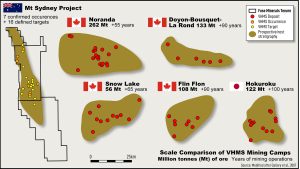
The implications are significant: this VHMS system could span over 15km, based on surface mapping, geological continuity, and a series of strong VTEM (airborne electromagnetic) conductors. VTEM surveys highlight zones of elevated conductivity, often associated with sulphide mineralisation, and are common tools used in VHMS exploration. One of the strongest conductors aligns directly with the sulphide-rich rocks drilled at Harrison. Many other conductive targets, hosted in the same volcanic sequence, remain untested.
Australia’s VHMS potential
Globally, VHMS systems are often found in clusters or ‘camps’ with multiple deposits occurring at predictable levels in the stratigraphy. The Noranda District in Canada is a prime example – with over 20 deposits, including the massive Horne No. 5 (150 Mt). Canada is renowned for its giant Archean-aged VHMS systems. The volcanics at Mt Sydney, dated to ~2.75 Ga, fall within the same geologic window known for prolific VHMS formation.
Australia, like Canada, boasts vast expanses of Archaean rocks. Yet, while VHMS deposits have been found here, none so far rival the scale of Canada’s giants. Is it because they don’t exist, or simply that they haven’t been discovered yet?
Mt Sydney’s geology – transitioning from basal rhyolites through intermediate volcanics to basalts – mirrors classic VHMS-hosting sequences. With multiple untested VTEM targets over a 15km strike, hosted in favourable stratigraphy, and early drilling already hitting sulphides, the signs are pointing to something much bigger.
Fuse Minerals believes Mt Sydney has camp-scale VHMS potential. The hunt is on – not just for a deposit, but for an Australian giant.
Please note, this article will also appear in the 22nd edition of our quarterly publication.