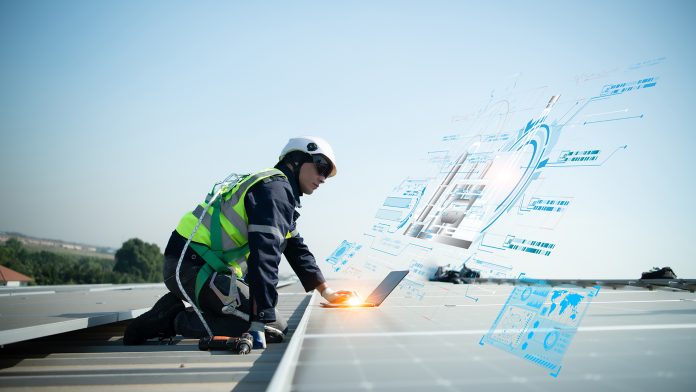
The SUPERNOVA project aims to improve the solar photovoltaic sector’s efficiency and quality, using AI to enhance efficiency, data management, and operational maintenance practices across the entire value chain.
The SUPERNOVA project sets out to enhance quality and efficiency throughout the entire solar photovoltaic (PV) sector value chain by breaking down barriers among different stakeholders.
Consisting of 20 diverse partners, the consortium encompasses the entire value chain of PV energy systems, including manufacturers, project developers, independent power producers, operations and maintenance (O&M) providers, and several research facilities.
SUPERNOVA’s objectives
Our main idea is to break silos, which can be summarised in two questions: First, how can my work be positively impacted by changes in previous steps of the value chain? Second, how can I positively impact the next phase of the value chain? This overarching objective is supported by seven specific goals outlined in the grant agreement.
- The first objective is to enhance the grid-friendliness of O&M during the design of PV plants. For example, when planning and designing a PV plant, we consider not only maximising yield but also optimising for various O&M procedures. This includes, for example, optimising the PV plant layout for manoeuvring unmanned vehicles or the structure design to increase resilience against harsh weather events.
- Our second objective focuses on leveraging robotic solutions, such as aerial vehicles (drones) and field robotics. We aim to reduce costs by utilising existing technologies, like maintenance robots already deployed in the field, and equipping them with inspection sensors to monitor PV modules and other components for potential failures.
- The next objective involves improving sensing solutions for data collection. We strive for high spatial and temporal granularity in the data we collect. To this end, we are developing smart modules and string-level Internet of Things devices to assist in monitoring and detecting failures.
- As a result of these advancements, we expect to generate a substantial volume of data. The fourth objective considers effective data management. Our strategy includes analysing data from O&M processes and integrating data across all stakeholders along the value chain.
- One challenge we face is ensuring the consistency of data, especially between different platforms and sources. Here, AI will play a crucial role in simplifying access to and analysis of all the data collaboratively, leading to what we refer to as an ‘insight explosion.’ This increased insight will facilitate better operational maintenance and enhance considerations regarding the end-of-life status of PV components.
- We aim to increase the profitability of PV systems by rethinking operational maintenance and grid-friendliness strategies. For instance, we are developing new business models to monetise data and improve energy trading practices.
- Finally, we want to create confidence and business value for sharing data. To do so, we are developing models overcoming privacy issues, and we are establishing best practices for data sharing and monetisation. A key element is the creation of an energy data space tailored for the PV sector. This space will allow for customised sharing in accordance with the data owner’s requirements, while also providing additional applications for data processing.
Employing AI for quality assurance
AI can significantly enhance quality assurance processes within the solar PV sector by allowing us to leverage the vast amount of data generated. This information greatly improves our understanding of the operational health of PV plants, enabling us to analyse issues in relation to specific variables, such as materials and climatic conditions.
However, the analysis of this data is often complicated, as information from different sources can be confusing, and the sheer amount of data makes the process time-consuming and labour-intensive.
AI offers an opportunity to extract hidden insights from this large volume of data. Instead of analysing different data segments individually, AI can help effectively fuse data from various sources and provide whole new insights, the ‘insight explosion’ mentioned before.
It is crucial to distinguish between two AI concepts: discriminative AI and generative AI. Discriminative AI has been utilised in PV research for many years, while generative AI, which is based on large language models like GPT, has gained significant popularity in recent years and is now widely applied.
Both approaches are essential for achieving this insight explosion, but it is vital to identify the role each approach should take. For instance, a well-trained discriminative approach (the traditional machine learning method) can perform simple defect detection tasks more accurately and efficiently. On the other hand, generative AI is more suited for organising data from various sources, determining the best tools for specific data analysis, and establishing connections between the information obtained.
At SUPERNOVA, we are actively integrating both AI approaches. One example of this integration is the development of AI agents based on generative AI, which utilise traditional models trained with data to retrieve and elaborate on relevant information. These agents can be applied in specific workflows, such as O&M.
SolarPower Europe: Facilitating collaboration and knowledge sharing
SolarPower Europe plays a vital role in the SUPERNOVA project. Leveraging our expertise, SolarPower Europe is responsible for communicating and disseminating information about SUPERNOVA’s work. As a business member organisation, SolarPower Europe unites hundreds of stakeholders across the entire value chain, maintaining direct communication with policymakers and possessing unique knowledge about existing and upcoming policies and regulations.
One of the key tasks of the organisation is defining cybersecurity guidelines and evaluating the impact of decisions along the value chain. Our engagement with a diverse array of stakeholders is invaluable, facilitating connections not only within the consortium but also with other partners.
Additionally, SolarPower Europe organises important initiatives that are firmly integrated into the project. One such initiative is the Solar Quality Summit, which serves as a central meeting point for stakeholders. At this summit, we gain insights from various partners, forge new collaborations, and disseminate the results and developments from SUPERNOVA.
In February of this year, SUPERNOVA was responsible for several presentations at the Solar Quality Summit, including two panels solely focused on our project. We also participate in SolarPower Europe’s Lifecycle Quality Workstream meeting, allowing us to share SUPERNOVA’s developments with partners outside the consortium.
Collaboration = success
Collaboration among stakeholders in the SUPERNOVA project is essential for the overall success of solar PV initiatives. Generally, Horizon Europe projects involve collaboration, working with multiple partners toward a common goal. These large projects can only succeed through strong collaboration among all involved partners. SUPERNOVA has partners across the entire value chain, which brings a wide variety of stakeholders into the project. Each partner contributes unique expertise, and this diversity can lead to differing levels of understanding regarding what constitutes state-of-the-art practices.
For some partners, what is considered best practice may be common knowledge, while for others, it may not be as clear. Therefore, open communication is vital. We must engage in in-depth discussions on various topics, share what is necessary, identify limitations, and more. It’s important to note that while collaboration is crucial, it is not always easy. The project’s goal is to break down barriers between stakeholders, improve communication, and create benefits for everyone, and we are beginning to achieve that in SUPERNOVA. With SUPERNOVA, we aim to demonstrate the value of this collaborative approach, which then shall be adopted across the solar PV industry, where implementation will be even more complex and ambitious.
From reactive to proactive
It is essential to transform quality assurance from a reactive process, where issues are addressed only after they arise, into a proactive and potentially predictive framework. The ideal scenario is one where we utilise sufficient data to anticipate potential problems, whether near or far, allowing us to plan accordingly. This shift depends on real-time data along with autonomous inspections and data analysis.
To accomplish this, we must employ deep learning and AI to analyse data and derive meaningful insights. AI will facilitate timely autonomous inspections and will help guide and plan these inspections using robotic systems. Additionally, AI must quickly adapt to and learn from new data, allowing for a streamlined process that does not require extensive system changes or lengthy training for our personnel.
The benefits of AI in this context, particularly when compared to manual processes, are significant. AI can process information much more quickly and respond in real time, delivering economic advantages that are not feasible with human labour alone. One of SUPERNOVA’s key roles involves orchestrating the flow of data between various stakeholders and platforms. AI’s ability to understand the relationships among different data sources – even when the labelling is inconsistent – will be crucial. By analysing this data, we can generate data-driven recommendations, such as developing a decision support system predominantly guided by AI or proactively ordering components that are likely to fail soon.
The generated insights will be beneficial for the whole PV sector by creating business value for more sustainable approaches like end-of-life treatment and for the whole energy sector by improving forecasting and therefore energy trading practices.
It is also essential that the AI tools we create remain trustworthy and explainable, especially as they take on more decision-making authority. To that end, we adhere to ethical guidelines for AI, ensuring that decisions made by AI systems are transparent and understandable to humans. This principle of having a ‘human in the loop’ ensures that AI does not operate in complete autonomy; rather, humans will verify critical decisions.
SUPERNOVA is at the forefront of this vision. We are actively pursuing many of these areas, with some already at an advanced stage of product development. For others, we are laying the groundwork by testing different approaches and establishing frameworks and foundational rules for AI applications. Our goal is to ensure that our innovations can be practically implemented in the PV industry and do not remain merely as research projects.
As we wrap up the first year of our project, we have about two and a half years ahead, during which we anticipate some significant advancements. To follow the journey and keep up to date with the latest news, visit the SUPERNOVA website.
Please note, this article will also appear in the 22nd edition of our quarterly publication.