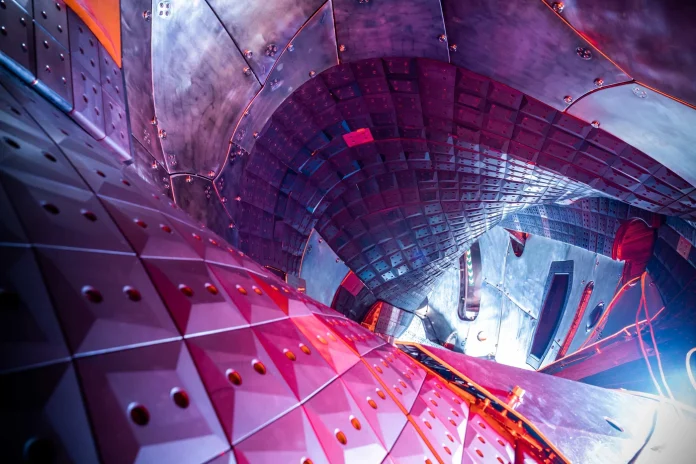
The Wendelstein 7-X (W7-X), the world’s most advanced stellarator, has reached a historic milestone in nuclear fusion research.
Scientists from Europe and the United States, working in collaboration, have set a new world record for a key fusion performance metric known as the triple product – a combination of plasma density, temperature, and confinement time.
This achievement marks the highest value ever sustained for long-duration plasma discharges and significantly advances the potential of stellarators as future fusion power sources.
This breakthrough reinforces Wendelstein 7-X’s role as a leading contender in the global pursuit of clean and virtually limitless energy through fusion.
What makes Wendelstein 7-X unique
Based in Greifswald, Germany, and operated by the Max Planck Institute for Plasma Physics (IPP) with support from EUROfusion, Wendelstein 7-X is designed to test the viability of stellarators for practical energy production.
Unlike the more widely studied tokamak design, stellarators rely solely on complex magnetic fields to contain their superheated plasma, eliminating the need for a current running through the plasma itself – a feature that makes them inherently more stable and potentially more suitable for continuous energy generation.
The recent experimental campaign, known as OP 2.3, concluded with a record-setting performance that underscores the stellarator’s potential to meet and exceed some of the critical benchmarks needed for a future fusion power plant.
Shattering records in fusion performance
On May 22, the final day of the OP 2.3 campaign, the Wendelstein 7-X team successfully maintained a world-best triple product for 43 seconds.
This surpassed the previous bests set by renowned tokamak devices such as Japan’s JT60U and the UK’s JET.
While these tokamaks achieved higher peak values over shorter bursts, Wendelstein 7-X’s ability to sustain high performance for longer durations marks a significant shift in what is possible with magnetic confinement fusion.
This accomplishment is particularly important for fusion power generation, where long, stable plasma discharges are essential for practical and economical energy output.
Fuelling the future with advanced pellet injection
The new record was made possible by a sophisticated hydrogen pellet injector developed by Oak Ridge National Laboratory (ORNL) in the United States.
This device injected nearly 90 frozen hydrogen pellets, each about a millimetre in size, into the plasma over the course of the 43-second discharge. At the same time, the plasma was heated using powerful microwave beams through a process known as electron cyclotron resonance heating.
Precise coordination between the pellet injection and heating allowed researchers to maintain an ideal balance between fuel supply and energy input.
For the first time, the pellet injector operated using pre-programmed variable rates, a method directly applicable to the design of future fusion reactors.
This innovation proved essential to achieving the sustained, high-performance plasma needed to break the record.
Other major Milestones from OP 2.3
Beyond the triple product record, the campaign saw two additional breakthroughs. Wendelstein 7-X increased its total energy turnover to 1.8 gigajoules during a 360-second plasma run, surpassing its previous record of 1.3 gigajoules.
This level of sustained energy input and heat removal closely mirrors the requirements of a functioning fusion reactor.
In a separate series of experiments, researchers achieved a plasma-to-magnetic pressure ratio of 3% across the full volume of the plasma. By deliberately reducing the magnetic field to allow plasma pressure to rise, they recorded ion temperatures of around 40 million degrees Celsius.
This ratio approaches the 4–5% range needed for commercial-scale fusion energy production, offering another strong indicator of stellarators’ viability.
A global effort driving breakthroughs
The achievement at Wendelstein 7-X was the result of extensive international cooperation. European labs provided critical groundwork: Spain’s CIEMAT contributed with simulation models, while Hungary’s HUN-REN Centre deployed ultra-fast cameras to analyse pellet behaviour.
The microwave heating system was developed with expertise from the Karlsruhe Institute of Technology and the University of Stuttgart.
Meanwhile, plasma diagnostics were carried out using tools from Princeton Plasma Physics Laboratory and IPP Greifswald, measuring temperatures that reached over 30 million degrees Celsius.
These partnerships brought together some of the most advanced technologies and scientific minds in the fusion community, demonstrating the value of global collaboration in solving one of energy science’s greatest challenges.
A promising path toward fusion power
With these latest achievements, Wendelstein 7-X is not only demonstrating theoretical predictions but also proving the stellarator’s capability in real-world experimental conditions.
As fusion research intensifies globally, this stellarator now leads in a critical area: long-duration, high-performance plasma operation.
By pushing the boundaries of what is possible in fusion energy, Wendelstein 7-X brings us a step closer to the long-sought goal of safe, clean, and sustainable fusion power.