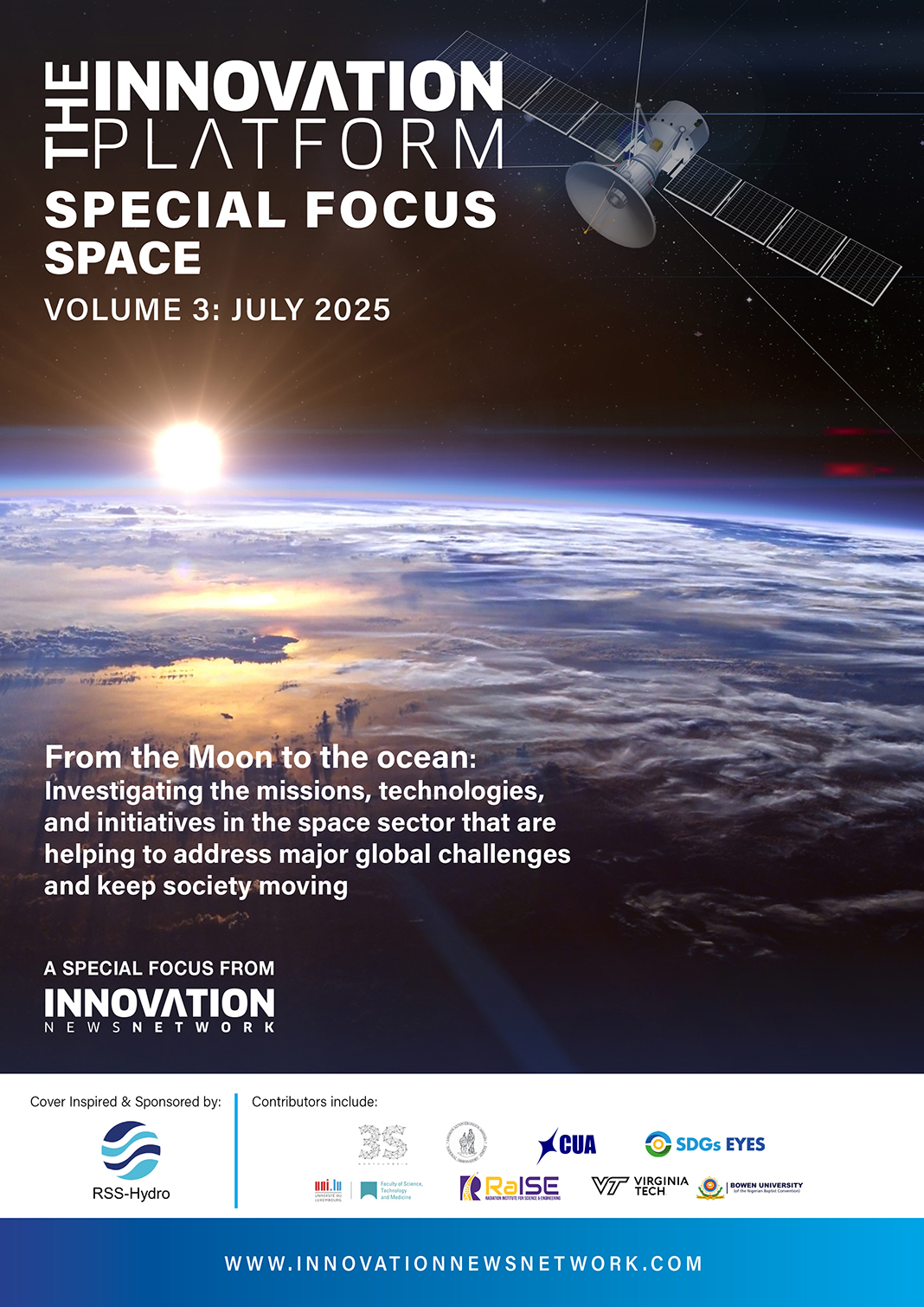
Welcome to our space special focus publication, which provides an in-depth analysis of how global space collaboration is tackling climate change, disaster response, and more, featuring insights from NASA, ESA, and top experts.
From global health to economic growth, exploration and activity in space has a profound impact on so many aspects of our lives. Worldwide, governments, space agencies and companies are collaborating to utilise space technologies and capabilities to address major global challenges, from climate change to disaster response. This carefully curated special focus publication explores a number of these challenges and shines a spotlight on the groundbreaking work taking place in the space industry. We sat down with some of the leading figures in the space sector, including experts from NASA and the European Space Agency, to discuss a number of important topics, including Earth observation, Moon and Mars exploration, space weather, space technologies and much more.
Returning to the Moon
Leading the publication, we have a conversation with NASA’s Deputy Associate Administrator for Programs in the Space Technology Mission Directorate (STMD), Walt Engelund. Engelund details the many activities that the agency is running in its quest to return humans to the Moon and continue on to Mars and beyond.
To support missions like NASA’s, innovation is of vital importance. In this edition, scientists from Prairie View A&M University share how they have developed and launched two first-of-their-kind space radiation measurement payloads. In addition, we hear from Champaign-Urbana Aerospace (CUA) about the multiple innovative micropropulsion systems that it has developed for future integration and flight on micro/nanosatellites.
Earth observation and disaster mitigation
Earth observation (EO) – the process of gathering information about the Earth’s surface, waters and atmosphere – is vital to ensure a safe, secure, and healthy society and economy. EO data can be used to inform policy and actions across a broad range of industries, including agriculture, forestry, fisheries, health, transport, tourism and more.
Within this publication, we take a look at key EO activities taking place around the world, as well as technologies and initiatives helping to support these. For 20 years, the European Space Agency (ESA) and its partners planned and developed the EarthCARE mission, designed to make global observations of clouds, aerosols and radiation and revolutionise our understanding of how these factors affect our climate. The mission launched in 2024, and it has already produced interesting data. I had the pleasure of speaking with Mission Manager Björn Frommknecht to find out more.
Continuing on the topic of observation, Félicia Norma Rebecca Teferle from the University of Luxembourg delves into Global Navigation Satellite Systems (GNSS) and explains how harnessing their capabilities can help to transform meteorological predictions and climate analysis.
Exploring why EO technologies are vital for disaster response and prevention, RSS-Hydro discusses its new cutting-edge applications for flood planning and introduces its recent project, CeDaRs, which is backed by ESA.
Looking at how space solutions can help combat climate challenges and meet sustainability goals, the Foundation Euro-Mediterranean Center on Climate Change (CMCC) introduces its SDGs-EYES project. The project turns satellite data into smart tools to boost Europe’s progress on the United Nations Sustainable Development Goals (SDGs).
Furthermore, we learn about the PITHIA-NRF project, which aims at building a European distributed network that integrates observing facilities, data processing tools and prediction models dedicated to ionosphere, thermosphere and plasmasphere research.
Space weather
Space weather is the physical and phenomenological state of natural space environments, impacted by solar activity. Severe space weather could have a detrimental impact on our society and infrastructure on Earth, and it is therefore of vital importance to monitor and predict space weather events to inform mitigative actions. ESA’s Space Weather Office works to deliver timely and accurate information to enable mitigation of the adverse impacts of space weather. I sat down with Juha-Pekka Luntama, Head of the Space Weather Office at ESA’s European Space Operations Centre (ESOC), to learn more about the Office’s key activities.
We also take a look at VT-NigerBEAR, an international collaboration between Virginia Tech, USA and Bowen University, Nigeria, which is poised to highlight the use of High-Frequency (HF) radars on monitoring space weather.
Space data
Elsewhere in this special focus edition, The UK Space Agency shares details about its ‘Unlocking Space for Business’ programme, which aims to drive private sector adoption of satellite data and services by tackling barriers to adoption being faced by private sector end-users. We also hear from 3S Northumbria about the importance of increasing available space data to support space operations.
This publication is a comprehensive look at the operations and innovations on the ground and in space that enhance our daily lives and keep our society moving. The issue is jam-packed with exciting and thought-provoking pieces from some of the industry’s leading voices, and I hope you find it as enjoyable to read as I have found its production.
Georgie Purcell
Editor, The Innovation Platform