France has launched Europe’s first pilot line for recycling rare earth magnets, boosting sustainability, supply security, and clean energy innovation.
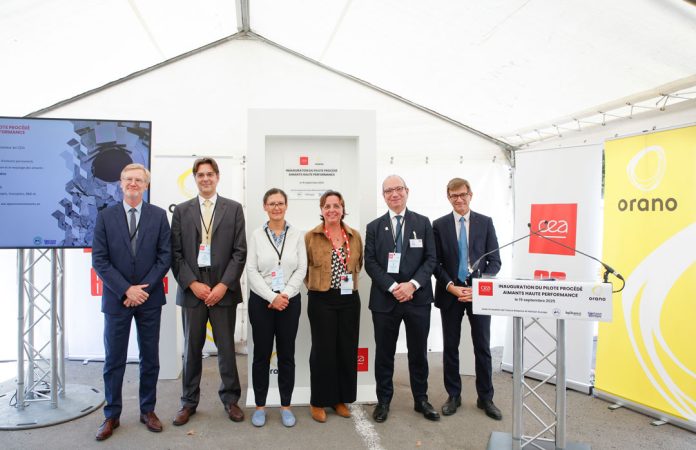
In Grenoble, France, the Orano Group and the French Alternative Energies and Atomic Energy Commission (CEA) have inaugurated the first European pilot line dedicated to recycling and manufacturing high-performance permanent magnets made from rare earths.
The ceremony was attended by key figures, including Benjamin Gallezot, France’s Interministerial Delegate for Strategic Minerals and Metals, Guillaume Dureau of Orano, and Philippe Stohr of the CEA Energy Division.
Commenting on the landmark facility, Stohr said: “The establishment of this pilot line dedicated to the circular economy of high-performance magnets containing rare earths, strategic materials for carbon-free mobility and renewable energies, is fully in line with the CEA’s mission of innovation in the service of reindustrialisation and sovereignty in France and Europe.
“With support from France Relance as well as European funding, our teams, together with those at Orano, have been able to develop key skills and expertise. Today marks a new milestone with industrial-scale equipment, which will be a decisive lever in speeding the path to industrial maturity for recycling and remanufacturing processes and ultimately offering a competitive and sustainable alternative to international competition.
“We are delighted to share this ambition, underpinned by 10 years of research at the CEA into high-performance magnets, with our long-standing partner Orano.”
Why rare earth magnets matter
Permanent magnets containing rare earth elements are critical to the global energy transition. They power electric vehicle motors, drive wind turbine generators, and support a wide range of clean-energy technologies.
Yet, production of these magnets has been heavily concentrated outside Europe, creating supply risks for industries that depend on them.
By advancing magnet recycling in France, this initiative strengthens both environmental protection and European autonomy over strategic materials.
A breakthrough in short-loop recycling
Since 2022, research teams from Orano and CEA Liten have collaborated to design a state-of-the-art pilot line capable of meeting the toughest performance standards.
Their work focuses on a pioneering ‘short-loop’ recycling process, which extracts rare earths in metallic form from end-of-life magnets and reintegrates them into new, high-performance magnets.
This innovation reduces pressure on natural resources while ensuring recycled magnets match the quality and performance of newly mined materials.
Industrial and environmental impact
The pilot line will act as a testbed for innovative processes, providing manufacturers with validated methods to scale production across Europe. Full results of the programme are expected by the end of 2026, setting the stage for large-scale deployment.
Supported by France’s France Relance recovery plan and the EU’s Horizon Europe programme, the project is part of two major consortia – Magellan and Magnolia – focused on magnet production from recycled critical metals.
Dureau added: “The magnets and rare earths project is aligned with Orano’s strategy to diversify its activities. Building on our purpose and expertise in the nuclear fuel cycle, we are proud to be able to contribute to the effective management of the critical metals supply chain and to Europe’s strategic autonomy, while preserving natural resources through recycling.
“The project responds to a need for high-performance magnets that are essential to the energy transition. I commend the commitment of the CEA and Orano teams, who have overcome numerous technical challenges to reach this important milestone.”
Building a sustainable future
By combining cutting-edge science with circular economy principles, the pilot line represents a decisive step toward securing Europe’s supply of rare earth magnets.
More than just a technological breakthrough, it signals a strategic move to protect the environment, reduce reliance on imports, and accelerate the continent’s clean energy transition.