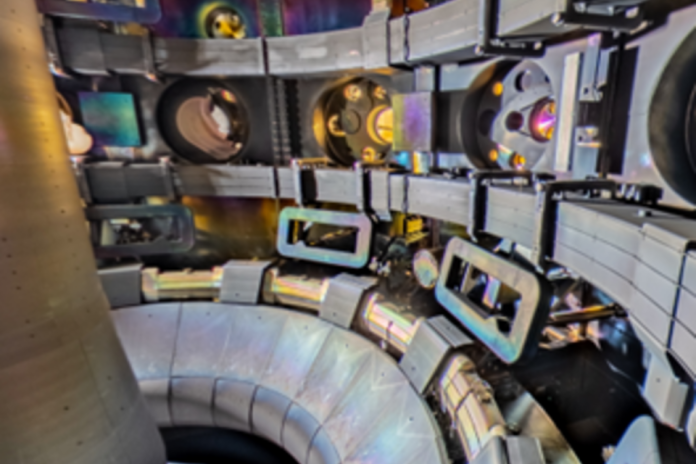
MAST Upgrade, the UK’s national fusion experiment, has demonstrated multiple world-first breakthroughs during its fourth scientific campaign, including the stabilisation of 3D magnetic fields.
As part of the Mega Amp Spherical Tokamak (MAST) Upgrade, scientists at the UK Atomic Energy Authority (UKAEA) used magnetic coils to apply a 3D magnetic field and stabilise instabilities in a spherical tokamak plasma for the first time.
Achieving stable 3D magnetic fields marks a significant step forward in the development of sustainable fusion energy within spherical tokamaks.
Stability: One of fusion energy’s biggest challenges
To achieve fusion using MAST Upgrade, fusion fuel needs to be confined at high temperature within the tokamak to create a plasma.
If the plasma current, pressure or density is too high, the plasma can become unstable, reducing performance or risking damage to tokamak components. Maintaining plasma stability is one of fusion’s key challenges.
Edge Localised Modes (ELMs) are instabilities that occur at the edge of a plasma and could pose a serious challenge to the inner components of a future fusion power plant.
Using Resonant Magnetic Perturbation (RMP) coils – which apply a small 3D magnetic field at the plasma edge – UKAEA researchers have demonstrated complete suppression of ELMs within the MAST Upgrade machine.
World-first 3D magnetic field achievement
This is the first time such suppression has been evidenced in a spherical tokamak.
James Harrison, Head of MAST Upgrade Science at UKAEA, explained: “Suppressing ELMs in a spherical tokamak is a landmark achievement.
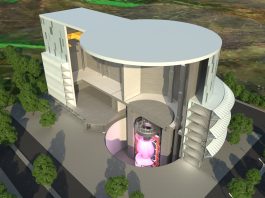
“It is an important demonstration that advanced control techniques developed for conventional tokamaks can be successfully adapted to compact configurations to develop the scientific basis for future power plants like STEP, the Spherical Tokamak for Energy Production.”
Advancing plasma exhaust solutions
In another world first, UKAEA researchers have demonstrated that they can independently control the plasma exhaust in the upper and lower divertors in MAST Upgrade without impacting the performance or density of the plasma in the main chamber of the tokamak.
A tokamak exhaust system, known as a divertor, takes the particles and heat ejected from the plasma and directs it onto surfaces within the tokamak. Managing plasma exhaust is another key fusion challenge, and the ability to independently control upper and lower divertors in a tokamak could significantly enhance the robustness and flexibility of future power plant operations.
Additionally, experiments involving nitrogen injection at the plasma edge have shown that energy can be more evenly distributed across plasma-facing components.
This technique prevents excessive heat concentration and opens a new path for managing power exhaust in compact spherical tokamaks, bringing them in line with advanced exhaust solutions being explored in conventional aspect ratio machines.
Record performance and plasma shaping
MAST Upgrade also set a record for power injected into its plasma, reaching 3.8 megawatts using neutral beam heating.
This milestone supports higher performance plasma scenarios and contributes to the development of power plant-relevant conditions.
In the latest round of experiments, the team also achieved the best plasma shape ever recorded on the machine, with an elongation of 2.5 – meaning the plasma height is 2.5 times its width.
The shaping of a plasma has a stabilising effect, enabling higher-performance plasmas which have higher pressure and better confinement. Greater plasma elongation, or height divided by width, improves plasma performance and will be a key target for future fusion power plants like STEP.
Fulvio Militello, Executive Director of Plasma Science and Fusion Operations, UKAEA, concluded: “I’m delighted with the ground-breaking findings from our team at UKAEA. These achievements reinforce the UK’s leadership in fusion research and bring us closer to realising fusion as a clean, safe, and abundant energy source for the future.”