Sellafield teams have successfully removed 70 tonnes of radioactive waste from the Magnox Swarf Storage Silo, which is one of Sellafield’s most hazardous legacy facilities.
Clearing radioactive waste from this legacy facility marks a significant step forward in one of the UK’s most challenging nuclear decommissioning tasks, as it places the waste into interim long-term safe storage.
However, success has presented a challenge, which is often the case in nuclear decommissioning.
Phil Reeve, head of legacy silos for Sellafield Ltd, explained: “As we’ve scooped waste out of compartment 10 in the silo, we’ve dug a 7-metre crater in the middle of it. This creates a risk that the waste around the edges will suddenly collapse into it.”
How a garden rake helps overcome these issues
An innovative spin on a traditional gardening tool is helping to overcome these issues.
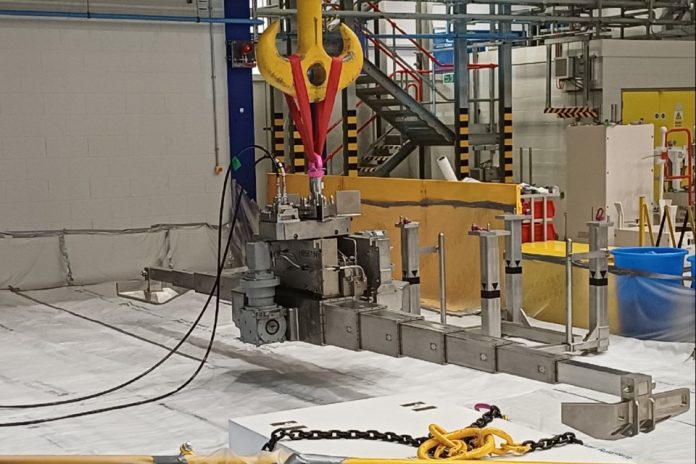
The answer is the Sellafield version of a garden rake. A 1.4-tonne machine that extends its stainless-steel arms outward, then pulls nuclear waste into the centre, smoothing it out.
“The rake has been developed alongside the retrieval machine. So, it’s a big moment to see it successfully deployed in an active environment for the first time,” Reeve commented.
Andrew Prince, a team leader at the Magnox Swarf Storage Silo, added: “Deploying the rake for the first time in Compartment 10 was a major milestone. It’s one of the most challenging areas on the Sellafield site, and the successful operation gives us real confidence in the wider retrievals programme.
“This achievement reflects the dedication of a large team across Sellafield Ltd and our supply chain.”
Why is nuclear decommissioning so important?
Nuclear decommissioning is necessary to ensure the long-term safety of people and the environment once a nuclear facility reaches the end of its operational life.
Over time, materials within reactors become highly radioactive, posing significant health and environmental risks if not properly managed and controlled.
Decommissioning safely removes and contains these hazards, preventing potential leaks, contamination, or accidental exposure. It also enables the responsible dismantling and disposal of radioactive components and waste, ensuring compliance with stringent national and international safety regulations.
Moreover, decommissioning frees up land for future use, whether for industrial redevelopment, renewable energy projects, or environmental restoration.
Without proper decommissioning, ageing nuclear sites could become dangerous and costly liabilities for future generations.
Therefore, decommissioning is a critical process that supports sustainability, public safety, and environmental protection, while upholding the ethical responsibility to manage nuclear technology safely throughout its entire lifecycle.
The nuclear waste cleanup programme is a complex process
Waste retrieval from the silo began in 2022, following 2 decades of careful preparation.
The retrieval operation is particularly complex due to the building’s original design in the 1960s, which did not account for future waste removal.
A painstaking process was needed to retrofit an exit route. It involved assembling huge retrieval machines on top of the building’s vast waste compartments, called a Silo Emptying Plant (SEP) machine.
Currently, one machine is operational, with 2 more due to begin work soon. All retrieved material so far has come from compartment 10 in the silo.