Currently, the maximum distance at which two quantum computers can connect through a fibre cable is a few kilometres.
This means that, even if fibre cables were run between them, quantum computers in the University of Chicago’s South Side campus and downtown Chicago’s Willis Tower would be too far apart to communicate with each other.
However, a new breakthrough from the University of Chicago Pritzker School of Molecular Engineering could theoretically extend that maximum to 2,000 km (1,243 miles).
With this new approach, the same UChicago quantum computer that previously couldn’t reach the Willis Tower could now connect and communicate with a quantum computer outside of Salt Lake City, Utah.
“For the first time, the technology for building a global-scale quantum internet is within reach,” said Assistant Professor Tian Zhong, who led the research.
Maintaining the quantum coherence of atoms
Linking quantum computers to create powerful, high-speed quantum networks involves entangling atoms through a fibre cable.
The longer the time those entangled atoms maintain quantum coherence, the longer the distance those quantum computers can link to each other.
As part of the new breakthrough, Zhong and his team at the University of Chicago’s PME raised the quantum coherence times of individual erbium atoms from 0.1 milliseconds to longer than 10 milliseconds.
In one instance, they demonstrated a latency of up to 24 milliseconds, which would theoretically allow quantum computers to connect at a staggering 4,000 km, the distance from the University of Chicago’s PME to Ocaña, Colombia.
Same materials, different method
The innovation was not in using new or different materials, but in building the same materials a different way.
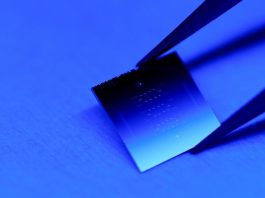
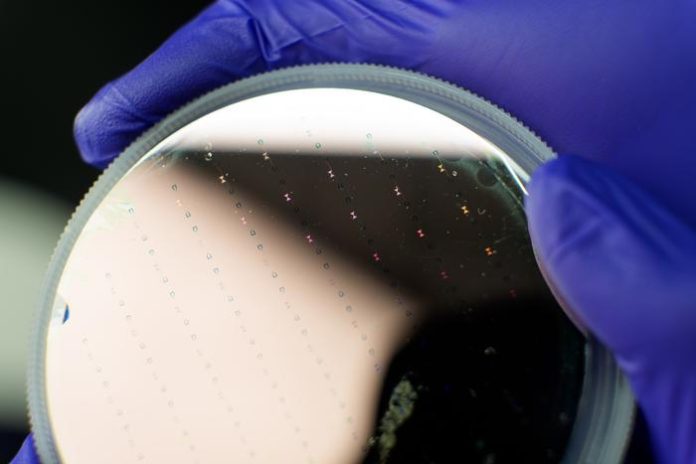
They created the rare-earth-doped crystals necessary for quantum entanglement using a technique called molecular-beam epitaxy (MBE), rather than the traditional Czochralski method.
To turn the crystal into a computer component, researchers then chemically “carve” it into the needed form. It’s similar to how a sculptor might select a slab of marble and chip away everything that isn’t the statue.
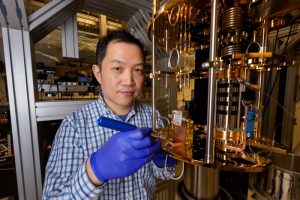
“We start with nothing and then assemble this device atom by atom,” Zhong explained. “The quality or purity of this material is so high that the quantum coherence properties of these atoms become superb.”
Next steps: Connecting quantum computers over long distances
Now, the team needs to test whether the increased coherence time enables quantum computers to connect to each other over long distances.
“Before we actually deploy fibre from, let’s say, Chicago to New York, we’re going to test it just within my lab,” Zhong stated.
This involves linking two qubits in separate dilution refrigerators (“fridges”), both in Zhong’s lab at UChicago PME, through 1,000 kilometres of spooled cable. It’s the subsequent step, but far from the final one.
Zhong concluded: “We’re now building the third fridge in my lab. When all is together, it will form a local network, and we will first conduct experiments locally in my lab to simulate what a future long-distance quantum network will look like.
“This is all part of the grand goal of creating a true quantum internet, and we’re achieving one more milestone towards that.”