Adam Hammond, EMEA Business Leader, IBM Quantum, discusses the UK’s position in the global quantum space and outlines the key needs for future growth.
While artificial intelligence (AI) reaches a fever pitch, quantum computing is emerging as the next technological transformation, with an estimated value of $850bn by 2040. UNESCO even named 2025 the ‘International Year of Quantum Science and Technology’. If the UK seizes this opportunity, quantum computing has the power to be a genuine differentiator for the country, and shape our economy, and world, for the better.
Getting there will require a policy strategy that favours technological neutrality, harnesses open-source software, prioritises funding for algorithm and application development research, and has a low barrier of access. Thankfully, Europe’s strong leadership in the physical sciences and technical expertise provides the perfect springboard.
The need for quantum technologies
You may ask, in a world of AI-accelerated computing capacity, why do we need quantum computers? Simply put, there are complex problems that cannot be solved by classical computers, such as simulating molecules for drug discovery and materials science and optimising large-scale systems in finance and logistics.
This year, UK financial services group HSBC published research that demonstrated what is believed to be the world’s first-known empirical evidence of the potential value of quantum computers for solving real-world problems in algorithmic bond trading. And E.ON, one of Europe’s largest energy companies, is exploring how quantum can optimise energy pricing amid volatile weather or different usage patterns from newly electrified sectors.
In addition to unlocking the maximum efficiency of energy grids and financial services, other opportunities are being explored in how quantum could optimise global shipping, and to help understand the complex chemical reactions that could lead to the discovery of new materials and medicines.
What does this mean for the UK?
The UK is home to one of the strongest quantum ecosystems in the world, with world-class talent and research facilities. The UK has the highest number of quantum computing startups in Europe. This reflects considerable research strengths, with nearly half of UK quantum hardware firms and a third of UK quantum software firms the result of spinouts from UK universities. Partnering with academia also helps us to speed up the creation of the new quantum workforce and ecosystem. We’ve also seen examples of effective industry-academia-government collaboration here in the UK. AstraZeneca is working with IBM and the STFC Hartree National Centre for Digital Innovation to explore how quantum could improve molecular modelling accuracy and accelerate drug development.
A 2025 Oxford Economics Quantum report found that quantum computing presents the UK with a huge opportunity to boost productivity and GDP growth across the economy – it could help achieve a 7% increase in productivity by 2045, which in turn could potentially deliver £212bn of gross value added to UK GDP – that’s about an extra £7,500 per UK household.
To maintain global competitiveness as a quantum leader, the UK needs long-term commitment and investment from the government, alongside industry partners.
Moving towards quantum advantage
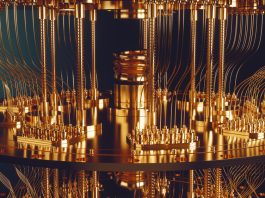
IBM recently announced progress on its path to delivering both quantum advantage by the end of 2026 and fault-tolerant quantum computing by 2029. IBM Quantum Nighthawk is the company’s most advanced quantum processor yet and is designed with an architecture to complement high-performing quantum software to deliver quantum advantage in 2026: the point at which a quantum computer can solve a problem more efficiently and accurately than all classical-only methods. The increased qubit connectivity with Nighthawk will allow users to accurately execute circuits with 30% more complexity than on IBM’s previous processor, while maintaining low error rates.
In a parallel path, IBM is rapidly delivering milestones towards building the world’s first large-scale, fault-tolerant quantum computer by 2029.
The company also announced IBM Quantum Loon, its experimental processor that, for the first time, shows all the key processor components needed for fault-tolerant quantum computing. Loon will validate a new architecture to implement and scale the components needed for practical, high-efficiency quantum error correction. The efficient quantum error correction decoding applied on Loon achieved ten times the speedup over the current leading approach – one year ahead of schedule.
Quantum computing is no longer a distant vision – it is rapidly becoming a cornerstone of future innovation. With the UK’s robust ecosystem of talent, research, and industry partnerships, the nation is well-positioned to lead in this transformative field. Achieving quantum advantage and ultimately fault-tolerant systems will unlock breakthroughs across sectors, from healthcare and energy to finance and logistics. To realise this potential, sustained investment, collaboration, and strategic policy will be essential. The race to quantum is not just about technology – it’s about shaping the next era of global competitiveness and economic growth.
Please note, this article will also appear in the 24th edition of our quarterly publication.