The race to deploy nuclear microreactor technology in real-world settings has moved from theory to practice.
The Idaho National Laboratory (INL) has taken a significant step towards accelerating next-generation nuclear energy by announcing the first group of end-user experiments for its Microreactor Application Research Validation and Evaluation programme, known as MARVEL.
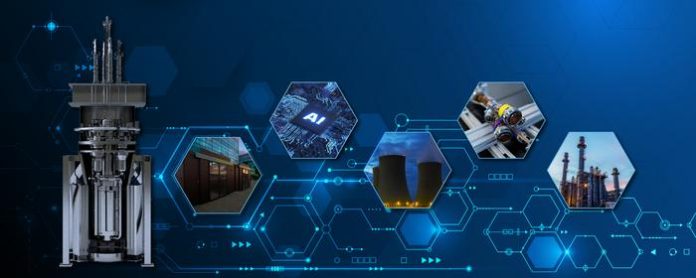
The initiative will explore how ultra-compact reactors can power AI-driven data centres, support remote and autonomous operations, enable advanced reactor monitoring, and even provide clean heat for industrial desalination – demonstrating how nuclear microreactors could reshape energy security, computing infrastructure, and water management in the years ahead.
A testbed designed for real-world applications
At the heart of the initiative is MARVEL itself, a compact nuclear microreactor being developed by the US Department of Energy.
The system uses a sodium-potassium coolant and is designed to produce around 85 kilowatts of thermal energy and up to 20 kilowatts of electrical output.
While modest in scale, the reactor is purpose-built to validate how microreactors can operate safely, reliably, and flexibly in demanding environments.
MARVEL will be installed at INL’s Transient Reactor Test Facility, giving private companies and research partners rare access to an operational nuclear microreactor.
This setting allows developers to move beyond simulations and laboratory models to test how advanced nuclear systems perform when connected to real equipment and real-world use cases.
Powering the next generation of data centres
One of the most closely watched applications involves using a nuclear microreactor to support data centres, particularly those running artificial intelligence workloads.
These facilities require enormous amounts of steady, uninterrupted electricity, often in locations where traditional grid infrastructure is unreliable or nonexistent.
Amazon Web Services plans to explore how MARVEL could be integrated with modular data centres that are designed to be rapidly deployed and self-sufficient.
Such systems could support defence, government, or emergency operations by providing computing power anywhere in the world without relying on diesel generators or fragile supply chains.
In a parallel effort, DCX USA and Arizona State University aim to study how a microreactor can provide stable, continuous energy tailored to the unique demands of AI processing.
Together, these projects could generate critical data on how nuclear microreactors might underpin the future of high-performance computing.
Advancing autonomous and remote reactor operations
Beyond computing, MARVEL will also be used to refine how nuclear systems are operated. GE Vernova intends to demonstrate remote and autonomous reactor control concepts, helping to establish operational standards that could later be applied to commercial reactors.
This work is expected to show how microreactors can be monitored and managed with minimal on-site staffing, a key requirement for deployment in isolated or high-risk locations.
Sensors and safety at the forefront
Radiation Detection Technologies will focus on testing advanced sensor technologies using MARVEL.
These high-performance instruments are designed to monitor reactor behaviour in real time, improving situational awareness and safety. Insights gained from this work could influence how future nuclear microreactors are regulated, inspected, and maintained.
Tackling water challenges with nuclear heat
Another major application centres on desalination and water treatment. Shepherd Power, NOV, and ConocoPhillips plan to use MARVEL’s process heat for a pilot-scale desalination project.
The goal is to demonstrate how nuclear microreactors could address produced water challenges in oil and gas operations, where large volumes of contaminated water must be treated or disposed of.
If successful, the approach could offer a low-carbon solution for water management in energy-intensive industries.
From selection to demonstration
The teams selected for MARVEL will now work closely with DOE and national laboratory experts to refine their concepts and assess technical feasibility.
This collaborative phase will determine which projects advance to full demonstrations using the reactor. Final agreements and confirmed demonstrations are expected to be announced in 2026.
By opening MARVEL to industry and academic partners, INL is transforming the nuclear microreactor from a promising concept into a practical tool.
The programme highlights how advanced nuclear technologies can support AI leadership, industrial resilience, and environmental solutions while reinforcing the United States’ role as a global leader in nuclear innovation.