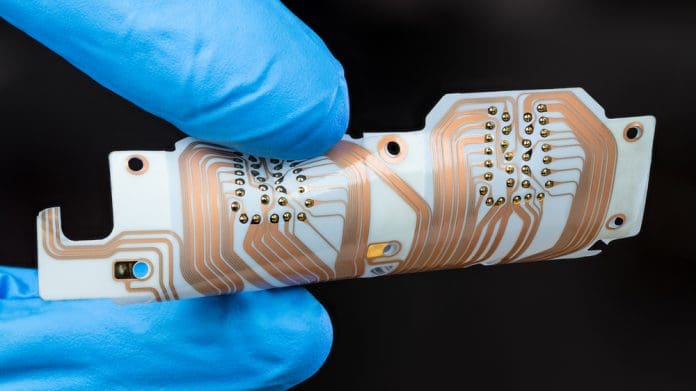
Electronics are everywhere – from healthcare and agriculture to packaging and logistics – but the way they are made has long carried a high environmental cost.
At Tampere University, Professor Matti Mäntysalo and his research group are challenging that status quo by advancing printed electronics and low-energy manufacturing methods that could fundamentally reshape the electronics industry.
Rather than focusing solely on individual components, the research targets the entire production system. The goal is clear: make electronics that are flexible, scalable, and dramatically more sustainable, without sacrificing real-world usability.
Manufacturing as the starting point
Traditional electronics manufacturing relies on high temperatures, complex chemical processes, and material-intensive methods such as etching. Printed electronics flip that logic entirely.
Using techniques adapted from the printing industry, such as screen printing, inkjet printing, and roll-to-roll production, electronic components are built layer by layer, adding material only where required. Conductive paths, sensors, capacitors, and even transistors can be printed directly onto flexible substrates.
This additive approach significantly reduces waste and chemical use compared to conventional printed circuit board manufacturing. It also consumes far less energy, largely because production temperatures are much lower.
Reduced energy use directly translates into lower carbon emissions, creating a clear and measurable sustainability benefit.
Lower temperatures also unlock new material possibilities. Bio-based and biodegradable materials that would be destroyed in traditional high-temperature processes can now be used in functional electronics. This expands the design space well beyond conventional metals and plastics.
Reducing dependence on critical raw materials
Another key focus area is reducing reliance on scarce and potentially environmentally harmful raw materials. Many modern electronic components – especially batteries – depend on critical minerals that are difficult to source sustainably.
Mäntysalo’s group is exploring alternatives such as printed supercapacitors, which can be manufactured without many of these materials.
In some experimental setups, electronic functionality can be achieved using surprisingly everyday substances, including carbon, salt, water, paper, aluminium, and small amounts of plastic.
The aim is not to replace high-performance electronics in demanding applications, but to complement them. Many use cases, such as disposable sensors or simple monitoring devices, do not require maximum performance. Printed electronics allow designers to match material and energy use to actual functional needs.
When electronics are designed to disappear
One of the most radical ideas emerging from this research is biodegradable electronics. At first glance, designing electronics that decompose may sound counterintuitive.
However, as the number of connected devices grows into the billions and eventually trillions, end-of-life challenges become impossible to ignore.
Many sensors are inherently single-use. Medical diagnostics, environmental monitoring, and agricultural applications often require devices that cannot be recovered or reused. In these cases, recycling alone is not sufficient.
The concept is simple but powerful: design electronics that can safely break down in natural environments or enter existing paper and plastic recycling streams without causing harm.
This approach is being explored in the SOIL research project, conducted in collaboration with VTT. The project focuses on biodegradable, flexible electronics for soil monitoring.
Sensors capable of wireless data transmission are developed using materials commonly found in soil, combined with low-temperature additive manufacturing processes. Once their task is complete, the devices can decompose without altering the soil’s composition.
Printed electronics in healthcare and remote monitoring
Sustainability is not only environmental – it is also social. Printed electronics have the potential to transform healthcare by enabling affordable, easy-to-manufacture diagnostic tools for home use.
Wearable and printed sensors can monitor vital signs such as heart rate, oxygen saturation, respiratory rate, temperature, and cardiac function. Data can be transmitted wirelessly to monitoring systems that analyse results and issue alerts when necessary.
This model supports earlier diagnosis, reduces unnecessary hospital visits, and improves follow-up care after discharge.
It is especially valuable for sparsely populated regions, where access to hospitals and specialised services may be limited. With printed electronics, healthcare services can reach patients rather than the other way around.
Finland’s strong position in pinted electronics
While printed electronics is a global field, Finland holds an unusually strong position. The country ranks among the world’s leading nations in scientific publications on printed electronics, and, relative to its population size, it sits at the very top.
This leadership is rooted in a unique industrial continuum that connects the forest industry, coating technologies, electronics expertise, and Nokia’s legacy. Collaboration between universities, research institutes, and industry plays a central role.
One major example is the EU-funded Sustronics project, which brings together dozens of partners across Europe to address sustainability challenges in electronics. Finnish participants include Tampere University, VTT, and several technology companies, with national funding support from Business Finland.
The project focuses on redesigning existing electronic products and developing entirely new ones using sustainable principles.
Educating the next generation of electronics experts
Developing sustainable electronics also requires new kinds of expertise. Mäntysalo emphasises the importance of a strong foundation in physics, chemistry, and mathematics, rather than early over-specialisation.
At the doctoral level, Tampere University is involved in multiple initiatives aimed at strengthening Europe’s microelectronics expertise. The EU-funded FERNS doctoral network trains researchers to think in terms of circular economy, bio-based materials, and low-energy processes.
Additional national programmes link doctoral research directly with industry, ensuring that graduates can move smoothly into applied roles.
Building the electronics of tomorrow
For Mäntysalo, printed electronics represent more than a technological shift – they embody a new way of thinking about how electronics are designed, manufactured, used, and ultimately returned to the material cycle.
With sustainability now a defining challenge of the electronics industry, that mindset may prove just as important as any single innovation.