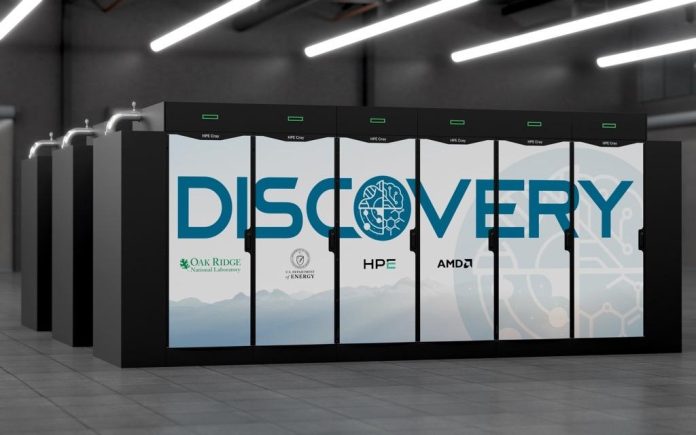
The U.S. Department of Energy (DOE) has unveiled two groundbreaking AI supercomputers, Discovery and Lux, that promise to propel America’s dominance in AI, high-performance computing (HPC), and scientific discovery.
The supercomputing systems, to be housed at Oak Ridge National Laboratory (ORNL), are poised to redefine the boundaries of scientific research, national security, and technological innovation.
By combining unprecedented computing power with advanced AI capabilities, Discovery and Lux promise to transform how scientists model complex systems, analyse massive datasets, and solve some of the nation’s most pressing technological challenges.
Powering the next era of AI science
Discovery and Lux are not just faster computers – they represent a new paradigm in how AI and science intersect.
Designed and built by Hewlett Packard Enterprise (HPE) and AMD, the machines will enable scientists to accelerate discovery in fields from clean energy to advanced manufacturing, medicine, and cybersecurity.
Discovery will be spearheaded by HPE, while the AMD-led Lux system will integrate Oracle Cloud Infrastructure (OCI) as part of the Lux AI Cluster, giving researchers access to unprecedented computing power both on-site and in the cloud.
Commenting on the landmark AI supercomputers, Secretary of Energy Chris Wright said: “Winning the AI race requires new and creative partnerships that will bring together the brightest minds and industries American technology and science has to offer.
“That’s why the Trump administration is announcing the first example of a new commonsense approach to computing partnerships with Lux. We are also announcing, as part of a competitive procurement process, Discovery.
“Working with AMD and HPE, we’re bringing new capacity online faster than ever before, turning shared innovation into national strength, and proving that America leads when private-public partners build together.”
Discovery: A leap beyond frontier
The Discovery system will mark a significant upgrade from ORNL’s current flagship supercomputer, Frontier, which in 2022 became the first to break the exascale barrier.
Discovery, scheduled for delivery in 2028, will surpass Frontier in every metric of performance, blending traditional supercomputing with cutting-edge AI and quantum computing research.
At its core lies the new HPE Cray Supercomputing GX5000, powered by AMD’s upcoming EPYC™ ‘Venice’ processors and Instinct™ MI430X GPUs.
The system’s next-generation architecture will enable scientists to simulate, model, and analyse data at record speeds.
Paired with an innovative Distributed Asynchronous Object Storage (DAOS)-based platform, Discovery is expected to deliver unmatched scalability and reliability for complex scientific workloads.
Accelerating discovery across disciplines
With Discovery’s AI-driven computing capabilities, researchers will be able to generate insights once thought impossible.
The system is expected to play a pivotal role in transforming nuclear energy by improving safety and reducing costs, creating AI-powered digital twins for personalised medicine, and dramatically shortening aerospace design cycles from years to months.
In essence, Discovery is built to make ‘Gold Standard Science’ faster, more accessible, and more impactful than ever before.
Lux: Expanding near-term AI capacity
Arriving earlier in 2026, the Lux AI Cluster will bolster the DOE’s near-term AI capacity, accelerating progress in fusion energy, quantum materials, advanced manufacturing, and power grid resilience.
The system will use AMD’s Instinct™ MI355X GPUs, EPYC™ CPUs, and Pensando™ networking technology, all housed in HPE’s ProLiant Compute XD685 framework.

Lux will provide a secure and scalable foundation for AI research across the national laboratory network, supporting large-scale training and distributed inference.
It will also serve as a testing ground for integrating cloud-based AI solutions with physical supercomputing infrastructure – a model expected to guide the DOE’s next generation of computing initiatives.
Charting the future of supercomputing
ORNL’s legacy in high-performance computing stretches back two decades, with leadership-class machines such as Jaguar, Titan, Summit, and Frontier – each the world’s fastest in its era.
Discovery and Lux continue that tradition, positioning the US at the forefront of global innovation in AI supercomputers and high-performance scientific computing.
By coupling world-class hardware with deep expertise across national laboratories and industry partners, Discovery and Lux will act as engines of innovation for decades to come.
As the race for AI supercomputers intensifies worldwide, the DOE’s bold investment signals a clear message: America intends to lead it.