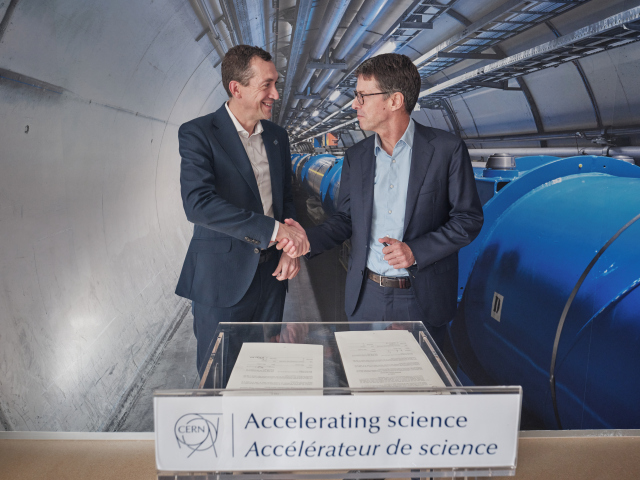
CERN, the European Organisation for Nuclear Research, and Fusion for Energy (F4E), the EU body managing Europe’s contribution to ITER, have signed a landmark framework collaboration agreement.
This alliance aims to accelerate progress in frontier technologies, including high-temperature superconducting magnets and the long-term pursuit of fusion energy.
The agreement strengthens a partnership that began in 2014, initially focused on studying radiation’s effects on materials. It was later extended in April 2025 to cover radiofrequency (RF) power couplers.
Now, the scope has widened significantly, opening the door to ambitious joint projects in engineering, testing, and scientific development.
Commenting on the partnership, Mike Lamont, CERN’s Director for Accelerators and Technology, said: “In a complex and fast-changing world, delivering large-scale scientific infrastructure calls for shared vision, technical synergy and organisational resilience.
“CERN and F4E face many of the same challenges – from advanced magnet technologies to sustainable project execution over decades. This agreement reinforces a partnership built on mutual interests and long-term commitment.”
Fusion energy explained
Fusion energy is often described as the ‘holy grail’ of clean power. It replicates the same process that fuels the Sun: combining light atomic nuclei, such as hydrogen isotopes, to form heavier elements while releasing vast amounts of energy.
Unlike nuclear fission, which splits atoms and produces long-lived radioactive waste, fusion offers the promise of abundant, safe, and virtually waste-free energy.
Harnessing fusion requires extreme conditions – temperatures hotter than the Sun’s core and powerful magnetic fields to confine plasma.
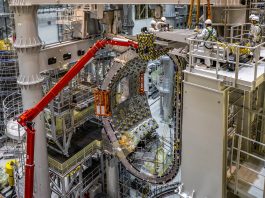
Projects like ITER in France, supported by F4E, aim to demonstrate that controlled fusion can be scaled into a practical, sustainable energy source for the future.
How the partnership will drive technological breakthroughs
The new framework sets out areas where CERN and F4E will collaborate closely:
- Engineering and construction of large-scale scientific instruments.
- Testing and validation of advanced materials, systems, and components.
- Project management and oversight of complex scientific initiatives.
- Knowledge transfer between research institutes and industry.
- R&D in physics and engineering, with applications extending beyond fundamental science.
These efforts align with CERN’s establishment of a dedicated fusion technology coordination unit in 2023.
The unit unites experts in accelerator physics, magnet design, and technology transfer to ensure innovations in particle physics can also serve broader energy and engineering challenges.
Marc Lachaise, Director of F4E, added: “Through this cooperation agreement, we will strengthen F4E’s capacity to deliver and, in parallel, address and answer complex questions in the fields of fusion energy and particle physics.
“By working together, we will capitalise on the excellence, talent and expertise resulting from large-scale international projects managed respectively by the two organisations.
“This collaboration is vital for the advancement of fusion energy, together with that of science. It is a fantastic step in the right direction.”
Propelling EU fusion efforts
By combining CERN’s expertise in large-scale research infrastructure with F4E’s leadership in fusion technology, this agreement strengthens Europe’s position in the global race toward fusion energy.
The collaboration represents not only a major step in science and engineering but also a potential turning point in humanity’s quest for limitless, carbon-free power.