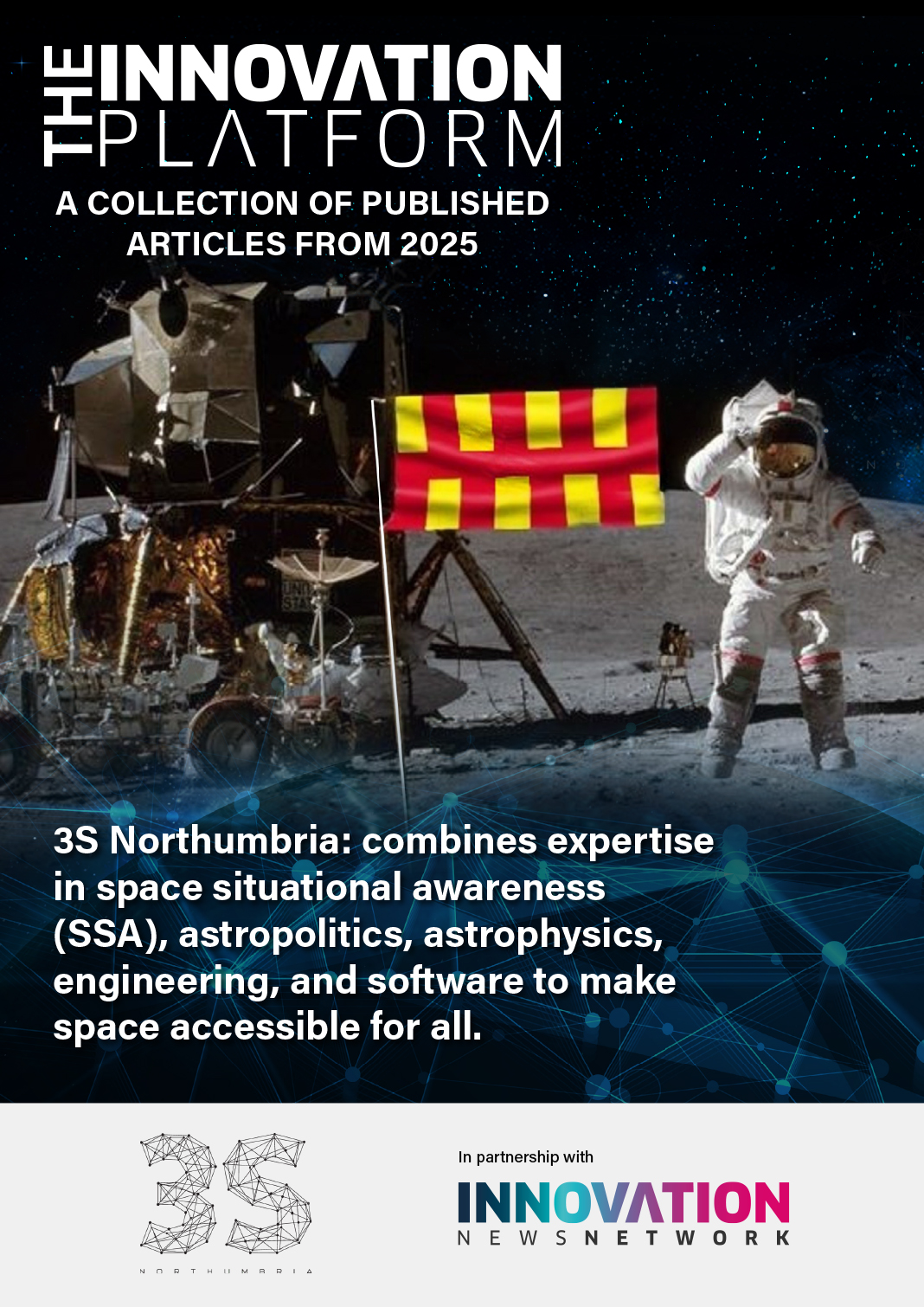
This ebook explores the latest work of 3S Northumbria, focusing on space sustainability and addressing orbital debris, space situational awareness, data management, and circular economy approaches.
Space sustainability has become a defining challenge for the modern space era. As reliance on satellite-enabled services continues to grow, near-Earth orbit has evolved into critical infrastructure underpinning communications, navigation, Earth observation, climate monitoring, and security.
At the same time, increasing launch rates, the proliferation of mega-constellations, and the accumulation of orbital debris are placing unprecedented pressure on the orbital environment.
3S Northumbria operates at the intersection of space situational awareness, engineering, policy, and data analysis, with a clear mission: to ensure long-term, safe, and sustainable access to space.
This ebook brings together a curated selection of articles from 2025 that reflect 3S Northumbria’s multidisciplinary approach to addressing space sustainability through practical, evidence-based solutions.
Here’s what to expect in this publication:
Trends in Zero Space Debris
This article explores how space sustainability is increasingly defined through the management of orbital debris.““““
It examines zero-debris initiatives, evolving mitigation guidelines, and regulatory limitations, while questioning whether current approaches adequately address long-term environmental and operational risk.
Data management and the orbital environment
As the number of objects in orbit increases, so does the volume and complexity of orbital data.
This feature highlights why effective data management and space situational awareness are foundational to space sustainability, examining the technical and institutional challenges of tracking, sharing, and acting on space traffic information at scale.
The AIAA Space Sustainability Task Force
Focusing on governance and collaboration, this article highlights 3S Northumbria’s involvement in the AIAA Space Sustainability Task Force.
It discusses how task forces, standards, and best-practice frameworks can influence sustainable behaviour in orbit while formal regulation continues to evolve.
Tackling space debris with a drydock
Taking a forward-looking perspective, this piece introduces a proposal for in-orbit repair, recycling, and manufacturing infrastructure.
It challenges traditional linear approaches to satellite disposal and considers how circular-economy principles could contribute to long-term space sustainability.
Shaping a sustainable orbital future
As activity in orbit accelerates, the challenge of space sustainability will increasingly define the success or failure of the space economy itself.
Through this eBook, 3S Northumbria brings together practical insight, technical expertise, and policy awareness to support informed decision-making and responsible action.
By examining current challenges and emerging approaches, the aim is to support a clearer understanding and more informed discussion of how the orbital environment can be managed safely and sustainably over the long term.