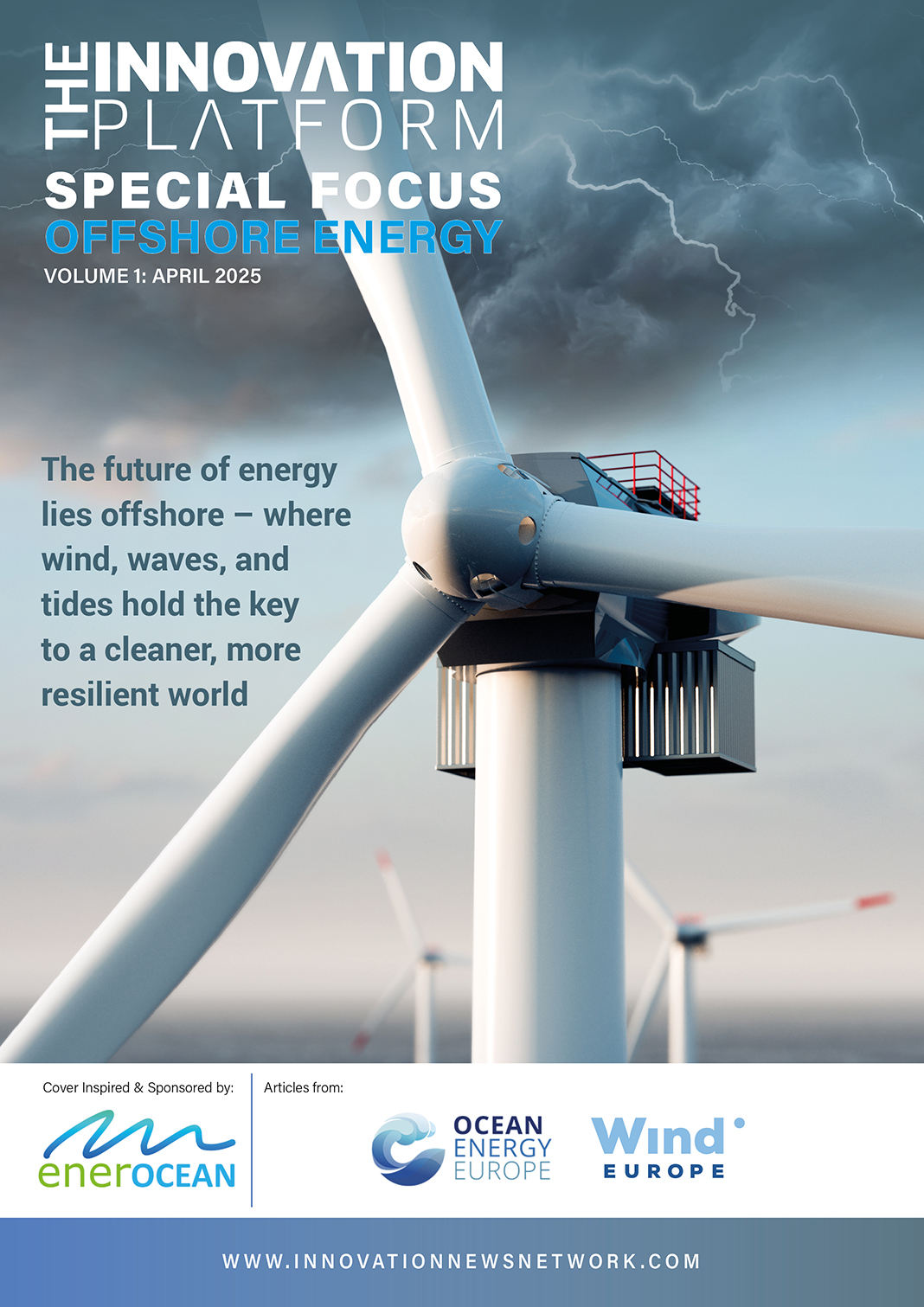
Welcome to our latest special focus publication, discussing cutting-edge innovations and policy shifts shaping the future of offshore renewable energy, featuring expert insights into floating wind, wave, and tidal power.
The world is entering a decisive decade for renewable energy. As nations race to reduce their reliance on fossil fuels, offshore energy has emerged as a vital frontier in transitioning to a cleaner, more sustainable future.
From floating wind farms harnessing powerful ocean winds to wave and tidal energy generating electricity with relentless consistency, offshore renewables offer an unparalleled opportunity to reshape the global energy landscape.
Unlike onshore renewables, offshore energy has the advantage of vast, untapped space and natural forces that operate with remarkable predictability. The wind blows stronger and more consistently at sea, tides follow precise lunar cycles, and waves deliver continuous motion – characteristics that make offshore renewables uniquely suited to providing reliable power. The question is no longer whether offshore energy will play a role in the clean energy revolution but how quickly it can scale to meet the growing demand for carbon-free electricity.
This special focus publication explores the latest advancements and challenges in offshore energy, featuring insights from industry experts shaping the future. From the industrialisation of ocean energy to game-changing innovations in floating wind technology and the policy shifts necessary to accelerate wind power deployment, these articles provide a comprehensive look at the forces driving the offshore energy sector forward.
Unlocking the power of the ocean
This publication’s first article, featuring insights from Rémi Gruet, CEO of Ocean Energy Europe, highlights the vast potential of wave and tidal energy to power Europe’s grid. Unlike renewable sources such as solar, ocean energy offers a uniquely predictable and consistent power source, making it an essential piece of the renewable energy puzzle. However, despite its promise, the sector faces significant hurdles, including financing, permitting, and international competition.
With the potential to generate 100 gigawatts of capacity and create hundreds of thousands of jobs, Europe’s leadership in ocean energy is at stake. Gruet’s analysis provides a roadmap for how policymakers, investors, and industry leaders can work together to bring ocean energy to full commercial scale. If successfully harnessed, this technology could provide 10% of the EU’s electricity while complementing existing renewables.
W2Power: The next frontier in floating wind
Floating offshore wind technology is revolutionising the wind energy sector by enabling power generation in deeper waters where traditional fixed-bottom turbines cannot be deployed. In the second article, Pedro Mayorga and Alexander Fairtlough of EnerOcean introduce W2Power, an innovative twin-turbine platform designed to maximise efficiency, reduce costs, and enhance energy security.
By minimising the amount of steel used per megawatt and streamlining the installation process, W2Power is setting new benchmarks for cost-effective floating wind deployment. This article explores how floating wind expands development opportunities worldwide, allowing wind farms to be placed farther offshore, reducing environmental impact, and increasing grid stability.
Scaling offshore wind: The policy push Europe needs
Offshore wind is set to become one of the dominant forces in the global energy transition – but only if governments act swiftly to remove the roadblocks hindering its expansion. The final article, featuring insights from Christoph Zipf of WindEurope, examines the urgent need for policy reform, infrastructure investment, and supply chain support to accelerate the growth of offshore wind across Europe.
While Europe has long been a leader in wind energy, deployment is falling behind the pace required to meet 2030 climate and energy security targets. The European Commission has introduced the Wind Power Package, a set of 15 key actions to strengthen the sector, yet national governments must now step up to implement these reforms effectively. Without faster permitting, improved grid infrastructure, and better-designed auctions, offshore wind risks stagnation at a time when its expansion is more critical than ever.
The article also highlights the growing competition from China in offshore wind manufacturing and the pressing need for Europe to invest in its own supply chains, port infrastructure, and workforce training. If Europe is to maintain its leadership in offshore wind and fully harness its vast marine resources, decisive action is needed today – not tomorrow.
A turning point for offshore energy
The transition to offshore renewable energy is an environmental necessity and an economic opportunity. The offshore sector holds the key to a sustainable future, whether through ocean energy’s predictability or floating wind’s adaptability. The question is no longer whether these technologies will play a role in our energy systems but how quickly we can scale them to meet the demands of a changing world.