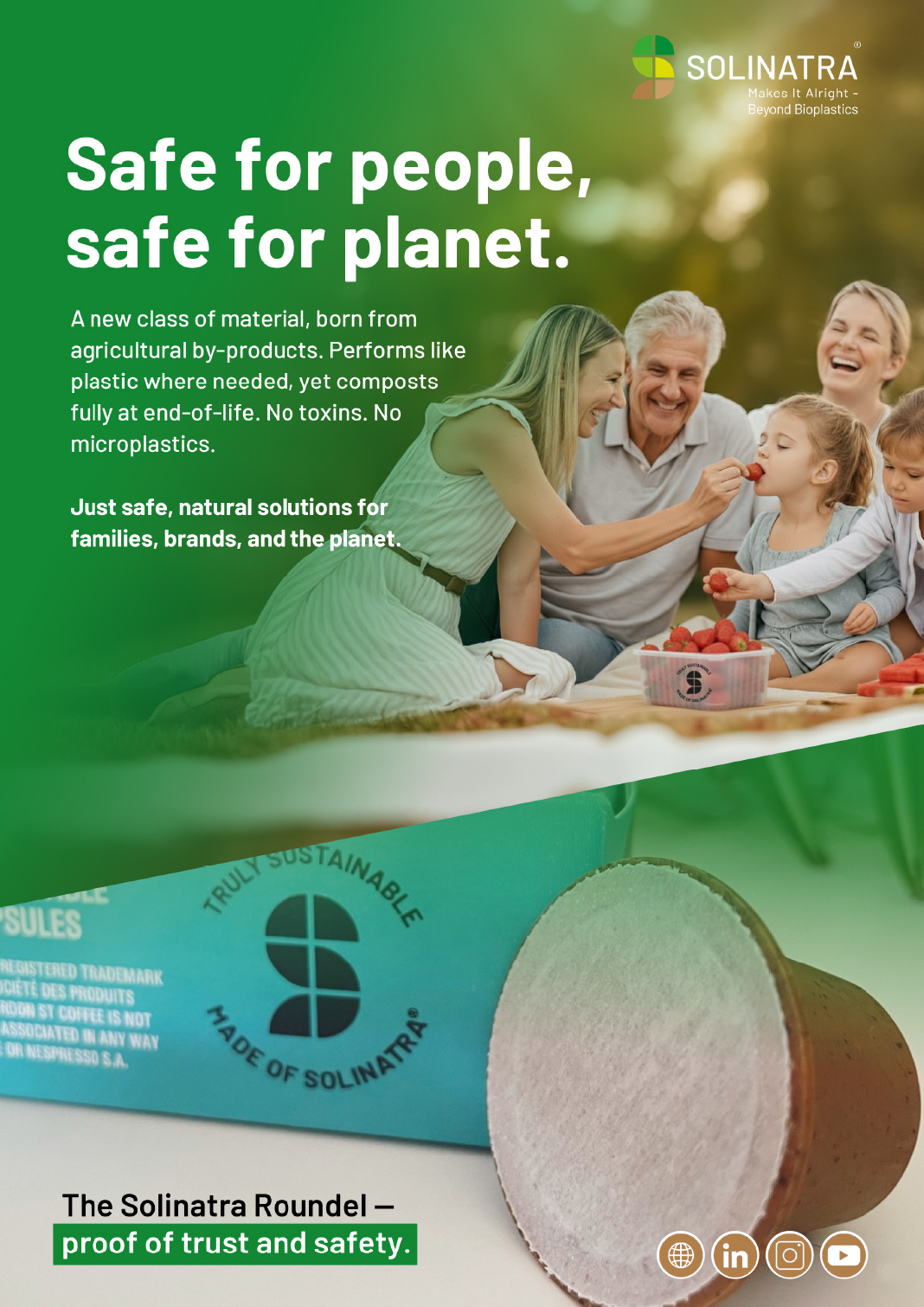
Plastics transformed modern life; brought convenience, versatility, and affordability. But today we know the cost: toxins in our living environment, waste that outlives generations, and microplastics in our bodies. Plastics may have been the success story of the last century, but cannot define our future.
That is why Solinatra exists. Not plastic, but a new class of material. Safe, natural and biodegradable. Born from agricultural by-products, designed to return fully to soil. No toxins. No microplastics. With the performance that brands, producers, and consumers expect.
Solinatra stands on explicit promises. It is safe by nature, fully compostable and free from toxins and microplastics. It delivers the convenience of plastics, running smoothly on existing production lines. It is scalable, adaptable to local feedstocks and competitive in both cost and supply. Above all, it is responsible for reducing CO2, preventing waste, and fostering trust between brands and consumers.
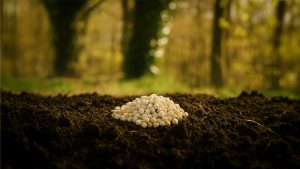
Our purpose is clear: to create materials that make health and sustainability the standard. By combining material intelligence with manufacturing power, and by adapting to local resources, we enable brands to build value, consumers to trust, and the world to embrace a new material standard.
Why we exist: Plastics are a health crisis
For decades, plastics were seen as a convenience problem — polluting oceans, clogging landfills, harming wildlife. An environmental issue, but one that felt distant.
New science makes the picture far more personal: plastics are inside us. Microplastics and nanoplastics have been detected in human blood, lungs, and even in unborn babies. With them come toxins that enter our cells, raising risks that we are only beginning to understand.

Scientists now warn that continuous exposure to microplastics is linked to chronic low-grade inflammation – the kind of silent damage that over time is associated with cardiovascular disease, diabetes, alzheimers, parkinsons and even cancer. What once looked like litter is now recognised as a direct threat to human health.
More than waste
Plastics also account for 3.4% of global CO2 emissions. If nothing changes, plastic pollution will triple by 2060. What once seemed like an inconvenience has become not only a climate burden but a health crisis we can no longer ignore.
The Solinatra alternative
Not plastic, but a new class of material. Designed to perform in use and compost fully at end-of-life, Solinatra’s materials leave no toxins, no microplastics — only safety for people and planet.
As a material intelligence company and manufacturer, we combine data with production power.
Ingredient-agnostic, we adapt to local feedstocks and engineer applications for the proper performance. Our purpose is clear: to create materials that safeguard the health of our children and the future of our environment.
Plastics have crossed the line from convenience to crisis. From enabling modern life to a health and environmental crisis: toxins, microplastics, and waste that outlasts generations. What the world needs is not another compromise, but a material that delivers safety, performance, and scale — without leaving toxins behind.
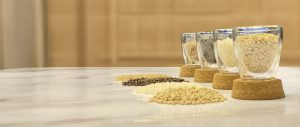
For years, alternatives fell short. Paper and wood collapsed, and many “bioplastics” proved brittle, costly, or only partially degradable — often leaving microplastics. Dependence on single feedstocks and lack of marine degradability led to higher levels of pollution.
With Solinatra, that compromise ends. It is not plastic, and not just another bioplastic. Solinatra is a new class of natural material — safe, locally adaptable, designed for existing moulding, thermoforming and extrusion lines. Solinatra runs competitively across supply chains, and composts fully at end-of-life.
The Solinatra vision
A safe, versatile material that performs like plastic yet degrades naturally — marine-safe, adaptable to local feedstocks, and scalable in cost and supply. It builds brand value with visible integrity.
At its core, Solinatra is about material intelligence — combining deep data with production know-how and biodegradability science. Our R&D understands the entire chain, from raw material to finished application, and onwards to safe return to the soil.
We are ingredient-agnostic. Depending on the performance needed, Solinatra can adapt to local agricultural by-products, achieving the appropriate mechanical and chemical properties as well as biodegradability for each application. This flexibility ensures scalability, reduces transportation impact, and supports regional supply chains.
We are also manufacturers. Solinatra is not just a technology platform but also a material produced on an industrial scale, designed to operate on existing production lines. This enables brands and converters to adopt Solinatra without expensive retooling — a genuine solution, not merely a promise.
Superior performance
The result is that Solinatra matches or exceeds plastic where it matters most: costs, strength, versatility and food safety. Coffee pods remain stable with boiling liquids, packaging stays secure in transport, and families can trust consumer products. All without leaving microplastics behind.
Solinatra proves that convenience and sustainability can coexist, with no compromise on safety, scale, or responsibility.
Disposables are part of modern life — coffee on the go, takeaway meals, outdoor events, fast service.
Yet until now, they have involved an unacceptable trade-off: polluting plastics or “green” alternatives that collapse, splinter, or fail to meet expectations. Consumers want convenience, but they also seek safety, trust, and responsibility.
Solinatra makes this possible. Not plastic, but a new class of safe, natural material – designed to perform reliably in daily use and return safely to nature. It offers a future where disposables no longer mean compromise: strong in function, compatible at end-of-life, leaving no toxins, no microplastics.
Straws

Smooth sip, no sogginess. Solinatra straws stay firm in liquid, available in multiple colours and diameters. Customisable for brands, scalable in production, and safe at end of life.
Cutlery

Strong, smooth, and food-safe. Solinatra cutlery has none of the rough feel of wood, none of the collapse of paper. Scalable via existing moulding lines, available in natural tones, black, or custom colours. Even laser-brandable to carry a logo or message.
Lids

From cold drink lids to takeaway beverage tops, Solinatra offers a visible brand touchpoint. Durable in use, compostable at end of life, and aligned with consumer demand for genuinely plastic-free experiences.
Coffee capsules

Billions of conventional capsules end up unrecycled each year. Solinatra capsules preserve taste, fit existing brewing systems, and fully compost afterwards — proving that single-serve convenience can finally be sustainable and safe.
Brand value creation
Disposables are not just a functional necessity. They enable entire business models and are crucial for shaping brand perception. Without them, many propositions would lose profit margin and convenience. Coffee sold in cups yields much higher than coffee sold in bulk
Smoothies are expected with straws, and takeaway food without cutlery diminishes the customer experience.
Solinatra ensures that environmental or health costs do not undermine this economic and consumer value. It allows businesses to preserve the margins, convenience, and customer satisfaction that disposables deliver — while eliminating the hidden liabilities of plastics.
Turning necessity into brand advantage
Trust & safety – every product carrying the Solinatra Roundel signals health, responsibility, and authenticity to consumers.
Premium feel – smooth textures, natural tones, and visible integrity stand out against rough wood or soggy paper.
Customisation – with laser-marking and colour options, everyday disposables become brand carriers instead of anonymous items.

Disposables should not be overlooked or underestimated. With Solinatra, they become clear indicators of innovation and care. They continue to support business models, but now also enhance brand trust and customer loyalty.
In comparative testing held with young professionals in Jakarta, Solinatra cutlery and straws outperformed plastic, paper, and bamboo alternatives across every dimension that matters to consumers. Participants valued Solinatra for four key reasons:
Strength & reliability
Plastic broke mid-meal, paper straws collapsed, and bamboo felt rough. Solinatra stayed strong, even with tougher foods, giving consumers full confidence.
Comfort & ergonomic design
The smooth texture and ribbed design made utensils pleasant to use, while straws were sturdy yet soft — no sharp edges, no sogginess.
Perceived quality & trust
Solinatra felt premium, hygienic, and reliable, reinforcing consumer trust and elevating outlets that chose it.
Sustainability confidence
Clearly plastic-free and safe, Solinatra was seen as the genuine eco-friendly choice, making consumers more inclined to support outlets using it.
From packaging to pots: Scaling across industries
Packaging
Food and beverage brands face rising pressure to eliminate plastic trays, pots, and lids. Consumers demand packaging that is safe, responsible, and free from hidden plastics. Solinatra delivers thermoformed trays, cold food pots, and portion packs that are:
- Safe — food-contact approved, toxin-free, no microplastics.
- Durable — strong enough for transport and storage.
- Compostable — designed to degrade naturally, even alongside food waste.
Unlike paper alternatives lined with plastic films, Solinatra trays and lids are genuinely plastic-free. For brands, this means packaging that not only protects products but also safeguards consumers.
Horticulture
Plastic pots and trays are an unseen yet significant source of waste in gardening and agriculture. Consumers don’t fancy the hassle of collecting, and returning stacks of pots for recycling, or feeling bad about the stack of polluting plastic to dispose. Solinatra provides the solution: pots and trays that grow with the plant and then safely break down back into the soil.
For growers and retailers, this minimises waste streams and meets regulatory standards. For consumers, it directly links sustainability to the health of their gardens and food. Early adopters in horticulture are already demonstrating that Solinatra can replace plastic without disrupting existing production systems. From supermarket shelves to greenhouses, Solinatra proves that performance, safety, and responsibility can coexist.
Consumer & industrial products: Endless possibilities
Solinatra is not confined to disposables or packaging. Its adaptability allows it to power a new generation of consumer and industrial products — everyday items that touch people’s lives and reinforce brand trust.
Baby spoons and food scoops:

Safe for children, smooth to use, and fully compostable after their useful life. Parents can trust that what touches their child’s mouth is natural and toxin-free.
Hotel amenities:

Combs, shoehorns, hangers — items that typically leave a hidden plastic footprint — can now be made from Solinatra, turning even the smallest details into visible proof of responsibility.
Golf tees and pizza box spacers:

Often overlooked in sustainability discussions, these high-volume, disposable items can be reimagined in Solinatra, reducing waste without sacrificing performance.
Industrial potential
Because Solinatra is compatible with standard moulding, extrusion, and thermoforming processes, manufacturers can adopt it without needing to overhaul production methods. Tooling options are already available for many applications, allowing for quick commercial deployment. Ingredient-agnostic and locally adaptable, Solinatra can switch feedstocks to meet regional supply chains and specific performance needs.
Brand differentiation
Every Solinatra product tells a story: a baby spoon that signifies care and safety, a plant pot that returns nutrients to soil, a pizza spacer that embodies innovation. Each touchpoint is proof of integrity and leadership.
From the supermarket aisle to the golf course, Solinatra shows that safe, natural materials can substitute plastics in ways that are both practical and inspiring.
Closing the loop: From waste to healthier soil
Solinatra is designed to deliver measurable impact — not just promises. By replacing fossil plastics with safe, natural materials made from agricultural by-products, Solinatra closes the loop: from waste, to product, to soil.
Real sustainability, proven by data
Unlike many so-called “bioplastics” that still rely on fossil blends, Solinatra is 100% natural and toxin-free. Independent testing confirms:
Complete biodegradation within months or weeks in home or industrial compost conditions. No microplastics — ever.
Marine degradation compliance (e.g. Japanese standards), proving safety even if products escape waste streams.
CO2 savings compared with plastics, achieved by valorising crop residues instead of extracting oil and gas.
The Solinatra complete Life Cycle Assessment (LCA) reveals substantial reductions in greenhouse gas emissions, fossil resource consumption, and long-term waste. Every product made of Solinatra decreases both environmental pollution and microplastic exposure in people
Health and environment together
Plastic pollution is no longer just an environmental problem; it has become a threat to human health. By composting safely back into soil, Solinatra prevents microplastics from entering food chains, water systems, and ultimately, our bodies. True sustainability means protecting ecosystems and people simultaneously. With every cup, spoon, tray, or pot made from Solinatra, we take another step toward a healthier planet and healthier families.