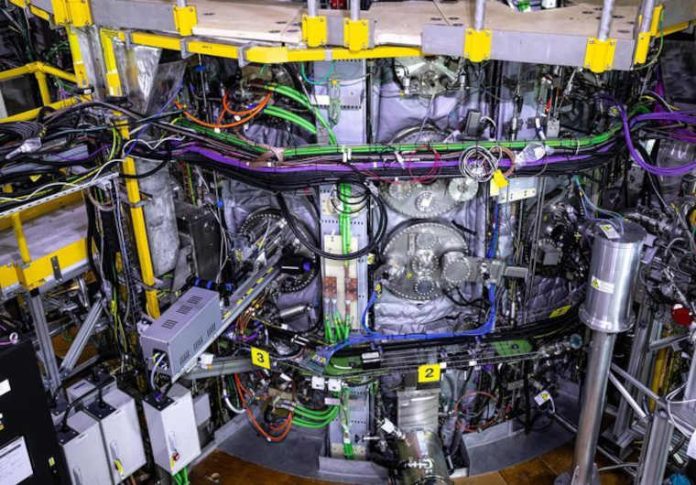
The UK Atomic Energy Authority (UKAEA) has begun a major new phase of fusion research as its flagship Mega Amp Spherical Tokamak (MAST Upgrade) enters its fifth scientific campaign.
The six-month programme marks a significant step toward delivering the UK’s first prototype fusion power plant and strengthens Britain’s position at the forefront of global fusion innovation.
With more than 200 scientists from over 40 international institutions involved, the campaign will deliver around 950 carefully controlled plasma pulses.
Each pulse represents a brief period during which superheated plasma is confined inside the machine, providing invaluable data on how fusion plasmas behave under extreme conditions.
James Harrison, Head of MAST Upgrade Science, explained: “This campaign will allow us to build on the world-first achievements from the previous scientific campaign.
“We’ve had significant interest globally for experiments on MAST Upgrade, illustrating the fantastic collaboration effort in fusion research. Over the coming months, we hope to push further the boundaries of what’s possible in spherical tokamak science.”
Why fusion energy is so important
Fusion energy is the process that powers the Sun, created when light atomic nuclei combine to form heavier ones, releasing vast amounts of energy.
Unlike fossil fuels, fusion produces no carbon emissions during operation, generates minimal long-lived radioactive waste, and relies on abundant fuel sources such as hydrogen isotopes.
If successfully harnessed at scale, fusion could provide a near-limitless supply of clean, reliable energy, complementing renewables and supporting global net-zero targets.
Programmes like MAST Upgrade are essential because they transform theoretical promise into engineering reality, addressing the scientific and technical challenges that stand between today’s experiments and tomorrow’s power plants.
What the MAST Upgrade campaign will achieve
The latest MAST Upgrade campaign is designed to push the limits of spherical tokamak performance while directly informing the design of future power plants, particularly the UK’s STEP Fusion programme.
Spherical tokamaks are a more compact variant of traditional fusion machines and could enable smaller, more economical fusion reactors.
This campaign builds on earlier breakthroughs by expanding experimental scope and testing new ideas at a scale not previously possible.
The high volume of pulses planned allows researchers to explore a wide range of plasma conditions, accelerating learning and improving confidence in predictive models.
Key research priorities driving the MAST Upgrade
The fifth campaign focuses on four priority areas that are essential for turning fusion from a scientific challenge into a practical energy source.
First, scientists will investigate high-pressure fusion plasmas to refine performance predictions for future reactors. By testing theoretical models against real experimental data, researchers can reduce uncertainty in how plasmas behave at power-plant-relevant conditions.
Second, the campaign will explore improved control of plasma stability and energy flow. For the first time, instability-control techniques will be combined with advanced exhaust technology, including the Super-X divertor, to achieve more efficient and stable plasma operation.
Third, researchers will work to optimise divertor design. Divertors handle excess heat and particles escaping the plasma, and improving their shape and magnetic configuration could reduce component size and cost, making fusion plants more commercially viable.
Finally, advanced computer modelling tools will be tested against experimental results. These tools aim to forecast plasma behaviour related to heating, stability and exhaust, supporting the design and operation of future machines such as STEP and ITER.
Building on world-first results
This new phase of research follows a highly successful fourth campaign, during which MAST Upgrade achieved several world-first milestones.
Scientists demonstrated suppression of plasma instabilities in a spherical tokamak, reached a record 3.8 megawatts of injected heating power, and achieved independent control of plasma exhaust in both upper and lower divertors.
The strong international response to those results, reflected in over 100 research proposals, underscores the global importance of the MAST Upgrade facility.
Major upgrades strengthen the programme
Significant enhancements planned for the coming years will further expand MAST Upgrade’s capabilities.
In 2026, an Electron Bernstein Wave heating system will be installed, using the same technology planned for STEP Fusion. This will allow researchers to test STEP-relevant plasma heating techniques well in advance.
Additional neutral beam injectors will follow in 2026–2027, doubling the machine’s heating power. Crucially, the MAST Upgrade will be the first spherical tokamak to operate Both Electron Bernstein Waves and neutral beam heating simultaneously, unlocking new experimental possibilities.
A critical step toward fusion power
As the MAST Upgrade campaign progresses, the insights gained will directly shape the design of STEP Fusion and future reactors worldwide.
By combining international collaboration, cutting-edge upgrades and ambitious experimentation, the MAST Upgrade continues to play a central role in turning fusion energy from a long-held ambition into a practical solution for clean power generation.