


Innovation News Network brings you the latest research and innovation news from the fields of science, environment, energy, critical raw materials, technology, and electric vehicles.

Record forever chemicals pollution found in 98% of UK rivers
University of York study reveals dangerously high levels of forever chemicals contaminating UK rivers, raising urgent environmental concerns.

Government unveils new plans to supercharge UK cyber
The ever-growing UK cyber sector is set to receive a boost of millions in investment and a new Cyber Growth Action Plan. Find out more.
Researchers awarded grant to advance cattle disease detection
Infectious cattle disease will now be able to be detected using AI and hyperspectral imaging. Discover more here.

EU accelerates vehicle recycling with new rules on plastics and producer responsibility
EU advances vehicle recycling with new rules targeting recycled plastics, expanded scope, and stronger producer responsibility.
How can the feed industry drive a more sustainable livestock production sector?
Discover how the feed industry is reducing the environmental impact of raw materials to deliver a sustainable livestock production sector.

Realising quantum computing on a commercial scale
Quantum computing promises transformative potential solving complex problems more efficiently than classical computers. Discover more here.
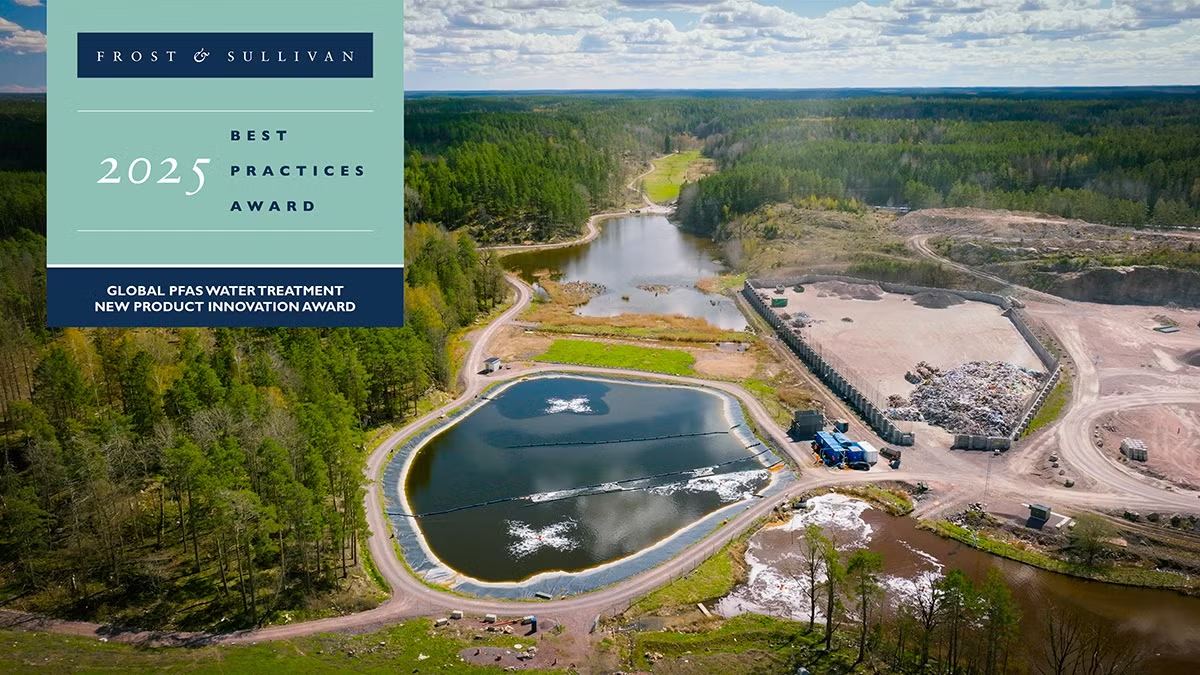
Chromafora wins Global Innovation Award for PFAS water purification
The award highlights Chromafora’s ability to provide customised water purification solutions in an increasingly complex and regulated market.

Meteosat-12 takes command: A new era in European weather monitoring begins
Learn how Meteosat-12 transforms European weather monitoring with satellite technology for improved forecasting and climate resilience.

Over a third of UK businesses dangerously unprepared for AI risks, research finds
Despite 30% of UK organisations naming AI among their top three risks, many remain significantly unprepared to manage these AI risks.

UK aerospace secures £250m boost to propel green revolution
UK aerospace receives a £255m investment to drive green aviation and support sustainable growth in the sector. Find out more.