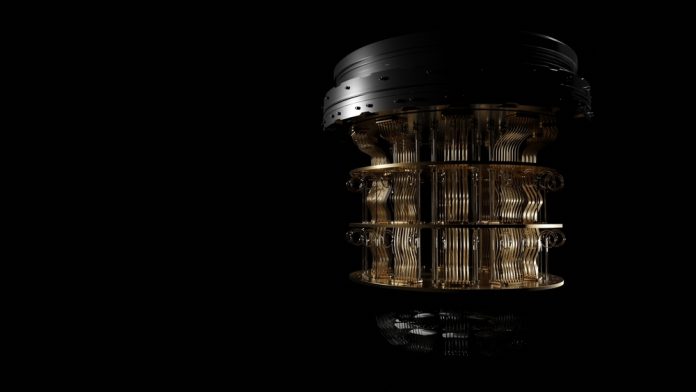
At the heart of modern quantum computers lies a deceptively simple structure: the Josephson junction.
Traditionally, this device is formed by placing two superconductors on either side of an ultrathin barrier. Despite the separation, superconducting electrons act in unison, allowing current to flow with remarkable precision and no energy loss.
This synchronised behaviour underpins today’s most advanced quantum processors and was recognised at the highest level when related advances earned the 2025 Nobel Prize in Physics.
Now, an international team of physicists has reported something that challenges the long-standing blueprint. In a new study, researchers provide the first experimental evidence that Josephson junction-like behaviour can emerge even when only one true superconductor is present.
A device that shouldn’t work – but does
In the new experiment, scientists constructed a layered structure made of superconducting vanadium and ferromagnetic iron, separated by a thin insulating layer of magnesium oxide.
According to conventional wisdom, this setup should not behave like a Josephson junction. Iron is not a superconductor, and ferromagnetism usually suppresses the delicate electron pairing required for superconductivity.
Yet electrical measurements told a different story. The team observed current flow patterns that closely matched those of a conventional Josephson junction.
Somehow, superconducting behaviour from the vanadium crossed the barrier and reorganised electrons inside the iron strongly enough to create synchronised motion between the two materials.
This finding confirms long-standing theoretical predictions and has never been demonstrated experimentally before.
Listening to the noise
The key evidence came from analysing electrical ‘noise.’ While electric current looks smooth at a macroscopic scale, it actually consists of discrete electrons arriving in rapid bursts.
The statistical patterns of these fluctuations reveal how electrons move and whether they act independently or in coordinated groups.
In the vanadium-iron device, noise measurements revealed electrons travelling in large, synchronised packets within the iron layer.
This collective motion is a hallmark of Josephson junctions and a strong indicator that superconducting correlations had taken hold where they were least expected.
Magnetism meets superconductivity
What makes the discovery particularly striking is the role of iron.
Superconductivity usually relies on pairs of electrons with opposite spins, while ferromagnets like iron favour electrons aligned in the same direction. These opposing tendencies are normally incompatible.
The experiment suggests that the iron developed a different, unconventional form of superconductivity involving same-spin electron pairs.
Even more remarkably, this induced state was robust enough to communicate back across the barrier, effectively coupling with the vanadium as if both sides were superconductors.
Implications for quantum technology
If confirmed and refined, this one-superconductor Josephson junction could have far-reaching consequences.
From a design perspective, reducing the number of required superconducting components could simplify fabrication and expand material choices for quantum circuits.
The results may also influence research into topological superconductors, which are prized for their resistance to environmental noise – a major obstacle in quantum computing.
Same-spin pairing could help stabilise quantum information encoded in electron spins, potentially making qubits more reliable.
From the lab to real-world devices
Another intriguing aspect is practicality. Iron and magnesium oxide are already widely used in commercial technologies such as hard drives and magnetic random-access memory.
Adding a superconducting element could lead to hybrid devices that blend quantum functionality with existing manufacturing techniques.
While questions remain about the precise mechanisms at work, the study opens a new chapter in Josephson junction research.
By showing that superconducting synchronisation can arise in unexpected places, scientists may have uncovered a simpler and more versatile path toward the next generation of quantum computers.