


The United States Department of Energy’s Oak Ridge National Laboratory (ORNL) has kicked off a four-year research programme that could revolutionise how scientists understand and engineer quantum materials.
The initiative, known as Controlled Numerics for Emergent Transients in Nonequilibrium Quantum Matter (CONNEQT), brings together experts from ORNL, Los Alamos National Laboratory, Lawrence Berkeley National Laboratory, SLAC National Accelerator Laboratory, and the University of Tennessee, Knoxville.
Their goal is to use high-performance computing (HPC) to model the complex behaviour of materials driven out of equilibrium – pushed out of their natural balance by heat, light, magnetic fields, or electrical currents.
The importance of nonequilibrium quantum materials
In real-world applications, materials are rarely at rest. Whether in microelectronics, quantum computing, or energy devices, constant exposure to external forces means their properties are always shifting.
Nonequilibrium environments can unlock hidden phases of matter, revealing new phenomena that remain invisible in equilibrium.
Understanding how quantum materials respond under these conditions is vital to developing next-generation technologies.
From unconventional superconductors to quantum magnets, mastering their behaviour could pave the way for breakthroughs in information technologies, energy efficiency, and quantum information science.
Closing the gap between experiments and theory
While experimental advances have revealed remarkable insights into how quantum materials behave when jolted out of balance, computational science has struggled to keep pace.
Predicting their long-term evolution and large-scale behaviour requires models that can capture the intricate interactions between electrons and particles with extreme precision.
That’s where CONNEQT steps in. By combining advanced mathematical tools with exascale computing power, the collaboration aims to bridge the gap between theory and experiment.
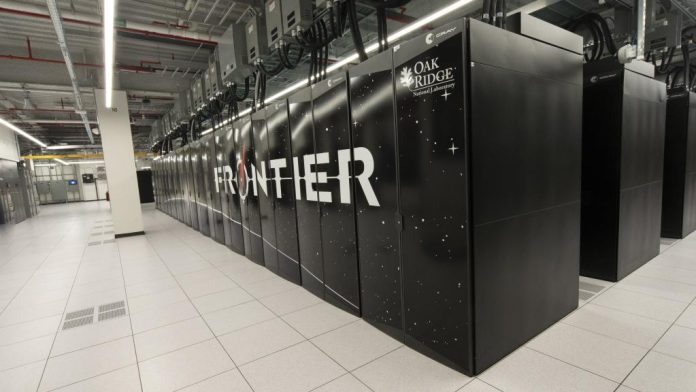
The project will leverage Frontier, the world’s first exascale supercomputer housed at ORNL, to perform cutting-edge simulations on an unprecedented scale.
The three research pillars of CONNEQT
Over the next four years, the team will concentrate on three ambitious objectives:
- New computational frameworks: Building robust, unbiased methods to predict how interacting electrons behave under external forces.
- Accelerated modelling: Applying computer science and mathematical innovations to speed up simulations of complex dynamical systems.
- Uncovering emergent behaviour: Harnessing supercomputers to probe how electrons interact to produce unexpected patterns and properties in nonequilibrium quantum materials.
By pursuing these goals, researchers hope to create a toolkit that can not only explain current experimental findings but also predict new states of matter that could transform technology.
A path toward future energy breakthroughs
The broader impact of this research extends far beyond theory. By revealing how quantum materials behave in real-world conditions, CONNEQT could spark innovation in energy-relevant applications, from more efficient superconductors to novel quantum devices.
The knowledge gained will also feed back into high-performance computing, advancing the capabilities of scientific simulation itself.
With the combined expertise of national laboratories, academic researchers, and the raw computational power of exascale systems, CONNEQT is poised to push the frontier of quantum materials research.
The next four years may not only deepen scientific understanding but also lay the groundwork for technologies that redefine computing, communication, and energy.







This is fascinating! The collaboration between labs and the use of Frontier supercomputer really exciting for the future of quantum materials and potential breakthroughs in technology.