The ANTENNAE project explores the applicability of the 3GPP telecommunications standards to deliver CNS functions for low-altitude aircraft operations.
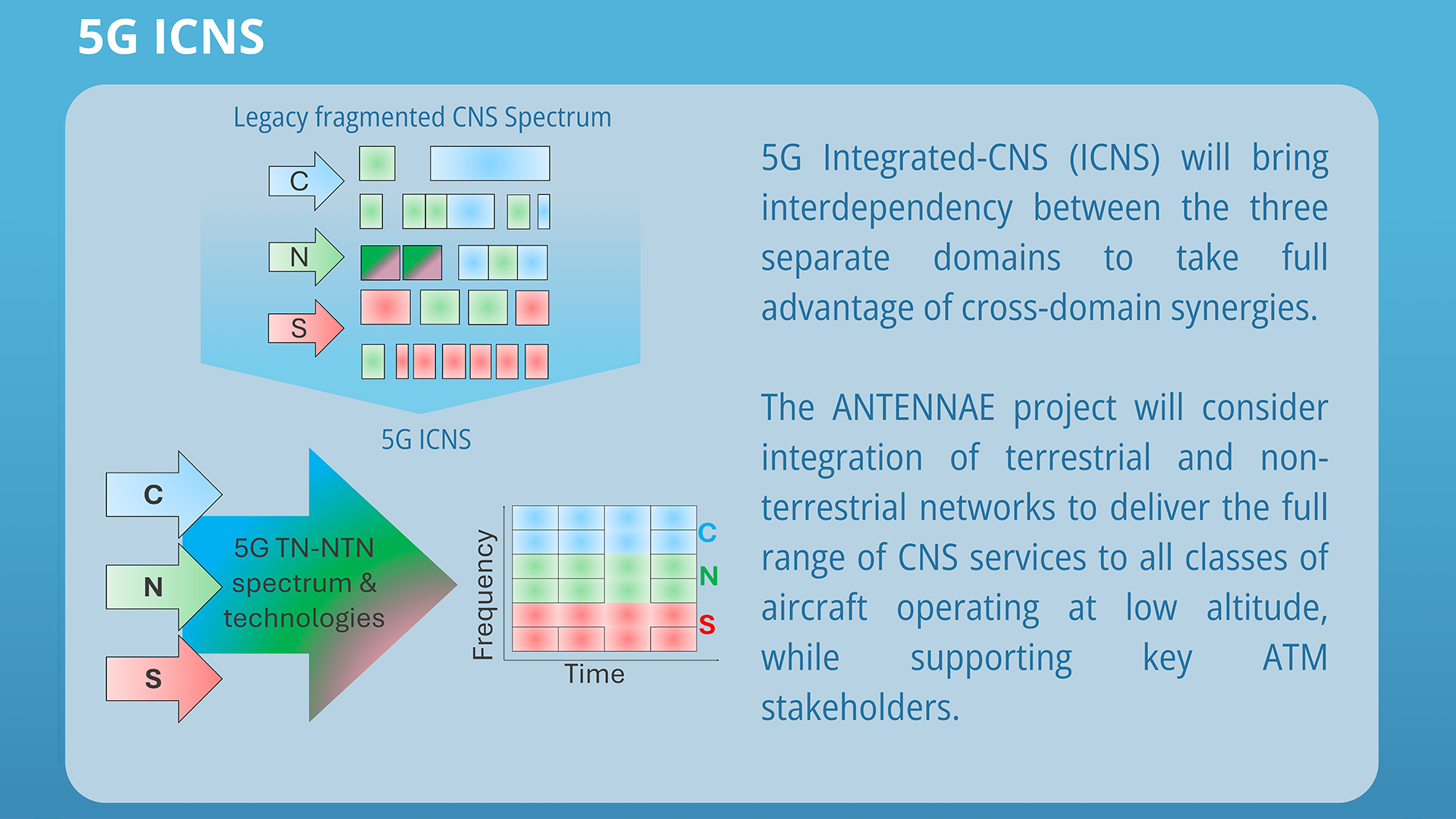
The ANTENNAE project considers integration of terrestrial and non-terrestrial networks to deliver the full range of Communication, Navigation and Surveillance (CNS) services to all classes of aircraft operating at low altitude, while supporting key aviation stakeholders, including U-Space Service Providers/Unmanned Aircraft System Traffic Management Service Providers, Air Navigation Service Providers, and Innovative/Advanced Air Mobility aircraft operators.
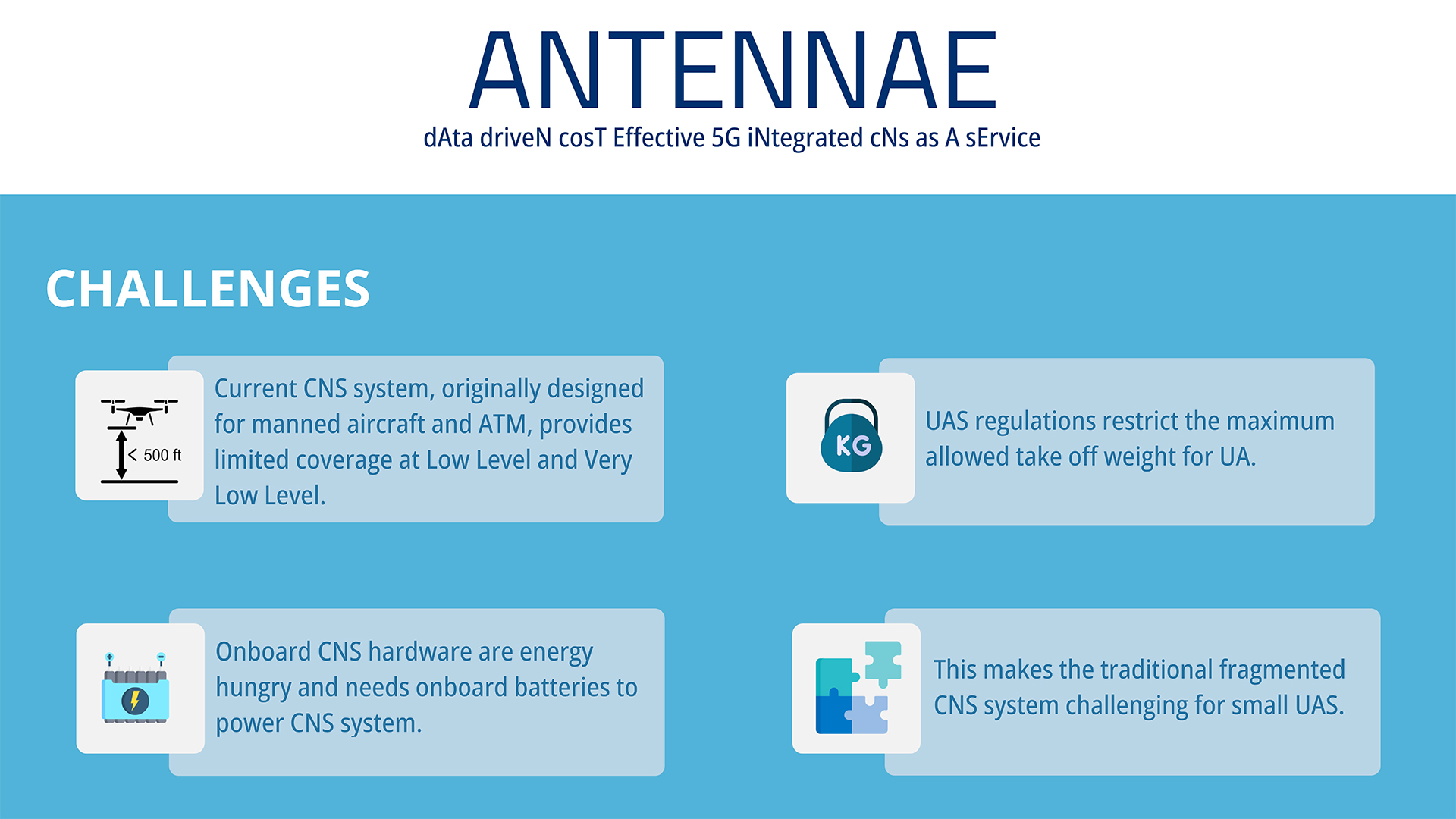
The problem: Why cell signals don’t fly high
Modern aircraft operations do not fully benefit from standard cellular networks. This is because commercial cellular networks are not designed to serve aerial users. Their wireless coverage is directed to serve users on streets and in buildings, leaving the skies above largely unserved by cellular coverage.
If GPS signals are disrupted or jammed, the CNS can fail. For aviation, this is critical because aircraft rely on GPS not just for navigation but also for surveillance, broadcasting their location to air traffic control and other planes via ADS-B and Remote ID messages. If GPS goes down, the aircraft becomes essentially invisible to digital tracking systems, compromising airspace safety.

The solution: Cellular networks and satellite networks
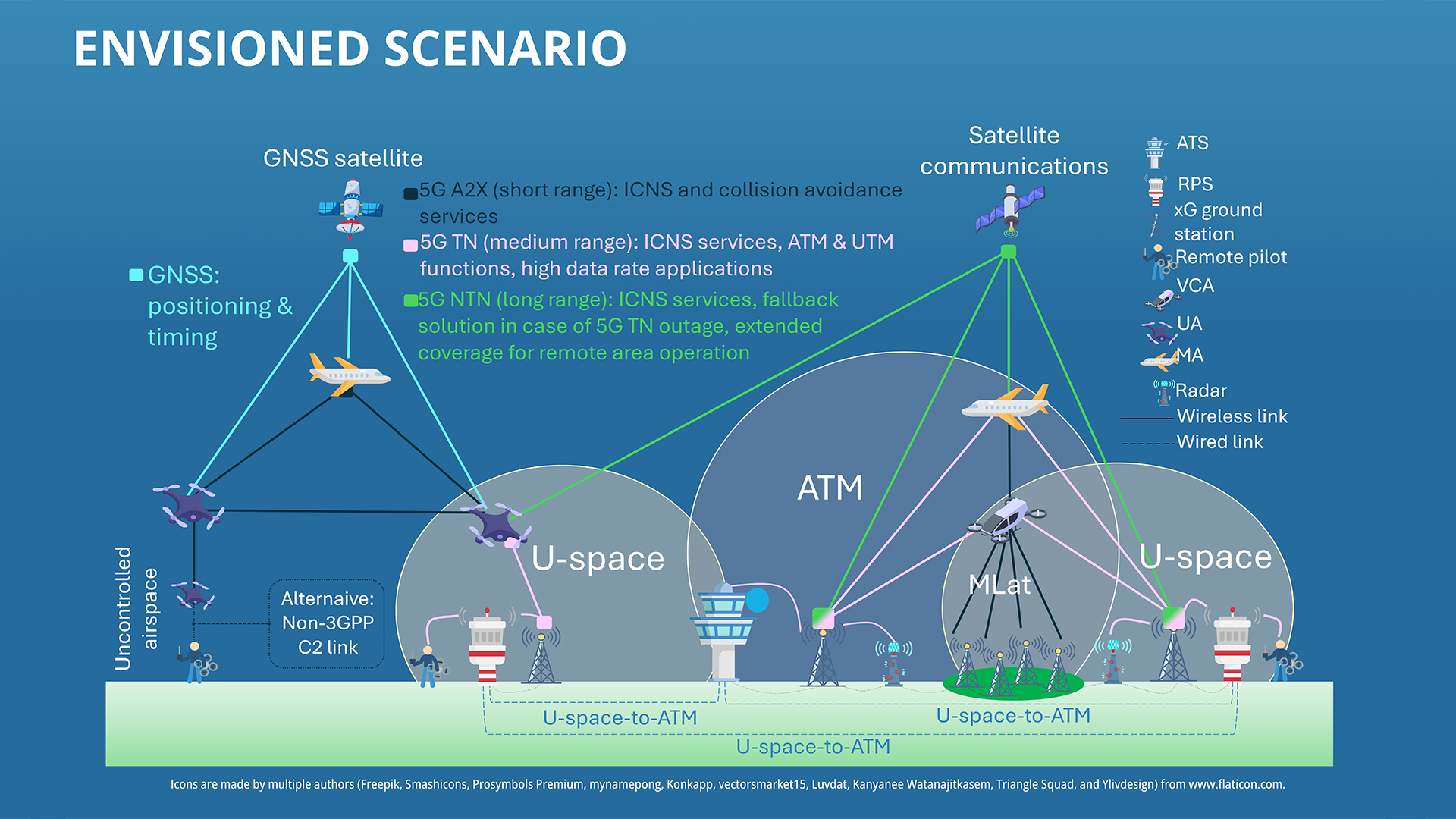
The industry is working to develop cellular networks optimised for both users on the ground and low-altitude aircraft, such as Unmanned Aircraft System (UAS), or drones, and vertical take-off and landing (VTOL) capable aircraft (VCA), or air shuttles.
However, in less populated areas, cellular network coverage may be insufficient. For these areas, the industry is turning to Non-Terrestrial Networks (NTNs) – essentially, satellites that could soon provide cellular service to aircraft. The use of both ground- and satellite-based networks is envisioned to enable critical aircraft control.
Advanced cellular network technologies such as 5G and 6G also offer alternatives to critical navigation technologies. Currently, on the ground and in the air, navigation relies heavily on Global Navigation Satellite Systems (like GPS). Advanced cellular technologies such as 5G and 6G can provide alternative positioning, navigation, and timing (APNT) services that complement GPS navigation.
Enter 6G: The “direct-to-device” revolution
Future cellular technologies, such as 6G, will enable aircraft equipped with 6G devices to directly communicate with each other. In the NTN umbrella, direct-to-device connectivity is emerging as a game-changer for the aviation industry.
Direct-to-device connectivity will allow aircraft to switch smoothly to satellite connection mode when it goes beyond ground network coverage
What does this mean for low-level operating aircraft, such as UAS and VCA?
- Seamless roaming: Just as your phone roams between towers, future devices will seamlessly switch between ground towers and satellites.
- Compact tech: Because future devices are small and energy-efficient (similar to a smartphone), they can easily be mounted on lightweight aircraft, such as drones.
- Flying further: Hybrid ground and satellite-based networks will allow drones to fly safely beyond the pilot’s line of sight, maintaining a robust connection for navigation and safety data even in areas where GPS might be unreliable.
5G and soon, 6G hybrid ground and satellite-based networks have the potential to enable a highly connected, safe, and resilient digital airspace for low-altitude IAM/AAM aircraft operations.
This makes 3GPP technologies a promising solution for digital airspace, providing beyond-line-of-sight coverage and CNS services to all aircraft classes.
If you are interested in the topics we research, welcome to get in touch with us!