The Basic & Applied Ecology Lab (PI: Daniel Montoya) at Basque Centre for Climate Change works to understand the structure and functioning of communities and ecosystems.
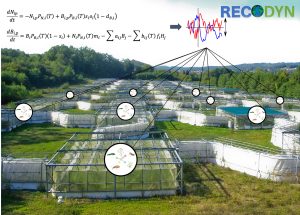
Anthropogenic global change has degraded biodiversity and ecosystems to levels unprecedented in human history, altering ecosystem functions and profoundly impacting human life.
Understanding and mitigating the effects of global change on communities and ecosystems is the environmental challenge of our age. This is the primary motivation for the research conducted at the Basic & Applied Ecology Lab (PI: Daniel Montoya).
Specifically, we aim to understand how biodiversity is organised and how this organisation influences the functioning and stability of ecosystems.
The more applied side of our research utilises concepts, tools, and methodologies derived from ecological theory to facilitate the design of more effective restoration initiatives and to manage agricultural systems sustainably.
Key research interests and questions
- Global change effects on communities and ecosystems: What is the relationship between structure, function and stability in ecological systems? How do ecosystems respond to multiple global change drivers (e.g. climate change, the loss and fragmentation of habitats, invasive species, microplastics)?
- Ecosystem recovery dynamics under global change: What are the patterns and mechanisms of ecosystem restoration under global change? How do multiple ecosystem facets – number of species, functional composition, ecosystem functions, and ecological stability – recover following disturbances?
- Biodiversity and food security in food production systems: How can we achieve biodiversity and food security in food production systems while simultaneously enhancing and preserving ecosystem health?
Integrating multiple types of organisms, ecosystems and methodologies
Given that global change impacts all types of organisms and ecosystems worldwide, our work is not confined to specific systems, taxonomic groups, habitats or communities. Rather, we work on a variety of ecosystems, including terrestrial, freshwater, and marine systems, as well as the biodiversity that inhabits them.
Some of our recent research, for example, has focused on the effects of microplastics on marine microbial communities, the impact and recovery of grassland communities following disturbances, plant-pollinator interactions and their effects on ecosystem function, and the study of long-term dynamics in freshwater communities.
In addition, to address our research questions, we integrate diverse methodological approaches, such as simulations and mathematical models, analysis of extensive datasets, field observations, and experimental manipulations.
The RECODYN project: Ecosystem recovery and its response to climate change
As part of the Daniel Montoya Lab’s research on communities and ecosystems, we are currently undertaking the RECODYN project, which studies ecosystem recovery dynamics and their response to climate change and habitat damage.
The RECODYN project aims to move restoration ecology from an idiosyncratic discipline to a predictive and more globally applicable science.
The project began in 2023 and incorporates three key shifts of restoration ecology, which are:
- Moving from a focus on ecological states to an examination of rates and trajectories. The objective is to compile a high-resolution temporal dataset that will enable a more detailed exploration of recovery dynamics.
- Expanding the scope from individual species and populations to encompass communities and ecosystems. In contrast to studies that focus on specific species, habitats, or locations, RECODYN aims to investigate the recovery of biological communities and ecosystems across multiple dimensions, including their biodiversity, functioning, and stability.
- Transitioning from primarily site-specific observations to a more integrated approach involving models and experiments. While much of restoration ecology relies on observations, artificial assemblages (such as chronosequences or space-for-time substitutions), and reviews (e.g., meta-analyses), RECODYN aims to establish a more balanced methodological framework that incorporates models and experimental observations.
The goal of RECODYN is ambitious yet crucial: to contribute to moving restoration ecology from an idiosyncratic discipline to a predictive and more globally applicable science.
The Basque Centre for Climate Change (BC3)
BC3’s mission is to strategically promote the co-production of knowledge relevant to decision making by integrating environmental, socioeconomic, and ethical aspects of climate change.
The rationale for the creation of BC3, over 15 years ago, was the idea that the science-policy interface on climate change needed a more robust integration of physical studies and socio-economic analysis.
Since its inception, BC3 has sought to achieve excellence in research on the fundamental aspects of climate change, encompassing its physical, ecological, and socio-economic components.
Consequently, BC3 integrates diverse skill sets from different disciplines and is consolidating its position as one of the leading institutions in supporting multiple components of the transdisciplinary climate change research lifecycle across different scales, ranging from local to global.