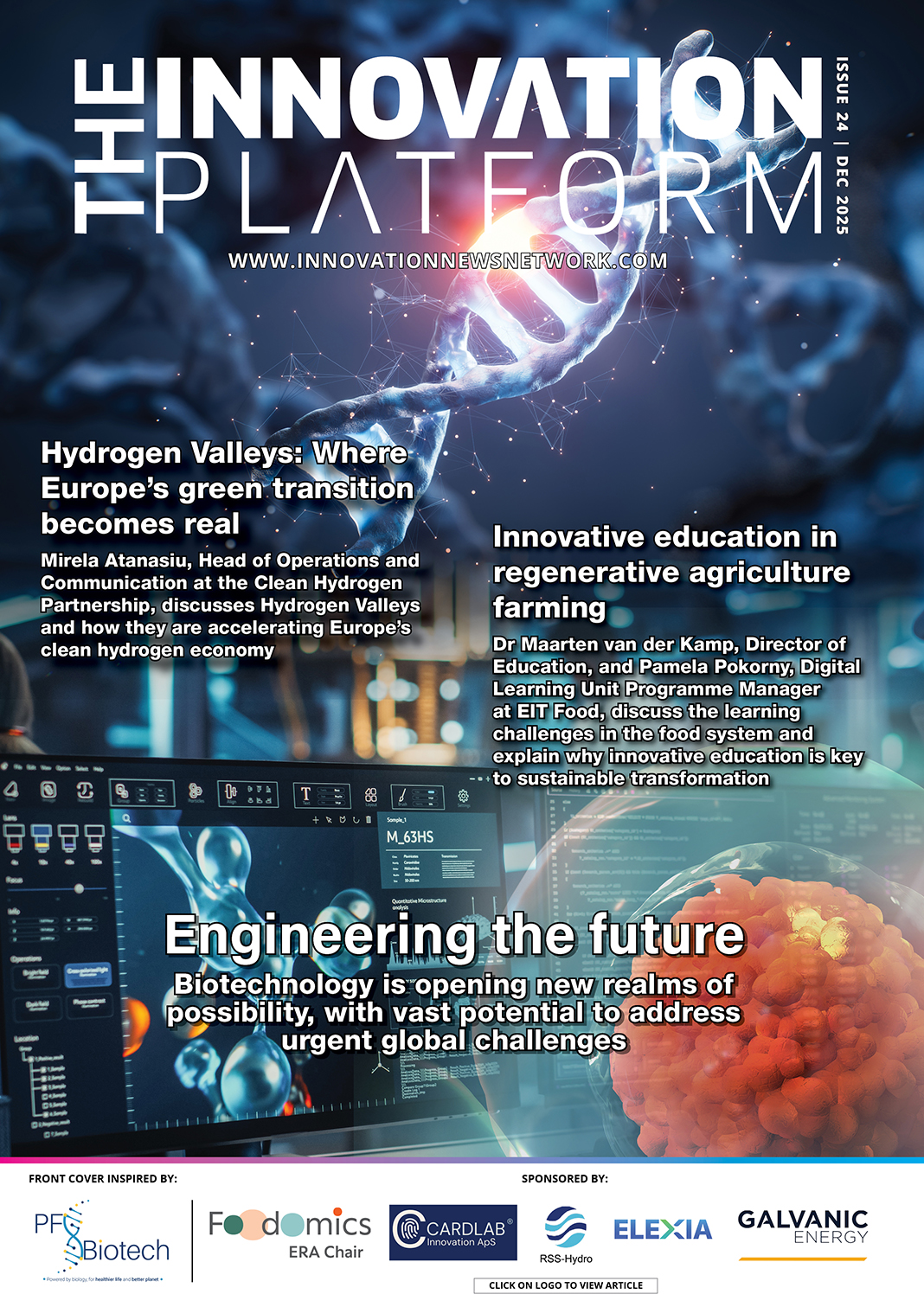
Hello and welcome to Issue 24 of The Innovation Platform, featuring cutting-edge insights into supercomputing, digital infrastructure, space and astrophysics, biotechnology, sustainable food systems, clean energy, and much more.
As another year draws to a close, I find myself reflecting on the insightful pieces and thought-provoking commentary from world-leading experts that we have been lucky enough to feature throughout the publication this year. I want to thank all of our contributors for enabling us to produce such a variety of interesting content.
This issue is no different, covering a plethora of important topics – from space to the environment. Our Technology section leads the issue, starting with a focus on Supercomputing & Artificial Intelligence. Anders Jensen, Executive Director of EuroHPC JU, explores how the European High Performance Computing Joint Undertaking is helping to accelerate innovation in high-performance computing across Europe.
In addition, Josh Turpin, Programme Manager – Telecoms and Net Zero at techUK, examines the UK’s current digital infrastructure, and The Next Generation Mobile Networks Alliance stresses that international collaboration is of the utmost importance when it comes to enhancing our digital infrastructure and progressing to a 6G world.
This issue’s Science section starts with a focus on Space & Astrophysics. Within this, we take a look at the European Innovation Council’s Space portfolio, particularly focusing on its work in the area of space debris. On the subject of physics, CERN’s Marco Calviani discusses how his team works to manage and maintain beam-intercepting devices.
An interesting addition to our Science section is our focus on Life Sciences. This section is predominantly centred around the topic of biotechnology – the use of biological processes, organisms, or systems to create new products and technologies. The Good Food Institute explores precision fermentation and its potential to solve some of the biggest global food challenges; we take a look at the recently launched Strategy for European Life Sciences; and the UK Bioindustry Association explores the topic of biosolutions and how they are helping to drive a more sustainable future in the UK and beyond.
Following on nicely from Life Sciences, our Health section starts with a focus on Food & Nutrition. Here, Dr Maarten van der Kamp, Director of Education, and Pamela Pokorny, Digital Learning Unit Programme Manager at EIT Food, discuss the learning challenges in the food system and explain why innovative education is key to sustainable transformation.
Further into our Health section, our Antimicrobial Resistance & Infection Control feature presents an interesting narrative from Henry Skinner, CEO of the AMR Action Fund. He explains how Russia’s invasion of Ukraine has highlighted a need for rapid diagnostics and new antibiotics.
Our Energy section addresses a number of topics, from fusion to hydrogen. The Special Competitive Studies Project’s President, Ylli Bajraktari, and Associate Director for Fusion, Nicholas Furst, reflect on the United States’ role in the global fusion space. Thomas Garabetian, Head of Research & Innovation at SolarPower Europe, discusses the highlights and key takeaways from the annual EU PVSEC, which took place in September. In addition, Mirela Atanasiu, Head of Operations and Communication at the Clean Hydrogen Partnership, introduces Hydrogen Valleys and explains how they are accelerating Europe’s clean hydrogen economy.
In the second half of the issue, you will find subjects from the environment and battery research to international research collaborations. Bioenergy Europe explains how bioenergy with carbon capture and storage could hold the key to Europe’s energy transition; Neil Wallis and Neil Stockley from Zemo Partnership detail an overview of the growing EV market; and Dr Colin Church, Chief Executive of the Institute of Materials, Minerals and Mining, provides insights into the role of the materials sector in delivering the UK Government’s Plan for Change. Also, EURAXESS’s Jackson Howard discusses the Choose Europe for Science initiative and the role of EURAXESS in facilitating collaboration and opportunities for researchers in North America seeking to connect with the programme.
This is just a snapshot of the pieces we have within this jam-packed issue. To reiterate my earlier sentiments, thank you to everyone who has worked with us on the publications throughout the year and to all our readers. I hope you enjoy this issue, and I look forward to bringing you more of the same in 2026.
Georgie Purcell
Editor
The Innovation Platform
Maddie Hall
Editor
The Innovation Platform