
Quantum sensors are at the forefront of technological innovation, harnessing the unique properties of quantum phenomena to deliver unmatched sensitivity and precision.
These cutting-edge devices are poised to disrupt traditional sensor markets, paving the way for transformative applications in industries ranging from electric vehicles and medical imaging to quantum computing and GPS-denied navigation.
According to the latest report by IDTechEx, the quantum sensor market is projected to grow to an impressive $2.2bn by 2045, driven by a compound annual growth rate (CAGR) of 11.4%.
In this article, we delve into the potential of quantum sensors, explore the diverse range of applications, and examine the key factors propelling their adoption and development.
The quantum edge: How these sensors work
Quantum sensors capitalise on the principles of quantum mechanics – such as superposition, entanglement, and tunnelling – to achieve exceptional sensitivity and accuracy in measuring physical properties.
These properties include time (measured by atomic clocks), magnetic and electric fields, gravity, acceleration, and light.
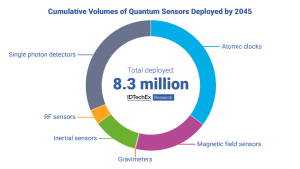
Unlike traditional sensors, which can face limitations in precision, quantum sensors offer unparalleled measurement capabilities. For instance, single-photon detectors can capture light at the smallest possible scale, while atomic clocks redefine timekeeping standards.
A diverse range of applications
The superior performance of quantum sensors is driving their adoption across multiple sectors:
- Automotive and electric vehicles: Quantum sensors are enhancing remote current sensing in electric and autonomous vehicles. Millions of chip-scale tunneling magnetoresistance (TMR) sensors have already been deployed in automotive systems, showcasing their commercial viability.
- Navigation without GPS: Quantum accelerometers and gyroscopes provide highly accurate navigation solutions, even in GPS-denied environments. These capabilities are particularly valuable for submarines, aircraft, and space exploration missions.
- Medical imaging: Optically pumped magnetometers (OPMs) are revolutionising non-invasive brain imaging.
- Quantum computing and communications: Quantum sensors are critical enablers of other quantum technologies. For instance, magnetometers and single-photon detectors play a pivotal role in scaling quantum computers, supporting increased qubit numbers and complexity.
- Consumer electronics and beyond: As technology advances, compact quantum sensors may find their way into consumer devices, offering enhanced functionality and new use cases in everyday applications.
Overcoming challenges: From lab to market
Despite their transformative potential, quantum sensors face significant hurdles in transitioning from laboratory prototypes to mass-market products.
One key challenge is the scalable manufacturing of exotic materials, such as artificial diamonds and superconductors, which are essential for these sensors.
Additionally, developing advanced semiconductor and photonic manufacturing capabilities is crucial to meeting the demands of this emerging market.
Recognising this, several national initiatives are fostering the domestic production of quantum materials and components, ensuring supply chain sovereignty and spurring innovation.
Startups and established players alike are actively addressing these challenges. While some quantum sensors, like TMR devices, are already commercially viable, others, such as bio-magnetic imaging tools, remain at earlier stages of development.
Quantum sensor market outlook
The quantum sensor market is set to revolutionise the sensor industry over the next two decades. By 2045, the market is expected to reach $2.2bn, driven by advancements in both proven technologies and emerging innovations.
For technologies such as atomic clocks, the focus lies in optimising existing designs to break into new markets, including data centres and autonomous systems.
Meanwhile, other innovations, like bio-magnetic imaging, represent long-term opportunities requiring sustained investment and research.
Quantum sensors are not only reshaping industries but also driving collaborative progress across the quantum technology ecosystem.
With synergistic developments in quantum computing, communication, and material science, the quantum sensor market is on a trajectory of exponential growth.