Lucas Mir, Junior Energy Analyst at the Nuclear Energy Agency (NEA), explores recent NEA analysis on small modular reactors (SMRs), highlighting the rise in interest and progress of SMR development across the globe.
Work to develop and deploy small modular reactors (SMRs) is gaining pace worldwide, with growing interest from the private sector as well as from governments keen to know more about its potential to support deep decarbonisation and energy security.
Research shows growing interest in SMRs
Recent analysis by the Nuclear Energy Agency (NEA) shows that projects to develop SMRs exist in almost all regions of the world, including in emerging economies, to serve a wide variety of purposes. The principal challenges they face are in the qualifying and licensing of new technology concepts and the innovative fuels that many require. Nevertheless, the NEA’s analysis suggests that the demand-side pull for these technologies is such that SMRs are likely to see widespread deployment in the coming years.
The ongoing NEA analysis is part of an effort to monitor and evaluate the progress of various SMR designs towards first-of-a-kind deployment. The aim is to help policymakers, regulators, investors, industry professionals and others navigate a period of rapid change in the nuclear energy industry. The latest results of this work are published in the third edition of the NEA Small Modular Reactor Dashboard ¹, which was released in July 2025, along with a new interactive online tool, the NEA Small Modular Reactor Digital Dashboard,² which provides readers the ability to access and visualise the database directly online.
A total of 74 SMR designs were analysed in the latest report, out of 127 identified globally. These 74 were the designs for which there was enough publicly available information to assess and whose designers were willing to participate. The analysis, as in previous editions, focused on progress made in licensing, siting, financing, supply chain, engagement, and fuel.
SMRs: A global development
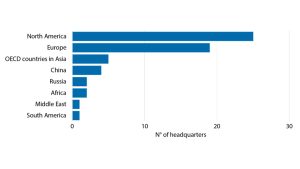
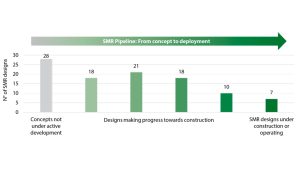
In terms of geographic location, Fig. 1 shows how work on SMRs is truly global. Some seven designs are either already operating or under construction (Fig. 2) and there is a strong pipeline of projects progressing toward first-of-a-kind deployment.
Of the 74 SMR designs assessed by the NEA, in 2025, 51 are involved in pre-licensing or licensing processes across 15 countries, and there are approximately 85 active discussions between SMR developers and site owners worldwide. Progress has also been made in financing and supply chain readiness, with an 81% rise in SMR designs confirming financing announcements since the previous edition of the Dashboard, published in 2024. This influx of capital is catalysing progress in supply chain development and early-stage manufacturing capabilities.
The range of technical characteristics – including the concepts, configurations, neutron spectrums, sizes, and temperatures – enables SMRs to broaden the traditional market of nuclear energy. Some SMR designs may be particularly suited to provide heat to industrial sectors, such as chemical production or oil and gas extraction, where reducing carbon emissions is particularly difficult. Other SMR designs may be better suited to provide reliable electricity production in remote or offshore locations. Some technologies may also be used specifically for non-power applications, including to produce medical isotopes or to reduce or recycle radioactive waste.
Investment
Unlike traditional large-scale nuclear power plants, SMRs are also attracting particular interest from the private sector, with a vibrant startup culture around their development and interest growing among large corporations, particularly in technology and heavy industry, to support energy-intensive activities like data centres. While most potential SMR sites (49) are still associated with utilities and government-owned entities, 11 are connected to private industrial players exploring SMRs as sources of clean, reliable power and heat. The United States is home to the greatest diversity of types of site owner, reflecting a broad spectrum of stakeholders now engaged in SMR deployment. SMR projects are increasingly being considered for siting near industrial or commercial centres, or near retiring coal plant sites. Ownership structures are also evolving, with some vendors exploring build-own-operate (BOO) models, power purchase agreements (PPAs), virtual power purchase agreements (VPPAs), or leasing arrangements, rather than relying solely on utilities as owners and operators.
In terms of financing, private capital is playing an increasingly important role, often complementing public matching grants. The NEA’s analysis finds approximately $15.4bn (in 2023 USD) of financing committed towards SMRs worldwide. The latest estimates include $10bn from public sources and approximately $5.4bn from private sources.
Different countries are positioned to capture different types of benefits by participating differently in SMR global value chains. In the United States, France, the People’s Republic of China (China) and Russia, the majority of SMR-related supply chain activities support SMR designs that have headquarters within those countries. In contrast, in the United Kingdom, Canada, and Italy, most SMR-related supply chain activities support SMR designs developed by design organisations headquartered abroad.
Fuel for SMRs
A majority of the SMR designs reviewed in the NEA’s analysis require high-assay low-enriched uranium (HALEU), which is defined as uranium enriched between 5% and 20%. The availability of HALEU remains a significant barrier to the deployment of many SMR designs, though some developers have engaged early to secure supplies for their first-of-a-kind reactors. The data collected shows that, as of early 2025, more than half of the SMRs planning to use HALEU had not yet progressed beyond non-binding agreements or collaborative studies with national laboratories related to fuel supply.
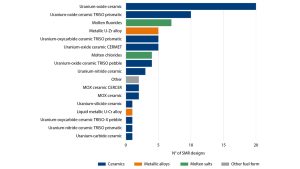
Another key challenge is that SMR designs are based on an increasingly diverse range of fuel forms, most of which have not yet been licensed or qualified for use. Standard uranium oxide ceramic is the most common physical-chemical fuel form among the SMR technologies under active development, with 39 planning to use it as their fuel (Fig. 3). Out of these, 19 incorporate or plan to incorporate a composite fuel architecture, such as TRISO (TRi-structural ISOtropic), distinguishing them from the conventional fuel used in today’s large-scale light-water reactors (LWRs) and potentially altering fuel fabrication requirements and performance characteristics significantly. More broadly, 47 SMR designs rely on fuel forms that are not currently available at commercial scale.
While SMRs potentially offer significant safety enhancements, the novelty and diversity of SMR designs mark a significant departure from established regulatory experience. Careful analyses backed by test data and validated codes and simulation tools will be required to establish that such systems are effective in the variety of circumstances in which they will be used.³
Nuclear waste management
Waste management is another enabling condition that is critical to the deployment of SMRs. Some advanced SMR designs are being developed to potentially reuse fuel from traditional nuclear reactors. Combined with recycling strategies, this has the potential to reduce the volume of high-level nuclear waste to be stored and managed in deep geological repositories as well as the uranium that is mined for the nuclear sector in the front end. There is so far, however, insufficient available information from verifiable public sources to assess the progress of SMRs in terms of waste management planning and readiness for end-of-life cycle management.
Continued monitoring of SMR development and deployment
The sheer number and variety of SMR designs being tested and developed around the world will require ongoing analysis to assess the progress made toward actual deployment of these new technologies. The NEA will continue to gather data and publish analysis as more verifiable information becomes available. This will be included in future editions of the NEA SMR Dashboard and feed the NEA SMR Digital Dashboard on a rolling basis.
References
- NEA (2025), NEA Small Modular Reactor Dashboard, OECD Publishing, Paris, https://www.oecd-nea.org/jcms/pl_73678/nea-small-modular-reactor-smr-dashboard
- NEA (2025a), NEA Small Modular Reactor Digital Dashboard, OECD Publishing, Paris, http://www.oecd-nea.org/smr-digital-dashboard
- NEA (2025b), CSNI Technical Opinion Paper No. 21: Research Recommendations to Support the Safe Deployment of Small Modular Reactors, OECD Publishing, Paris, https://doi.org/10.1787/0df32944-en, also available at www.oecdnea.org/7660
Please note, this article will also appear in the 23rd edition of our quarterly publication.