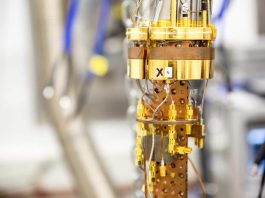
In a move to reinforce America’s global leadership in cutting-edge technology, the United States Department of Energy (DOE) has announced a $625m investment to renew its five National Quantum Information Science (QIS) Research Centers.
These facilities, originally launched under the National Quantum Initiative Act, signed into law in 2018, will continue pioneering the next generation of quantum computing, networking, and sensing technologies.
The renewed funding will be distributed over five years, beginning with $125m in Fiscal Year 2025, with future support contingent on congressional appropriations.
The DOE’s latest commitment represents a significant continuation of national efforts to expand quantum research, strengthen innovation ecosystems, and maintain American leadership in quantum information science.
Through this renewed support, the Department aims to accelerate scientific discoveries that could reshape fields ranging from national security and energy to advanced computing and communication.
DOE Under Secretary for Science Darío Gil explained: “Breakthroughs in QIS have the potential to revolutionise the ways we sense, communicate, and compute, sparking entirely new technologies and industries.
“The renewal of DOE’s National Quantum Information Science Research Centers will empower America to secure our advantage in pioneering the next generation of scientific and engineering advancements needed for this technology.”
The importance of QIS
Quantum information science is an emerging interdisciplinary field that explores how the laws of quantum mechanics can be harnessed to process, store, and transmit information in revolutionary new ways.
Unlike traditional computing, which relies on bits that can exist only as 0 or 1, quantum computing operates with quantum bits or qubits, which can exist in multiple states simultaneously through a principle known as superposition.
When these qubits become entangled, their states are linked, enabling complex calculations to be performed with extraordinary speed and accuracy.
This distinctive capability allows quantum computers to tackle problems far beyond the reach of even the most powerful classical supercomputers.
From simulating molecular interactions to improving encryption, optimising complex systems, and creating next-generation sensors, quantum information science is poised to transform technology and science alike.
It represents not only a new era of computing but also a foundation for quantum communication networks and precision measurement tools that could redefine innovation across multiple industries.
Expanding the national quantum network
The renewed DOE funding ensures that America’s five leading National QIS hubs remain at the forefront of this transformation.
Each facility contributes to advancing core aspects of quantum technology while building the infrastructure and talent pipelines needed to sustain national progress.
At Brookhaven National Laboratory, the Co-design Center for Quantum Advantage (C2QA) will enhance quantum computing and sensing by improving superconducting and diamond-based materials and developing modular systems that connect superconducting and neutral-atom platforms.
Fermi National Accelerator Laboratory’s Superconducting Quantum Materials and Systems Center (SQMS) will focus on scaling quantum devices through microwave cavity technology and advanced cooling systems, paving the way for future quantum data centres.
Meanwhile, Argonne National Laboratory’s Q-NEXT will work on algorithms, chip components, and quantum networks that link laboratories and preserve quantum entanglement across distances.
The Quantum Systems Accelerator (QSA) at Lawrence Berkeley National Laboratory will lead efforts to build large-scale quantum computers using improved error correction techniques and hybrid qubit architectures.
Finally, the Quantum Science Center (QSC) at Oak Ridge National Laboratory will explore quantum-accelerated high-performance computing and develop open-source software to integrate quantum and classical workflows across scientific domains.
Securing America’s quantum science future
According to the DOE, the renewed support for these facilities will not only accelerate research but also strengthen partnerships among universities, industries, and government laboratories.
This coordinated effort is designed to ensure that the United States remains the global leader in quantum information science – a field that is rapidly becoming critical to both technological innovation and national security.
By deepening investment in these foundational research hubs, the DOE is positioning America to lead the coming quantum revolution, fostering breakthroughs that could define the next century of computing, communication, and discovery.