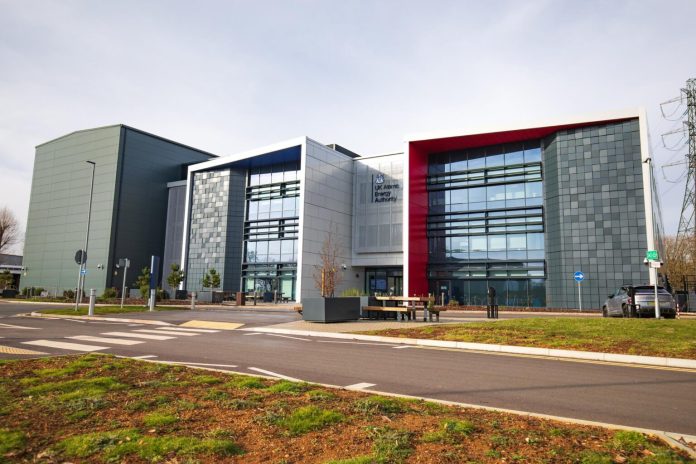
A world-first tritium fuel cycle virtual control room has been installed at UKAEA’s Culham Campus to train engineers in the handling and management of tritium.
This solidifies the UK Atomic Energy Authority’s reputation as a world leader in the use of digital platforms for training, research, and development, extending to tritium fuel cycle technologies, which will be critical for delivering sustainable fusion energy in the future.
Developed in conjunction with Bilfinger UK, UKAEA’s new and unique virtual simulator will enable operators of the UKAEA-Eni H3AT Tritium Loop Facility to undertake simulated training in a safe, controlled environment.
Stephen Wheeler, Executive Director for Fusion Technology and Tritium Fuel Cycle at UKAEA, said: “The UKAEA-Eni H3AT Tritium Loop Facility will be the largest and most advanced tritium fuel cycle in the world.
“It also represents a significant advance in enhancing industry capability within the fusion sector.
“By creating this digital control room with the support of Bilfinger, we’re increasing technical capability and supporting industry to deliver the mechanisms that will serve fusion in the future.”
Digital technology is key to fusion engineering training
The digital system will also allow UKAEA to simulate potential changes to H3AT’s operating parameters and their possible knock-on effects, increasing the optimisation and efficiency of processes.
Furthermore, in addition to demonstrating H3AT’s capabilities to visiting stakeholders, the virtual control room could be made available in the future for third parties to test their own tritium fuel cycle management systems.
“The development will provide an unprecedented opportunity to train the next generation of fusion engineers through cutting-edge virtual simulation technology,” Wheeler explained.
“Using digital technology to train operators is business-as-usual across several divisions at UKAEA, so it is really pleasing that we can employ the same principles within the UKAEA-Eni H3AT Tritium Loop Facility.”
Tritium fuel cycle training can help the world discover clean, limitless energy
Tritium fuel cycle training at Culham has the potential to dramatically change the world’s future energy mix – realising the potential for safe, clean, and virtually limitless energy.
Darren Clement, Vice President EAP, Bilfinger Engineering and Maintenance UK, commented: “This virtual control room will give UKAEA the ability to improve its processes further while also ensuring staff can learn the important skills needed to help make sure operations run smoothly and safely.
“At the same time, it can also help give important stakeholders a valuable insight into the ground-breaking work taking place in Culham.”
Bilfinger UK has experience in delivering marquee projects across multiple sectors. In addition to providing the control system, as a Tier One contractor, Bilfinger UK facilitated and coordinated the sub-contracting process, including to Schneider Electric, AVEVA, and Siemens.
Clement added: “We’ve supported the nuclear industry for 60 years, helping pioneers and major operators safely deliver clean energy in abundance.”
UKAEA’s proven track record in using digital technologies
The H3AT Tritium Loop Facility isn’t the first time UKAEA has used digital technologies to speed up efficiency, training, and delivery.
UKAEA has a proven track record of using digital platforms to improve efficiency in time and cost during staff training and the development of new technologies and processes.
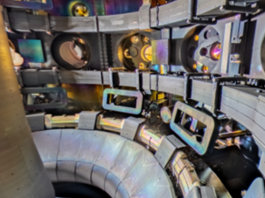
The Remote Operations team at the Joint European Torus (JET) has been using such platforms for over 25 years, and they will now be applied to support the decommissioning of the fusion machine.
Additionally, a full digital rehearsal of fuel debris retrieval at Fukushima Daiichi was conducted using the Next Generation Digital Mock-Up (NG-DMU), developed under the LongOps project, working with the Nuclear Decommissioning Authority, UK Research and Innovation, and the Tokyo Electric Power Company.