Professor Konstantina Lambrinou of the University of Huddersfield describes the link between radically innovative nuclear materials and safer nuclear energy.
The Fukushima Daiichi event in March 2011 demonstrated the need for safer nuclear energy, thus becoming a major driving force for global investments in accident-tolerant fuels (ATFs). The Fukushima event was caused by material failure – the melting of zirconium-based alloy (zircaloy) fuel claddings during the loss-of-coolant accident (LOCA) following the 2011 Great East Japan Earthquake and tsunami. Zircaloy fuel cladding failure was caused by its runaway oxidation reactions with steam, which produced copious amounts of heat and hydrogen, thus quickly raising the core temperature until meltdown, followed by hydrogen explosion and release of radioactive fission products beyond the site boundary.
Such undesirable nuclear events can have detrimental effects on both society and environment in the vicinity of nuclear power plants, discouraging the widespread use of nuclear energy – a low-carbon energy that can reduce greenhouse gas emissions and assist humanity in combatting climate change.
As the root cause of the Fukushima event lies in the inherent shortcomings of standard zircaloys, the development of ATF cladding materials that can overcome these shortcomings is of paramount importance. The expedited deployment of ATF claddings will enhance nuclear reactor safety by buying valuable time needed to deploy appropriate countermeasures during accident scenarios, thus resuming the control of the reactor. Moreover, ATF claddings can secure economic benefits from the higher achievable levels of fuel burnup and enrichment due to the slower in-reactor material corrosion during nominal operation, thus resulting in longer fuel cycles, lower fuel costs, and better use of nuclear fuels prior to their disposal to waste.
The SCORPION project
The HORIZON SCORPION project is an international collaboration (16 partners from the EU, the UK, the USA, Japan, and Switzerland) that targets the performance optimisation of the ‘revolutionary’ SiC/SiC composite ATF cladding material concept. SiC/SiC composites (i.e., SiC fibre-reinforced SiC matrix composites) exhibit excellent refractoriness (i.e., high-temperature stability due to the high melting point of SiC, Tm ≈ 2830°C), pseudo-ductility (i.e., damage tolerance stemming from an enhanced resistance to crack propagation as compared to monolithic SiC), and a lack of accelerated steam oxidation in the event of a LOCA, which make them ideal for light-water reactor (LWR) service environments. It is also worthwhile noting that the refractoriness and chemical compatibility of SiC/SiC composites with corrosive media (e.g., heavy liquid metals and molten salts) make them candidate materials for future generation fission reactors, such as lead-cooled fast reactors (LFRs), gas-cooled fast reactors (GFRs), very-high-temperature reactors (VHTRs), molten-salt reactors (MSRs), as well as fusion reactors.
Success in overcoming certain material shortcomings is a prerequisite for the deployment of SiC/SiC composite ATF cladding materials in LWRs. One such shortcoming is the inadequate compatibility of SiC with water (nominal operation conditions) and steam (transient/accident conditions), which has been observed during R&D activities in the framework of two international collaborations directly linked to SCORPION and also focusing on innovative ATF cladding materials – the H2020 IL TROVATORE project (30 partners from the EU, the USA, and Japan) and the I-NERI US/EURATOM PERSEUS project (7 partners from the EU and the USA).
First, the damage suffered by SiC under irradiation in contact with water (i.e., the primary coolant of LWRs) was detected using synergistic proton irradiation/aqueous corrosion tests on CVD (chemical vapour deposited) SiC exposed to slowly flowing water of controlled chemistry. These tests were performed within the I-NERI PERSEUS project at the unique IAC (irradiation-accelerated corrosion) cell, which is depicted schematically in Fig. 1a; the IAC cell¹ is available at the MIBL (Michigan Ion Beam Lab), University of Michigan, USA. CVD SiC is typically used as the outer protective coating of CVI (chemical vapour infiltrated) SiC/SiC composite ATF claddings. The disc-shaped CVD SiC sample (Ø 3 mm, 48 μm-thick) was tested using 5.4 MeV protons (p+), at 320°C, for 48 hours, in PWR (pressurised water reactor) water with 3 ppm hydrogen (H₂). Microstructural inspection of the as-fabricated CVD SiC showed that the material consisted of columnar SiC grains with a high density of stacking faults (SFs), which appear as parallel fine lines in the HAADF STEM (high-angle annular dark-field scanning transmission electron microscopy) images of Fig. 1c.
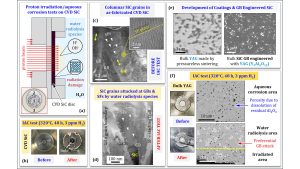
After testing, the CVD SiC disc appeared perforated (Fig. 1b), and three areas could be identified on its surface (see inset schematic in Fig. 1a) due to changes in the SiC degradation mechanism: area 1 (proton irradiation and water radiolysis), area 2 (water radiolysis), and area 3 (aqueous corrosion). Further STEM analysis revealed the preferential attack of grain boundaries (GBs) and SFs by water radiolysis species such as H+ (Fig. 1d); the attack of GBs and SFs created fresh surfaces in the originally dense CVD SiC, facilitating the formation and subsequent dissolution of silica (SiO₂), the main product of the oxidation of SiC in water and steam. These findings agree with ab initio molecular dynamics simulations of SiC aqueous corrosion effects, which showed that the scission of Si–C bonds by hydrogen species is a critical step in the SiC hydrothermal degradation process.²
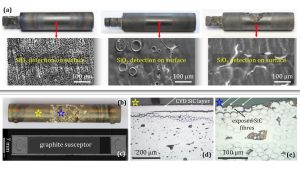
Second, the damage suffered by SiC in contact with steam was observed at test temperatures above the melting point of β-cristobalite (Tm ≈ 1723°C), which is the high-temperature SiO₂ polymorph. Molten SiO₂ reacts with solid SiC, producing gaseous species (SiO and CO), thus quickly damaging SiC/SiC composite ATF claddings in the event of a severe accident that raises the core temperature above the melting point of β-cristobalite. This was systematically confirmed within the H2020 IL TROVATORE project by very high-temperature steam oxidation tests³ conducted at the cutting-edge Quench-SR facility available at Karlsruhe Institute of Technology (KIT), Germany. Indicative results of these highly valuable tests are shown in Fig. 2.
The value of test setups able to simulate in-reactor conditions
The IAC cell and Quench-SR facility findings highlight the added value of laboratory test setups that are able to recreate – to a certain extent – in-reactor material service conditions, thereby justifying further investment in the design and construction of such test setups.
Obviously, the ultimate validation of material performance can only be provided through the neutron irradiation of innovative nuclear materials in contact with the nuclear-system-specific coolant (e.g., water, liquid metals, molten salts, helium, etc.). Unfortunately, the scarcity of sufficiently powerful test reactors that could be accessed after the Fukushima event in Europe and the USA, or elsewhere, to reliably assess the performance of innovative ATF cladding materials in an expedited manner presents a serious hurdle in our collective efforts to make nuclear energy safer as soon as possible. The few available test reactors (e.g., BR2 in Belgium, HFIR and ATR in the USA) that can quickly accumulate radiation damage in novel materials are either oversubscribed or prioritise the production of medical radioisotopes for the detection and treatment of cancer. Hence, investment in new test reactors is of paramount importance for the modernisation of nuclear energy and to support our aspirations of a future that guarantees global energy security.
Another challenge is the scarcity of research facilities that are properly equipped to perform post-irradiation examination (PIE) analyses on neutron-irradiated materials (e.g., JRC Karlsruhe in Germany and certain US national labs). New investment in such facilities is needed to facilitate the testing and qualification of innovative nuclear materials, thus helping to increase the efficiency and safety of nuclear reactors in the near term.
The SCORPION approaches to SiC performance optimisation
The HORIZON SCORPION project employs two radically new approaches to improve the compatibility of SiC/SiC composite ATF cladding materials with the coolant (water/steam) of LWRs:
- The development of protective coatings that can prevent the formation of SiO₂, as it jeopardises the reliable performance of SiC in contact with water and steam.
- Grain boundary (GB) engineering of SiC with compounds that exhibit excellent stability in water and steam.
Fig. 1e shows SEM (scanning electron microscopy) images of pressurelessly sintered yttrium aluminium garnet (YAG) and spark plasma sintered SiC with GBs engineered with YAG. YAG (Y₃Al₅O₁₂) is a candidate SiC coating material with excellent water/steam compatibility; this material has already been tested in the IAC cell under identical conditions to CVD SiC, i.e., 5.4 MeV p+, 320°C, 48 hours, in PWR water with 3 ppm H₂. Fig. 1f shows that the tested YAG disc (Ø 3 mm, 50 μm-thick) exhibited good overall performance, showing only mild GB etching in areas 1 and 2 and dissolution of parasitic alumina (Al₂O₃) in areas 1–3.
References
- S.S. Raiman, A. Flick, O. Toader, P. Wang, N.A. Samad, Z. Jiao, G.S. Was, A facility for studying irradiation accelerated corrosion in high temperature water, Journal of Nuclear Materials 451 (2014) 40–47
- J. Xi, C. Liu, D. Morgan, I. Szlufarska, Deciphering water–solid reactions during hydrothermal corrosion of SiC, Acta Materialia 209 (2021) 116803
- M. Steinbrueck, M. Grosse, U. Stegmaier, J. Braun, C. Lorrette, Oxidation of silicon carbide composites for nuclear applications at very high temperatures in steam, Coatings 12 (2022) 875
Acknowledgements
HORIZON SCORPION received funding from the Euratom Research and Training Programme 2021–2025 under Grant Agreement No 101059511. The IAC test on CVD SiC was funded by the U.S. Department of Energy, Office of Nuclear Energy, under DOE Idaho Operations Office Contract No DE-AC07-051D14517, while the post-test analysis was co-funded by Westinghouse Electric Company LLC, PNNL (Pacific Northwest National Lab), and H2020 IL TROVATORE (Grant Agreement No 740415; Euratom Research and Training Programme 2014–2018).
About the author
Prof Dr Konstantina Lambrinou is Professor of Advanced Materials at the School of Computing and Engineering, University of Huddersfield, UK. Her main research interests revolve around the accelerated development of advanced nuclear materials, including ATFs. Prof Lambrinou is the coordinator of HORIZON SCORPION (Grant Agreement No 101059511) and H2020 IL TROVATORE (Grant Agreement No 740415), the European lead of I-NERI PERSEUS, and the technical lead of a Westinghouse GAIN programme on the Cr-coated ATF cladding material concept (NE-23-31246).
Further Information:
HORIZON SCORPION
H2020 IL TROVATORE
Please note, this article will also appear in the 22nd edition of our quarterly publication.