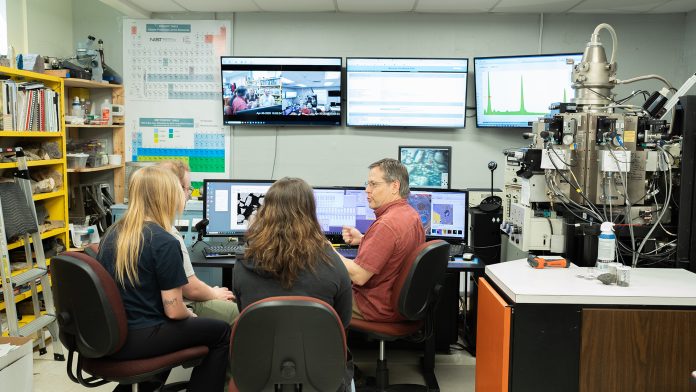
Following a multi-year effort, the Analysis Center recently installed new imaging and automation electronics and software, enhancing usability and remote access.
As part of a major modernisation and enhancement of instrument operations, the Concord University Materials and REE Analysis Center has completed another set of pioneering, first-of-their-kind upgrades to electron microprobe hardware and software. This builds upon the earlier 2024 installation of a high-performance Ge diffracting crystal for improved X-ray spectral resolution and lowered detection limits. And the laboratory isn’t stopping here. Further planned enhancements are currently in the engineering and development phase.
Advancing instrumentation
In collaboration with SEMTech Solutions and Advanced Microbeam Inc, the Concord University Materials and REE Analysis Center has implemented a customised version of the SEMView8000 system on an ARL SEMQ electron probe microanalyser (EPMA). The March 2025 installation combines modern electron microscopy imaging, electronics, and control software with the unique X-ray analytical characteristics of the ARL SEMQ design.
The instrument also has a new Bruker 730M energy-dispersive (EDS) spectrometer installed and utilises the latest versions of the powerful Probe for EPMA 14.x quantitative analytical software and Bruker Esprit 2.6 software running on a Windows 11 PC platform. This new ‘SEMQ 8000’ instrument configuration uniquely offers seven total X-ray spectrometers (six diffraction-based WDS type and one EDS type) combined with modern automation for high-performance micro-analytical applications.
Robust infrastructure for consistent performance
Supporting infrastructure provides stable environmental conditions, vibration isolation, and a clean electrical supply for consistent operation. A separate sample preparation lab means that most materials can be taken from raw sample to analysis-ready in-house.
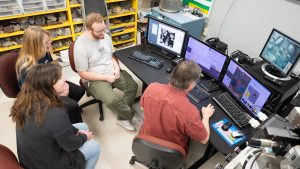
A collection of several hundred minerals, glasses, metals, and synthetic compounds supports instrument calibration and quality-control verification. Abundant elements in many samples can be routinely quantified to better than 1% relative precision in just a few minutes with a spatial resolution of a few micrometres.
Trace element detection limits of several tens of ppm are also readily obtained for most elements with further procedural optimisation. These capabilities are available to both internal and external users in education, government, and industry.
Please note, this article will also appear in the 22nd edition of our quarterly publication.