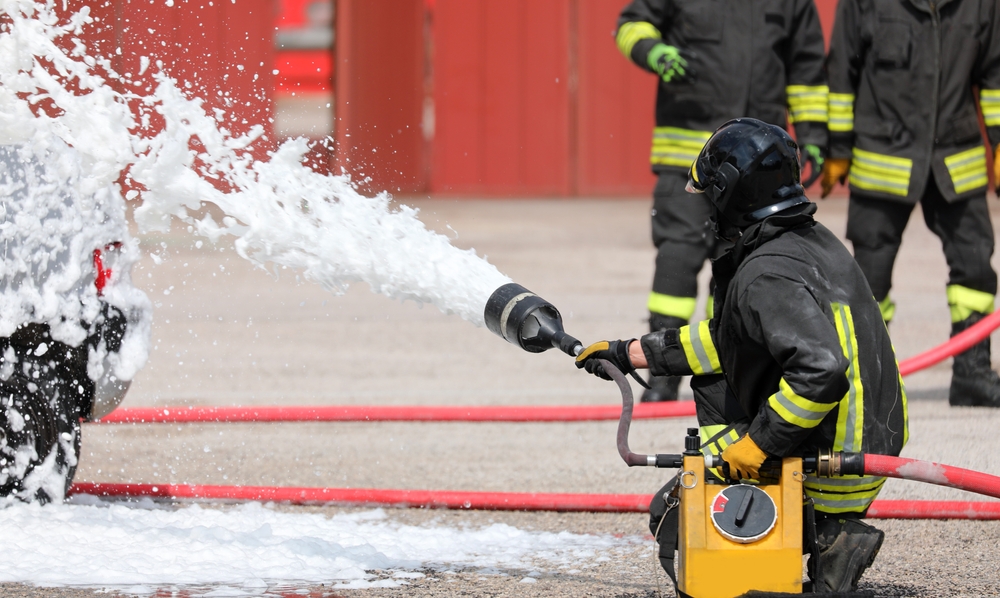
A groundbreaking study has uncovered troubling trends in PFAS levels among frontline workers, revealing that firefighters and healthcare professionals may be at greater risk of exposure to these toxic “forever chemicals” than previously thought.
Conducted by researchers at the University of Arizona Health Sciences, the study is the first to comprehensively examine PFAS concentrations across different essential occupations – highlighting not only the well-documented dangers faced by firefighters but also raising new concerns about chemical exposure in healthcare settings.
The findings offer a critical warning about unseen workplace hazards and call for urgent action to protect those on the front lines.
What are PFAS, and why are they a concern?
Per- and polyfluoroalkyl substances, or PFAS, are artificial chemicals prized for their resistance to heat, water, and oil.
Commonly used in firefighting foam, non-stick cookware, stain-resistant fabrics, and even some medical equipment, PFAS are notoriously durable. They do not break down easily in the environment or the human body, earning them the nickname forever chemicals.
While almost all US adults have some level of PFAS in their blood, prolonged or high-level exposure is linked to serious health issues.
These include certain types of cancer, elevated cholesterol, weakened immune responses to vaccines, and reproductive complications.
Firefighters: Highest risk group
Among the 1,960 study participants – including 280 firefighters – the research confirmed that firefighters carry the highest PFAS concentrations in their bloodstream.
Blood samples showed elevated levels of PFHxS, Sm-PFOS, n-PFOS, and PFHpS. These results align with previous studies and reinforce concerns that firefighting gear and fire-suppressing foam are key sources of PFAS exposure.
Despite growing awareness and changes in fire service practices, the study highlights that distinct occupational exposure pathways continue to exist for firefighters in Arizona and likely elsewhere.
Healthcare workers: An emerging exposure group
While not as exposed as firefighters, healthcare workers demonstrated moderately elevated PFAS levels – particularly PFHpS and PFUnA.
More strikingly, they had significantly higher odds of having Sb-PFOA and PFDoA in their blood compared to other essential workers.
The study is among the first to investigate PFAS exposure in healthcare settings. Potential sources include disposable surgical gowns, masks, and even X-ray film.
These findings suggest healthcare environments may harbour previously unrecognised PFAS exposure risks, prompting calls for deeper research into the materials used in medical settings.
A broader occupational issue
Other essential workers included in the study – totalling 734 participants – showed declining PFAS levels over the study period from 2020 to 2023, with a 6% to 17% annual reduction.
Nevertheless, researchers found notable residual levels across the board, underlining the widespread nature of PFAS contamination.
Given the established health risks associated with elevated PFAS levels, researchers emphasise the importance of understanding how different jobs contribute to exposure.
Improved identification of occupational sources could lead to safer practices and better health protections for frontline workers.
Reducing risk and advancing PFAS research
The study was part of the Arizona Healthcare, Emergency Response, and Other Essential Worker Surveillance Study (AZ HEROES), collecting data over nearly three years.
Its findings underscore a growing need to investigate and mitigate occupational PFAS exposure –especially in fields historically overlooked, like health care.
As evidence builds, experts call for increased surveillance, safer product alternatives, and stricter regulatory oversight to curb PFAS exposure and protect worker health.
Get The Latest PFAS News
Explore the latest PFAS news, updates on PFAS contamination, health risks, regulations, and environmental impact. Visit our comprehensive PFAS news archive to stay informed with in-depth reporting, expert analysis, and breaking developments. Start reading now to stay ahead on all things PFAS and ‘forever chemicals’.