At the 2025 European Physical Society Conference on High Energy Physics (EPS-HEP) in Marseille, France, the ATLAS collaboration unveiled compelling new findings in the study of Higgs-boson decay.
The results, based on a combination of Run 2 and early Run 3 data from the Large Hadron Collider (LHC), mark a significant leap in identifying two elusive decay modes of the Higgs boson: into a pair of muons (H→μμ) and a Z boson and a photon (H→Zγ).
These rare decay paths are not just statistical anomalies – they could reshape our understanding of how fundamental particles gain mass and may even hint at physics beyond the Standard Model.
What is the Higgs boson?
First predicted in the 1960s and confirmed in 2012, the Higgs boson is a cornerstone of the Standard Model of particle physics.
It is linked to the Higgs field, an invisible energy field that permeates space and gives particles their mass. Without the Higgs field, elementary particles would remain massless, making the Universe as we know it impossible.
Studying Higgs-boson decay provides a deeper understanding of how this particle interacts with other fundamental particles, particularly those from lighter generations, and opens the door to possible new physics.
First evidence of Higgs decaying to muons
The decay of a Higgs boson into two muons is incredibly rare, occurring in just 1 in 5,000 Higgs decays.
However, it is of great scientific interest because muons belong to the second generation of fermions.
Until now, Higgs interactions had only been confirmed with the heaviest third-generation particles, such as tau leptons and top and bottom quarks.
By analysing data from both Run 2 and early Run 3 of the LHC, ATLAS researchers reported a 3.4 standard deviation observation for H→μμ, with an expected sensitivity of 2.5 standard deviations.
This strengthens earlier hints from both the ATLAS and CMS collaborations, pushing this decay mode closer to a confirmed discovery.
Enhanced sensitivity in Z boson–photon decay
The second major finding centres around the H→Zγ decay. This path involves a Z boson decaying into either electron or muon pairs and a photon, and occurs via an intermediate loop of virtual particles.
Because these loops could include unknown particles, this decay is a potential window into physics that lies beyond the current Standard Model.
ATLAS’s latest analysis found an excess consistent with this decay at 2.5 standard deviations, up from an expected sensitivity of 1.9.
This is now the most stringent expected sensitivity for this process to date, surpassing the results from earlier combined ATLAS-CMS Run 2 data.
How researchers uncovered these rare decays
Isolating these rare signals was no easy feat. The background ‘noise’ from standard particle interactions can easily mask the subtle signs of Higgs-boson decay.
To tackle this, scientists improved their modelling of background processes and refined event-selection techniques. Events were categorised by Higgs production mode to enhance the clarity of potential decay signatures.
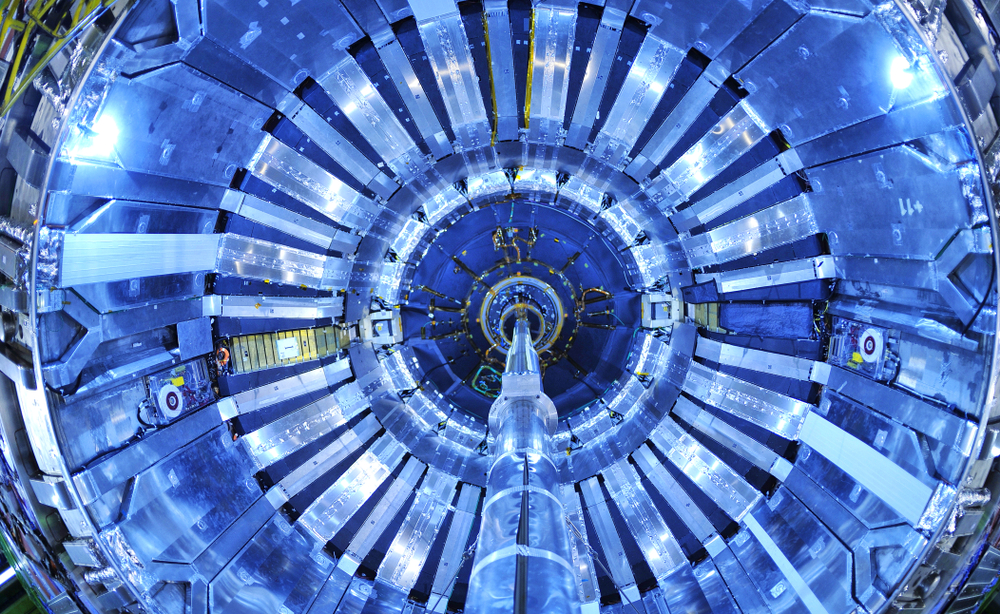
The success of this work was made possible by the enormous datasets provided by the LHC and the cutting-edge performance of the ATLAS detector.
A new era of discovery
These findings mark a milestone in Higgs boson research. As more data pours in from Run 3 and future LHC operations, researchers expect to tighten these observations, possibly confirming them as full-fledged discoveries.
With each new insight into Higgs-boson decay, scientists edge closer to unravelling the full mechanics of the Universe and potentially uncovering new physics waiting just beyond the Standard Model.