Elestor’s hydrogen-iron flow batteries offer scalable, safe energy storage to boost Europe’s grid resilience and autonomy.
As Europe intensifies efforts to decarbonise its energy systems, the challenges of grid stability, supply security, and strategic autonomy have moved to the forefront. The accelerating shift to renewables calls for infrastructure that can not only balance intermittent generation but also withstand external shocks.
Dutch-based Flow Battery developer and manufacturer Elestor is addressing this need with a technology purpose-built for large-scale resilience: the hydrogen-iron flow battery.
According to Jacopo Tosoni, Head of Policy at the European Association for Storage of Energy (EASE), efficient energy storage systems “keep prices low by integrating renewables, so we get cheap electricity, while also preventing curtailment and reducing grid congestion.”
This transition represents more than a cleverly engineered energy storage system. It signals a strategic move to equip local, national and European power systems with storage that is scalable, safe, affordable and geopolitically independent.
A scalable backbone for a renewable energy system
Today’s electricity grids are under pressure. As solar and wind grow in share, the need for long-duration energy storage becomes critical. Short-term battery solutions, such as lithium-ion, LFP, or sodium-ion systems, fall short when it comes to bridging periods of low generation that can last several days, known as the “dunkelflaute.”
By 2025 or 2026, EASE estimates that battery energy storage systems are expected to overtake pumped hydro in terms of total installed capacity.
Elestor’s hydrogen-iron flow battery is a large-scale, long-duration, and affordable solution that fills this gap by enabling eight to 150 hours of electricity storage with a design that is inherently modular and scalable. Power and capacity are decoupled, allowing users to scale energy storage simply by adding liquid electrolyte, an extremely low-cost component, without duplicating the power infrastructure.
“With our design, you can build energy resilience into the grid without overspending. You just scale the part that stores energy,” explained CEO Hylke van Bennekom.
“This is precisely what is needed to ensure that renewables can form the stable backbone of the electricity system, without the need for imported fossil fuels, such as oil or gas, to make up the baseload.”
The battery’s ability to stabilise the supply of renewable energy over a time period of multiple days without generation helps to reduce or even eliminate dependency on fossil fuel reserves and imported balancing power. In doing so, it supports strategic goals for energy sovereignty at both national and continental levels whilst making the utmost sense. This approach democratises the energy system in ways that strengthen our democracies.
Designed for deployment, built for trust
Technology readiness is not enough. For solutions to be widely adopted across Europe’s energy landscape, they must also gain public trust, meet regulatory standards, and be operationally safe.
This is where Elestor’s hydrogen-iron technology stands out. Iron is not only one of the most abundant elements globally, but it is also safe to store and handle. Unlike other redox chemistries, Elestor’s iron-based electrolyte is non-toxic, non-volatile, and requires no hazardous containment. As a result, it eliminates the need for materials such as ‘forever plastics’ and simplifies permitting processes across European jurisdictions.
Joep Lauret, Project and Compliance Manager at Elestor, said: “Energy security isn’t just about megawatts and market structures. It’s also about social licence, regulatory clarity and practical deployment. Our hydrogen-iron chemistry meets or exceeds all these requirements.”
Indeed, the system is fully aligned with EU Battery Regulation (2023/1542) and other major safety directives, including those concerning machinery, low voltage, electromagnetic compatibility and cyber resilience.
Elestor’s close collaboration with national regulators, local fire brigades and public safety institutions ensures that each deployment contributes to, rather than complicates, grid safety and system reliability.
A redox flow battery is an electrochemical energy storage system where energy is stored in a liquid electrolyte held in external tanks and circulated through an electrochemical cell. Unlike conventional batteries, which store energy within the cell itself, flow batteries decouple energy and power, allowing energy capacity (tank size) and power output (cell stack size) to be scaled independently. This architecture makes them highly suited for large-scale stationary storage applications, additionally leveraging key advantages such as long cycle life, excellent safety characteristics, quick response times, and minimal degradation over time, leading to lower total cost of ownership in long-duration energy storage.
Elestor sets itself apart in the energy storage landscape by developing a gas-liquid flow battery based on hydrogen-iron. This system utilises hydrogen gas and an iron sulphate liquid as active reactants, enabling a highly efficient and cost-effective energy storage method. The use of hydrogen as one of the reactants brings significant additional benefits, such as a high energy density, fast reactions kinetics, flexibility in storage methodologies and even seamless integration with (local) hydrogen infrastructure.
Moreover, both iron sulphate and hydrogen are extremely low-cost reactants, avoiding the use of scarce or expensive raw materials and aligning well with sustainability and scalability goals.
Geopolitical independence through locally sourced materials
The decision to select hydrogen and iron sulphate as our reactants is also informed by global developments. As international supply chains become more volatile, the strategic importance of domestically available materials cannot be overstated.
“Recent geopolitical turbulence has elevated energy security and regional resilience to national priorities,” Van Bennekom noted.
“Using iron sulphate as electrolyte, which is widely sourced and often a by-product of existing industries, allows us to build energy infrastructure that is less exposed to international risks.”
Iron’s global availability not only stabilises costs but also reduces vulnerability to geopolitical leverage over rare or regionally concentrated materials. This directly contributes to the European Commission’s goals of strategic autonomy in energy technologies.
The hydrogen-iron battery is ready for industrial scale
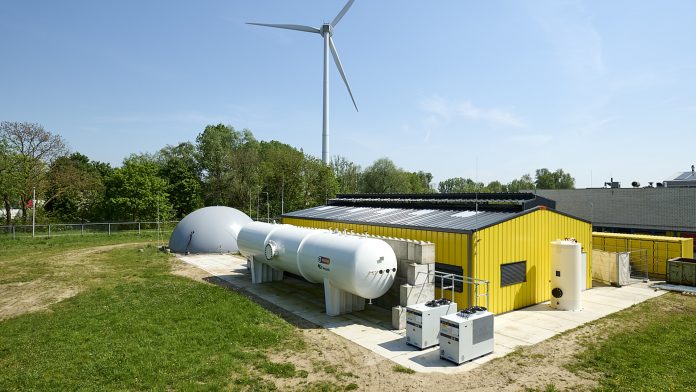
Elestor is not standing still. After completing a series of pilot installations, the company will deploy its first industrial-scale hydrogen-iron battery system this year.
With a maximum power output of 500 kilowatts and a storage capacity of up to three megawatt-hours, this project will demonstrate the system’s readiness for commercial use. Larger systems will follow, with the aim of introducing standardised modules to the market by 2027 or 2028.
These installations are powerful demonstrations of technical feasibility. They offer proof of concept for integrating long-duration storage into real energy systems, whether coupled with renewables, stabilising grids or supporting industrial decarbonisation.
“We are not building lab prototypes. We are deploying assets that will keep critical infrastructure running independently, also when the sun isn’t shining and the wind isn’t blowing,” said Van Bennekom. “This is energy resilience, in practice.”
Enabling a resilient and sovereign European grid
Elestor’s hydrogen-iron flow battery is more than a technological innovation. It is a policy-aligned, safety-verified and economically rational building block for Europe’s future power system. By enabling reliable, long-duration energy storage built with locally available materials, the technology directly contributes to a robust grid, resilient infrastructure and a secure energy supply.
Spyridon Pantelis, Project Manager at the European Energy Research Alliance, noted that by 2030, more than half of Europe’s electricity is expected to come from variable sources, necessitating the need for more flexible and distributed storage assets.
In an era when energy systems must do more than simply deliver electricity, they must also protect economies, support sovereignty, and withstand disruption. Elestor’s contribution is timely and essential.
Van Bennekom concluded: “We are building a foundation for a new kind of energy system that is clean, autonomous and built to last.”