BATRAW develops advanced pilot technologies to optimise EV battery dismantling, material recovery, and lifecycle traceability.
The BATRAW project was launched in response to the growing environmental and strategic challenge posed by end-of-life electric vehicle (EV) batteries. As electric mobility continues to expand rapidly across Europe, it has become essential to develop sustainable solutions for the reuse, recycling, and recovery of critical raw materials (CRMs) contained in these batteries. BATRAW addresses this need by promoting a circular economy approach in the battery sector, in full alignment with the upcoming European Battery Regulation, which aims to ensure sustainability, safety, and traceability throughout the entire battery lifecycle.
What is the BATRAW Project?
The project brings together 17 partners from across Europe, including research centres, SMEs, industrial stakeholders, recyclers, and sustainability and policy experts. Co-ordinated by LEITAT Technological Center (Spain), BATRAW is funded by the European Commission through the Horizon Europe programme, with the goal of developing cutting-edge technologies for semi-automated dismantling, mechanical pre-treatment, hydrometallurgical recycling, and the creation of a second-life battery prototype, as well as a blockchain-based digital passport to ensure full traceability across the battery value chain.
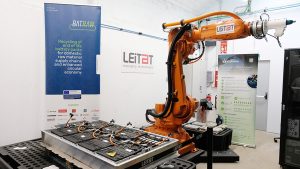
One of the project’s core objectives is the implementation of two innovative pilot plants focused on the sustainable recycling and end-of-life management of EV batteries, domestic batteries, and battery production scrap. These pilots will contribute to generating secondary sources of strategically important CRMs and battery raw materials (RMs), while validating the circularity, economic potential, and technical feasibility of the solutions developed under BATRAW. The two plants are located in Spain and France, and serve as testbeds for scaling up the project’s key technologies.
Pilot plants
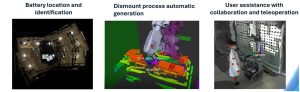
The first pilot plant, located at BeePlanet’s facilities in Pamplona, Spain, focuses on the semi-automated dismantling of EV batteries. It integrates AI-based battery recognition, cobots for safe manipulation, and a robot equipped with a force sensor enabling force control techniques – critical for sensitive tasks such as unscrewing components. BeePlanet, COMANAI, and LEITAT have worked jointly on the development and deployment of this robotic system. It performs a range of dismantling operations including battery and screw recognition, unscrewing, cable disconnection, glue and metal cutting, and lid and module extraction. The goal is to refine this system to operate at the module level, enabling access to battery cells for improved material recovery. The plant is expected to be fully operational by November 2025.
Additionally, BeePlanet has developed a battery health characterisation tool for rapid and accurate diagnosis of battery modules, supporting their reuse in second-life applications. Once an EV battery pack is deemed suitable for reuse, it is dismantled, and the modules are analysed to determine their internal condition. The tool has already been successfully applied to battery modules from Stellantis, achieving a root-mean-square error (RMSE) of 0.604% in just 15 minutes. Furthermore, a battery cabinet prototype was designed using 34 reused modules from EV packs, demonstrating a promising solution for stationary energy storage using second-life batteries in good condition.
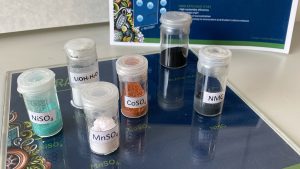
The second pilot plant is hosted at Orano’s site in Bessines-sur-Gartempe, France, and is dedicated to the hydrometallurgical recovery of CRMs such as cobalt (Co), nickel (Ni), manganese (Mn), lithium (Li), graphite, aluminium (Al), and copper (Cu) from end-of-life batteries. Over the first three years of the project, Orano, CEA, MTB, and LEITAT have collaborated on developing technologies for mechanical pre-treatment (battery deactivation, size reduction, graphite separation) to optimise downstream recovery, as well as innovations in the leaching and metal recovery stages of the hydrometallurgical process. Several innovations are already implemented and operational, as demonstrated during the BATRAW General Assembly visit to Orano’s site in July 2025.
Battery Passports
Another key pillar of the BATRAW project is the development of a blockchain platform for raw materials, product, and supply chain tracking, aligned with European Commission efforts on transparency and the upcoming Battery Passport regulation. Minespider is leading this effort by creating a digital battery passport with multiple data-sharing layers (public, private, transparent), incorporating all relevant regulatory data and templates – including Carbon Footprint Declaration, EU Conformity Declaration, and Due Diligence Report – adaptable to future legal requirements. Future improvements consist of developing and testing AI-based tools to support creation and understanding of Battery Passports.
Guidelines
In line with safety and circularity objectives, two public guideline documents have also been developed: one on best practices for the safe handling and transport of end-of-life battery waste, and another on eco-design strategies for battery packs. The latter focuses on improving dismantling efficiency, enabling easier module access for repair or second-life use. Both documents are available through the project’s official website.
A promising future for critical raw materials
The BATRAW consortium is confident that, by the end of the project, all the objectives will be successfully achieved. Based on the promising results obtained so far in the development of both pilot lines, particularly the high selectivity and purity levels in the hydrometallurgical recovery process and the effectiveness of the semi-automated dismantling technologies, we expect to meet or exceed the targeted recovery rates for critical raw materials (CRMs). These advancements will validate the technical and economic viability of the solutions developed within BATRAW, strengthening the foundation for industrial-scale deployment and contributing to Europe’s strategic autonomy in raw materials.

This project has received funding from the European Union’s Horizon Europe research and innovation programme under grants agreement No 101058359
ISLE UTILITIES LTD participant in Horizon Europe Project BATRAW is supported by UKRL
Please note, this article will also appear in the 23rd edition of our quarterly publication.