More than a decade after the 2012 discovery of the Higgs boson, global particle physics is preparing for its next leap forward.
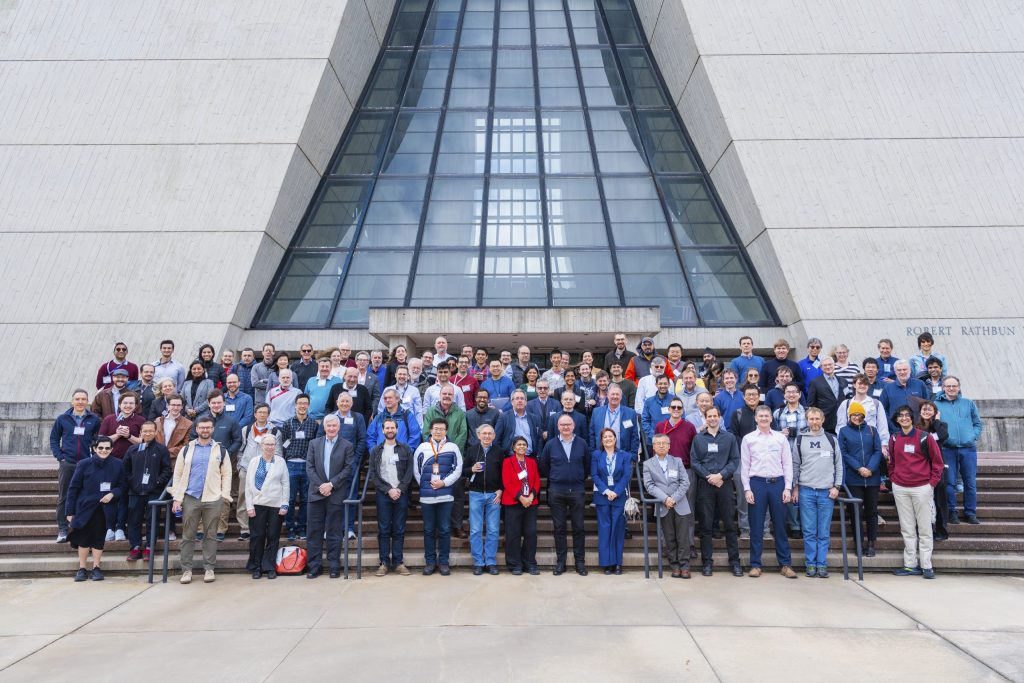
In April, around 200 scientists, engineers, and students gathered at the Department of Energy’s Fermi National Accelerator Laboratory (Fermilab) for the US Higgs Factory – Future Circular Collider Workshop.
Co-hosted by Fermilab and Argonne National Laboratory, the event united US researchers with Europe’s vision for the successor to CERN’s Large Hadron Collider (LHC).
Central to the discussions was the Future Circular Collider (FCC) Feasibility Study, a roadmap for two groundbreaking machines that could redefine our understanding of the Universe.
What is the Higgs boson?
The Higgs boson is a fundamental particle linked to the Higgs field – an invisible energy field thought to permeate all of space.
As particles move through this field, they acquire mass, making the Higgs boson crucial to explaining why matter, from subatomic particles to galaxies, exists in the form we see today.
Without it, the building blocks of the Universe would remain massless and unable to form structures.
Two-stage plan to explore the Higgs boson
The feasibility study outlines a two-phase project at CERN:
- FCC-ee (Electron-Positron Collider): Designed as a ‘Higgs factory,’ it would produce vast numbers of Higgs bosons for in-depth study, enabling scientists to measure their properties with unmatched precision.
- FCC-hh (High-Energy Hadron Collider): A successor operating at even greater energies, capable of directly searching for unknown particles and potentially shedding light on dark matter.
Since the Higgs boson’s discovery, the LHC has probed its properties, but physicists agree that more sensitive tools are needed to unlock its remaining mysteries.
Artur Apresyan, a scientist at Fermilab and one of the organisers, highlighted the significance of the initiative: “The FCC-ee will offer a unique opportunity to study the Higgs boson and the electroweak sector with unprecedented precision and discovery potential.
“It is the most consequential particle physics experimental programme viable before the mid-21st century with a path to a high-energy hadron machine, the FCC-hh, to explore the next energy frontier.”
International collaboration and training ground for the future
The workshop drew participation from over 50 early-career scientists, who played pivotal roles in shaping discussions on detector technologies, accelerator design, software, and physics analysis.
Fermilab postdoctoral researchers Irene Dutta and Grace Cummings were instrumental in organising the event, underscoring the project’s significance for the next generation of researchers.
The FCC-ee is expected to provide unmatched opportunities for hands-on training with cutting-edge instrumentation, data analysis, and theoretical modelling – experience that will feed directly into future discoveries.
Dutta explained: “The project promises to provide the next generation of researchers with an exceptional training ground, where hands-on experience with new detector technologies, advanced data analysis, and innovative theoretical techniques will build on the current knowledge and expertise in particle accelerators.
“It will strengthen our long-standing collaboration with CERN and help us push the frontiers of precision electroweak physics.”
Looking ahead to 2045
The European particle physics community is set to recommend the FCC-ee’s construction in 2026. If approved, collaborations could begin by 2028, with operations starting around 2045.
The long-term plan envisions transitioning to the FCC-hh, pushing the boundaries of energy and discovery potential well into the mid-21st century.
With its long history in collider science, Fermilab is poised to be a central hub for US contributions to the FCC-ee and FCC-hh programmes.
The workshop emphasised that these colliders represent not only an opportunity to deepen our understanding of the Higgs boson but also a bridge to the next great breakthroughs in fundamental physics.
As the plans advance, the Higgs boson – once a theoretical concept – remains at the heart of humanity’s quest to understand the Universe’s most profound secrets.