
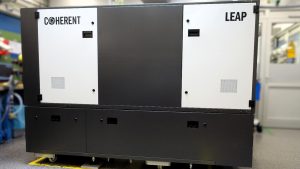
LEAP series excimer lasers from Coherent are key to manufacturing superconducting tapes required in large quantities for high-field fusion magnets.
In the race to harness the power of the stars, magnetic confinement fusion approaches have long grappled with the challenge of containing plasma at temperatures hotter than the sun. For decades, superconducting magnets made from copper conductors or niobium-alloy-based low-temperature superconductors (LTS) were the backbone of any fusion reactor design. But the emergence of high-temperature superconducting (HTS) tapes on the production floor over the course of the last decade has sparked a breakthrough in fusion magnet performance.
HTS tapes transforming the fusion landscape
HTS tapes, based on multi-crystalline REBCO (rare-earth barium copper oxide) layers, can carry immense electrical currents while operating at significantly higher temperatures and magnetic fields than their LTS counterparts. The commercial advent of this material has enabled the design of more compact, efficient, and powerful fusion reactors. With HTS-based fusion magnets, magnetic fields exceeding 20 T are now achievable. Roughly speaking, doubling the magnetic field in a tokamak or stellarator device leads to a 40-fold reduction in reactor volume without sacrificing output. This has lowered the cost and complexity of fusion prototypes, accelerating timelines for the commercial viability of clean fusion energy.
The scale-up of high-temperature superconductor (HTS) production is critical to unlocking the potential of magnetic fusion energy. With nearly $10bn in mostly private funding, the fusion industry is rapidly advancing toward commercialisation. According to the latest report from the Fusion Industry Association, of the 50+ fusion companies, 25 companies follow a magnetic confinement fusion approach, and 75% of all fusion companies expect to begin delivering electricity to the grid by 2035.
Achieving this milestone will require the construction of many HTS-based magnetic fusion devices, consuming large amounts of HTS tape that easily exceeds the global HTS tape capacity currently at around 10,000 km per year by an order of magnitude.
Growing crystalline thin films by the metre
In HTS tape manufacturing, the superconducting properties of a tape are largely determined by the quality of its few microns-thin REBCO layer, which is to be grown consecutively on tape substrates of several hundred metres up to a kilometre in length.
Various chemical and physical deposition methods, such as Chemical Solution Deposition, Chemical Vapour Deposition, Magnetron Sputtering, Electron Beam Deposition and Pulsed Laser Deposition (PLD) using excimer lasers, have been employed in the pursuit of achieving smooth and homogeneous REBCO films with well-aligned crystal grains and with good adherence to the adjacent material layers.
Standing out from the crowd, PLD-deposited REBCO-films exhibit an intrinsic growth structure which lends itself to superior critical current density under high fields up to 20 T and beyond. Today, PLD is the dominating REBCO manufacturing method serving all types of HTS-based fusion magnets as well as high-field magnet coils in high-resolution NMR spectrometers.
PLD rising to the occasion
PLD has long been known as an excellent method for growing high-quality oxide films on sub-square centimetre-sized substrates. To this day, thousands of excimer laser-based PLD systems are used for a few hours per day with single-digit pulse frequency in material research labs. The advent of HTS-based fusion less than a decade ago has sparked an unprecedented demand for PLD-REBCO films, where a single prototype reactor alone may consume 10,000 kilometres of typically 4 mm wide tape material. This corresponds to a total REBCO film deposition area of 40,000 m² – roughly the size of six soccer fields.

Enter the LEAP excimer laser platform
The Coherent LEAP excimer laser platform, designed for fast large-area thin film processing, has been following this demand with increasing power levels up to 300 W at the required output wavelength of 308 nm and is now employed by all major HTS tape suppliers. To scale up tape manufacturing capacity, new fabs have been built, housing multiple LEAP 300 W-based PLD systems operating at maximum intensity and at an annual capacity of several 1000 km of HTS tape. As HTS-tape demand is expected to soar with the next wave of prototype and grid-scale fusion reactors already projected, the next generation LEAP at 600 W has been introduced in June 2025 at the Laser World of Photonics Fair in Munich. With its core innovations, performance and lifetime improvements, LEAP 600 W is the most cost-effective PLD laser on the market.
LEAP 600 – A big leap toward grid energy reactors
As PLD is the rate and performance-determining process step on the HTS tape production floor, the LEAP 600 W is poised to become the linchpin of the imminent global HTS tape capacity expansion.
The LEAP 600C is a cutting-edge 600-watt excimer laser developed and produced at the Coherent excimer laser facility in Goettingen, Germany. It operates at a 308 nm wavelength and is specifically designed for industrial-scale HTS tape fabrication.
The LEAP 600 C excimer laser features on-the-fly active injection technology, which triples runtime and doubles the HTS tape throughput per PLD system compared to previous LEAP 300 W-based REBCO deposition systems.
Until now, scaling HTS tape production is still regarded by many fusion companies as a bottleneck to achieving their next fusion reactor milestones due to the limited capacity. The LEAP 600 has been introduced to the HTS tape market, with a clear focus on changing this picture.
Equally important as the next level of capacity scaling of the game-changing HTS tapes, the fusion industry needs to meet energy cost targets set by existing coal, gas and nuclear power plants. As the magnets make up for a large part of the reactor costs, in the next wave of grid reactor magnets, HTS tape procurement will be guided significantly by the performance-price ratio.
With these fusion market economics in mind, the LEAP 600 has been designed to provide unprecedented cost-efficiency and offers not only the highest power but also the lowest cost-per-watt-ratio of the LEAP excimer laser product family.
To this end, innovative developments such as on-the-fly active gas injections significantly extend the intervals between gas replacements in the LEAP 600, which the operator must conduct on a regular basis. Therefore, significantly longer batch lengths and more consecutive batches can now be achieved between the gas exchanges.
Although the laser-related expenses are but a smaller fraction in the HTS tape manufacturing cost pie chart, innovations like this are essential steps in the right direction toward supply chain readiness and putting commercial HTS-based magnetic fusion reactors as early as possible on the power grid.
Fusion and beyond – the look ahead
HTS tapes with their ongoing commoditisation via PLD-driven upscaling are poised to reshape our future in several transformative ways – first and foremost through their role in making magnetic confinement fusion more efficient and economically viable. If successful, fusion will provide virtually limitless, carbon-free energy, reducing dependence on fossil fuels and mitigating climate change. Thanks to HTS tapes, fusion machines can be built smaller and closer to where energy is needed—urban centres, industrial zones, or remote areas. This decentralisation could revolutionise energy infrastructure and resilience.
HTS tapes are not only advancing fusion as the holy grail of energy generation, but soon will push boundaries in energy distribution via superconducting high-voltage cables and multiple other superconducting grid components, which today are copper-based and suffer from transmission losses and inefficiencies.
Also, in a multitude of other application fields like accelerator magnets in particle physics, medical and biological imaging (MRI/NMR), HTS tapes enable cost-effective and energy-efficient system advances as opposed to traditional low-temperature superconductors.
Transportation is another area which will strongly benefit from employing HTS tapes. From ultra-fast, frictionless travel via Maglev trains powered by HTS magnets to electric aircraft and ships driven by lightweight, high-efficiency HTS motors.
In summary, HTS tapes have the potential to revolutionise our world by enabling technologies that were previously limited by energy inefficiency, size, or cost. The superconducting transformation of the world has already begun. Many hundreds of thousands of kilometres of HTS tape must be produced on the road ahead. The LEAP 600, in conjunction with sophisticated three-shift PLD system technology, will be central to success.
Please note, this article will also appear in the 24th edition of our quarterly publication.