Nicholas Mazzei, Vice President of Sustainability, Europe, DP World, explores how the supply chain sector in Europe is working together to deal with the current constraints and congestion.
European supply chains have been running hot for years, so it’s no surprise that some view the glass as half empty. Energy insecurity and climate change, to name a few, have all tested our capacity to the limits. And yet, remarkably, the real story today is resilience and collaboration.
Across Europe, cargo owners, logistics providers and port authorities are sharing data and combining digital tools with on-the-ground improvements to keep trade flowing. No doubt the picture varies from market to market, but the common thread we’re seeing is more pragmatic collaboration than panic or speed at any cost.
Visibility is a valuable currency
Let’s start with transparency. A few years ago, ‘track and trace’ meant knowing a container’s last hand-off point. Today, shippers expect to see where goods are, what temperature or condition they’re in, and how likely a delay is – whether that’s over road, rail, river or sea. The technology is continually improving, but the more significant shift is cultural: competitors are now willing to share selected data, and where possible, ports and carriers are aligning their physical and digital assets, so everyone sees the same “single version of the truth.”
Innovations in terminal operating systems (TOS) can create digital replicas of yards and quays, allowing bottlenecks to be identified before they arise, and partners to collaborate on plans rather than working in silos. Initiatives that standardise data models across equipment and processes, such as the TIC 4.0 programme, an initiative that aims to drive digital transformation and standardisation within the cargo-handling industry, are accelerating that shift by creating a common ‘language’, which is crucial if you want different companies’ systems to talk to each other cleanly.
This transparency has a useful side effect: it cuts waste. If a barge is late on the Rhine, a rail alternative can be triggered earlier; if a cold-chain consignment is idling, alerts prompt a change of gate or lane to protect temperature. These tweaks all add up, so even modest efficiency gains can reduce carbon at scale.
Regulation is accelerating this direction of travel. The EU’s Corporate Sustainability Reporting Directive (CSRD) is bringing many more companies into scope for audited sustainability disclosures, including value-chain emissions; the first wave reports on 2024 data in 2025, with further waves following. In parallel, the eFTI Regulation is phasing in digital-by-default freight information across modes. Member State authorities are required to accept electronic freight data as part of the regulation’s rollout, advancing the adoption of paperless freight across the EU. Together, these measures raise the bar on accurate, shareable information – and reward those investing in interoperable systems, not just standalone tools.
Collaboration you can see on the ground
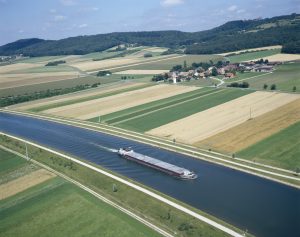
Collaboration is also physical. One response to repeated congestion has been to diversify transport modes and routes – shifting more inland volume to rail and river where networks exist and building that capability where they don’t. In Northern and Western Europe, with dense waterways and rail corridors, operators are expanding trimodal inland terminals and running regular services that tie seaports to inland areas of production. For example, DP World’s facilities in Stuttgart and Mannheim on the Rhine now link road, rail and barge, giving shippers more options when a single corridor bottlenecks.
You can see the same logic in Eastern Europe, where recent investments have reduced friction at multiple points in the supply chain – deep-sea access to attract services, faster scanning to expedite compliance, and roll-on/roll-off (ro-ro) capacity to streamline vehicle flows. In Romania, for example, new assets at the Port of Constanța include a ro-ro terminal and a dedicated project/general cargo facility, complemented by an inland intermodal hub at Aiud. The programme is designed to create reliable alternatives to long road legs, with upgrades such as high-throughput scanners and added yard capacity helping to lift overall flows and smooth hand-offs between modes.
None of this works without disciplined operational alignment. The most effective collaborations are refreshingly specific: synchronised gate hours between a terminal and a rail operator, so trains aren’t idling; common appointment systems, so hauliers aren’t double-booked; and shared rules for barge consolidation, so scarce river slots are used where they add the most value. They may not be flashy, but they free capacity where it matters and make alternative transport choices viable for more shippers, more of the time.
It’s also worth being honest about what collaboration is not. It’s not a perfect ‘control tower’ that sees and steers everything in real time, and it’s not a silver bullet for congestion. It’s a series of targeted agreements—about windows, data fields, handoffs, and incentives—that help the network absorb shocks with less drama and sustainably as possible. That’s why the language in the sector is slowly shifting from ‘faster’ to ‘steadier’. Reliability is what protects a production line from downtime or keeps a supermarket shelf stocked when weather closes a waterway.
What to expect next
The next phase involves scaling and proof. As CSRD raises expectations around audited value-chain data and eFTI speeds up digital documentation, the sector will need to demonstrate, not just claim, how goods moved and what emissions were saved. Expect more joint pilots between ports, railroads, barge operators and tech firms to measure corridor-level performance (not just site-level metrics), and to publish service levels that make choices clearer for customers.
We’ll also see more ‘network thinking. Rather than adding capacity in isolation, investments will be sequenced so they unlock options across an entire corridor. That’s the thread running through the examples above. When assets and data standards are designed to complement each other, the whole corridor behaves more like a system than a set of parts.
There are limits, there always will be. Climate events will persist, and energy markets can be volatile. Neither is it clear how certain protectionist policies will play out. So, there will be days when several disturbances stack and operators feel the heat.
However, Europe’s recent experience offers a clear lesson: when pressure rises, the winning move is rarely to go it alone. It is to share enough data to build trust, create sufficient transport options to spread risk and reduce carbon emissions, and align enough processes that partners can adjust their plans together. That won’t make headlines, but it does make shipments arrive.