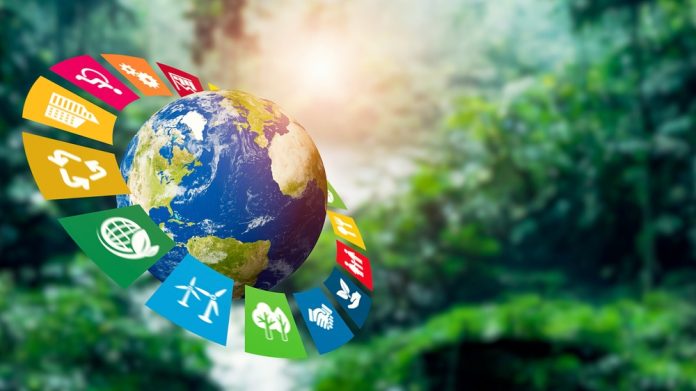
The UN Sustainable Development Goals (SDGs) are the world’s shared blueprint for ending poverty, protecting the planet, and ensuring prosperity for everyone by 2030.
Adopted by all 193 United Nations member states in 2015, the SDGs translate broad ambitions – on poverty, health, education, gender equality, climate and more – into 17 measurable goals with 169 targets and hundreds of indicators.
They are universal, as they apply to high-, middle-, and low-income countries, and they are integrated – progress on one goal often depends on progress on others. The SDGs have become the organising framework for governments, investors, civil society, and businesses that want to align their actions and track measurable outcomes.
History and background of SDGs
The Sustainable Development Goals grew out of a long process of global negotiation and learning from earlier international development agendas.
Their immediate predecessor was the Millennium Development Goals (MDGs, 2000–2015), a set of eight goals that drove large improvements in child mortality, primary education and extreme poverty reduction but also exposed gaps – particularly around inclusiveness, environmental sustainability, inequality, and governance.
After the MDGs expired in 2015, the UN member states negotiated a more ambitious, universal agenda. The result – Transforming our world: the 2030 Agenda for Sustainable Development – was adopted on 25 September 2015 as UN General Assembly Resolution A/RES/70/1.
That document formalised the 17 SDGs, 169 targets and a commitment to “leave no one behind.” The agenda is both aspirational and operational: countries are expected to adapt and implement it through national policies, budgets, and partnerships.
Since the adoption of the 2030 Agenda, tracking and reporting systems have been established, led by the United Nations Statistical Commission and UN agencies, enabling policymakers and citizens to measure progress and identify where country-level or global course corrections are needed. Independent trackers, such as the Sustainable Development Report (SDG Index) and the UN’s annual SDG Reports, provide data-driven snapshots of global progress.
How the SDGs are structured: Goals, targets and indicators
The SDGs are arranged as:
- 17 goals: Broad, interlinked objectives (e.g., No Poverty; Climate Action).
- 169 targets: Specific outcomes tied to the goals (for example, reducing maternal mortality).
- Indicators: Measurable metrics used to assess progress (e.g., proportion of population below national poverty line).
This three-tier structure fosters both political ambition and technical precision. Goals provide political direction, targets make objectives specific and time-bound, and indicators enable data-driven monitoring. The SDG framework recognises that achieving the goals requires action across social, economic and environmental dimensions simultaneously.
The 17 Sustainable Development Goals — What each one means
The Sustainable Development Goals represent a comprehensive roadmap for addressing the world’s most pressing social, economic, and environmental challenges. Each goal focuses on a specific area, ranging from eradicating poverty and hunger to promoting gender equality, sustainable cities, and climate action. Together, they form an interconnected framework that drives progress toward a fairer, healthier, and more sustainable planet. The following section breaks down each goal, explaining its purpose, key targets, and why it matters.
Goal 1 – No Poverty
End poverty in all its forms everywhere. This goal targets both extreme poverty and multidimensional poverty, ensuring access to basic services, income support, social protection systems, and resilience against shocks (natural disasters, health crises, conflict).
Goal 2 – Zero Hunger
End hunger, achieve food security and improved nutrition, and promote sustainable agriculture. It emphasises accessible, nutritious food, resilient food systems, and support for small-scale farmers.
Goal 3 – Good Health and Well-Being
Ensure healthy lives and promote well-being for all ages. Targets include reducing maternal and child mortality, ending epidemics (HIV, TB, malaria), achieving universal health coverage, and strengthening health systems and emergency preparedness.
Goal 4 – Quality Education
Ensure inclusive, equitable and quality education and promote lifelong learning opportunities. Focus areas include universal primary and secondary education, equal access to vocational training and higher education, and improving learning outcomes.
Goal 5 – Gender Equality
Achieve gender equality and empower all women and girls. This includes ending discrimination and violence, ensuring equal participation in leadership and the economy, and securing reproductive rights and access to services.
Goal 6 – Clean Water and Sanitation
Ensure availability and sustainable management of water and sanitation for all, including water quality, wastewater treatment, and equitable access to safe drinking water and sanitation facilities.
Goal 7 – Affordable and Clean Energy
Ensure access to affordable, reliable, sustainable and modern energy for all. This covers expanding renewable energy, improving energy efficiency, and ensuring energy access for underserved populations.
Goal 8 – Decent Work and Economic Growth
Promote sustained, inclusive and sustainable economic growth, full and productive employment, and decent work for all. This goal focuses on job creation, labour rights, safe working environments, and economic productivity.
Goal 9 – Industry, Innovation and Infrastructure
Build resilient infrastructure, promote inclusive and sustainable industrialisation, and foster innovation – recognising that infrastructure and industrial capacity are essential for economic growth and technological progress.
Goal 10 – Reduced Inequalities
Reduce inequality within and among countries. Targets include income growth of the bottom 40% of the population, social, economic and political inclusion, and policies for migration and mobility that protect rights.
Goal 11 – Sustainable Cities and Communities
Make cities inclusive, safe, resilient and sustainable, with attention to affordable housing, public transport, green public spaces, urban planning, and disaster risk reduction.
Goal 12 – Responsible Consumption and Production
Ensure sustainable consumption and production patterns, including resource efficiency, waste reduction, and sustainable business practices across supply chains.
Goal 13 – Climate Action
Take urgent action to combat climate change and its impacts, including integration of climate measures into policies, strengthening resilience, and mobilising finance for mitigation and adaptation.
Goal 14 – Life Below Water
Conserve and sustainably use the oceans, seas and marine resources, addressing overfishing, pollution (especially plastics), ocean acidification, and the protection of marine habitats.
Goal 15 – Life on Land
Protect, restore and promote sustainable use of terrestrial ecosystems – forests, deserts, mountains – and halt biodiversity loss, combat land degradation and desertification.
Goal 16 – Peace, Justice and Strong Institutions
Promote peaceful and inclusive societies, provide access to justice, reduce violence, tackle corruption, and build transparent, accountable institutions at all levels.
Goal 17 – Partnerships for the Goals
Strengthen the means of implementation and revitalise the global partnership for sustainable development—finance, technology, capacity building, trade and systemic issues such as data, policy coherence and multistakeholder collaboration.
Implementation: How countries turn goals into action
The Sustainable Development Goals are intentionally non-prescriptive about the exact policies countries must adopt – national ownership is a core principle. Implementation typically involves:
- Policy alignment: Integrating SDGs into national development plans, budgets, and sectoral strategies.
- Data systems: Strengthening national statistical systems to track indicators and report targets.
- Financing: Mobilising domestic resources, reorienting public spending, attracting responsible private investment, and securing international finance where needed.
- Partnerships: Engaging local governments, civil society, academia, the private sector and international organisations to co-design and implement actions.
- Monitoring and reporting: Regular national reviews (Voluntary National Reviews at the UN High-Level Political Forum), and contribution to global monitoring.
Implementation differs by country. High-income countries may focus on decarbonisation, inequality and sustainable consumption patterns, whereas lower-income countries may prioritise poverty eradication, infrastructure, health, and education. All countries face the challenge of balancing short-term needs with long-term sustainability.
Progress to date: Achievements and where the world is falling short
There have been significant successes since 2015, including reductions in extreme poverty and child mortality in many regions, expanded access to electricity and mobile broadband, and progress on certain health indicators, such as reductions in HIV infections in specific contexts. However, global progress is uneven and, in many areas, alarmingly insufficient to meet 2030 targets.
The UN’s Sustainable Development Goals Report (2024) warns that progress is too slow on many targets – nearly half of the monitored targets show minimal or moderate progress, and several are stalled or in reverse. Recent economic shocks, conflict, rising debt burdens in many low- and middle-income countries, climate shocks, and the lingering effects of the COVID-19 pandemic have reversed gains and made financing and implementation more difficult. These realities mean that without stepped-up effort, many targets will be missed.
Debt servicing and fiscal constraints are a running theme – many low-income countries face high borrowing costs that crowd out public investment needed for health, education and climate resilience. International financial architecture reforms, innovative financing instruments, and stronger private-public collaboration are frequently proposed remedies, but political will and scalable mechanisms remain decisive hurdles. Reporting by global institutions highlights that bridging the financing gap will require trillions of dollars annually in public and private investment.
The integrated nature of the SDGs: Systems thinking, trade-offs and synergies
A core strength of the SDGs is their integrated logic. Goals are interdependent. For example, climate action (Goal 13) affects agriculture (Goal 2), health (Goal 3), and livelihoods (Goal 8). Investments in education (Goal 4) pay dividends for gender equality (Goal 5), economic growth (Goal 8) and reduced inequalities (Goal 10).
But this integrated nature also creates trade-offs. Rapid industrialisation (Goal 9) can increase emissions if not managed sustainably; expanding irrigation (Goal 2) can stress freshwater resources (Goal 6). Effective policy requires systems thinking: identifying synergies to amplify positive outcomes (e.g., clean energy deployment that creates green jobs and reduces air pollution) while managing trade-offs through careful regulation, stakeholder engagement, and data-driven planning.
Measuring success: Data, indicators and the reporting landscape
Measuring SDG progress requires robust, timely and disaggregated data (by sex, age, income, disability status, geographic location, etc.) so that “no one is left behind” can be operationalised. The global indicator framework provides standardised metrics, but many countries lack the capacity or resources to generate reliable data for all indicators.
Innovations – satellite earth observation, mobile surveys, administrative data integration, and new statistical methods – are expanding what is measurable. However, capacity building, investment in national statistical offices, data-sharing agreements, and open data infrastructures are essential to scale up monitoring capacity globally. The UN and development partners regularly publish global and country-level reports; many countries also produce Voluntary National Reviews that detail national progress and policy responses.
Financing the SDGs: The scale of the challenge and promising approaches
Estimates vary, but filling the SDG financing gap will require trillions of dollars each year to cover infrastructure, health systems, education, social protection, and climate adaptation. Key channels for finance include:
- Domestic revenue mobilisation: Improved tax systems and efficient public spending.
- International public finance: Official development assistance (ODA) targeted to the poorest countries.
- Private finance: Mobilising institutional investors and development finance institutions through risk mitigation and blended finance.
- Innovative instruments: Green bonds, social bonds, GDP-linked debt instruments, and climate funds.
Addressing debt sustainability, reducing illicit financial flows, and improving investment climates are also important. The SDG agenda emphasises that finance alone is not enough – policy coherence, institutional capacity, and anti-corruption measures are part of the enabling environment that turns money into sustainable outcomes.
Practical recommendations for governments, businesses and civil society
To accelerate progress on the Sustainable Development Goals, stakeholders can pursue these practical steps:
- Governments: Mainstream SDGs into national planning, strengthen statistical systems, prioritise social protection, and reform tax systems to mobilise domestic resources.
- Businesses: Align corporate strategies with SDGs (e.g., sustainable supply chains, net-zero commitments), report on measurable impacts, and invest in green technologies.
- Investors/Finance: Develop blended finance and de-risking mechanisms to attract private capital to SDG-aligned projects.
- Civil society & citizens: Hold governments accountable through monitoring and advocacy, participate in local implementation, and use data to identify and address local gaps.
- International community: Reform international finance architecture to support debt sustainability, scale climate finance, and expand technical assistance.
Can the world meet the 2030 deadline?
As 2030 approaches, the window to achieve the Sustainable Development Goals is narrowing. Progress is patchy: some targets remain achievable with intensified effort, while others require transformative changes – especially in climate, biodiversity, and persistent inequalities. The next years will test global capacity to mobilise resources, strengthen institutions, and build political coalitions for change.
Critical pivot points include: rapid decarbonisation consistent with science-based targets; closing critical data and financing gaps for vulnerable countries; strengthening social protection to absorb shocks; and expanding technologies and partnerships that scale high-impact interventions. The SDGs remain the operating manual for a sustainable future, but achieving them requires unprecedented cooperation, fiscal innovation, and political will.
Why the SDGs still matter
The Sustainable Development Goals are more than a list: they are a compact between generations. They capture the complexity of contemporary global challenges while offering a shared framework for measurement and action. Whether the world achieves the SDGs depends on choices made now – how countries budget, how companies invest, how communities organise, and how international systems adapt to finance and govern a rapidly changing planet. For practitioners, advocates, and citizens, the SDGs offer both a yardstick for progress and a call to action: to align policies and resources so that prosperity, dignity and a healthy planet are shared by all.