CERN has taken a significant step toward the next frontier in particle physics with the review of the Feasibility Study for the proposed Future Circular Collider (FCC).
At a dedicated meeting on 6–7 November 2025, Council delegates from Member and Associate States examined the multi-year study, confirming that the FCC is technically viable and free of major obstacles.
This milestone sets the stage for what could become the world’s most powerful particle accelerator, designed to succeed the Large Hadron Collider (LHC) and push the boundaries of our understanding of the Universe.
What is the Future Circular Collider?
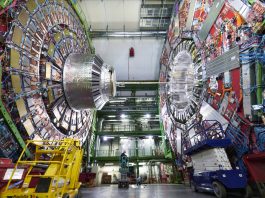
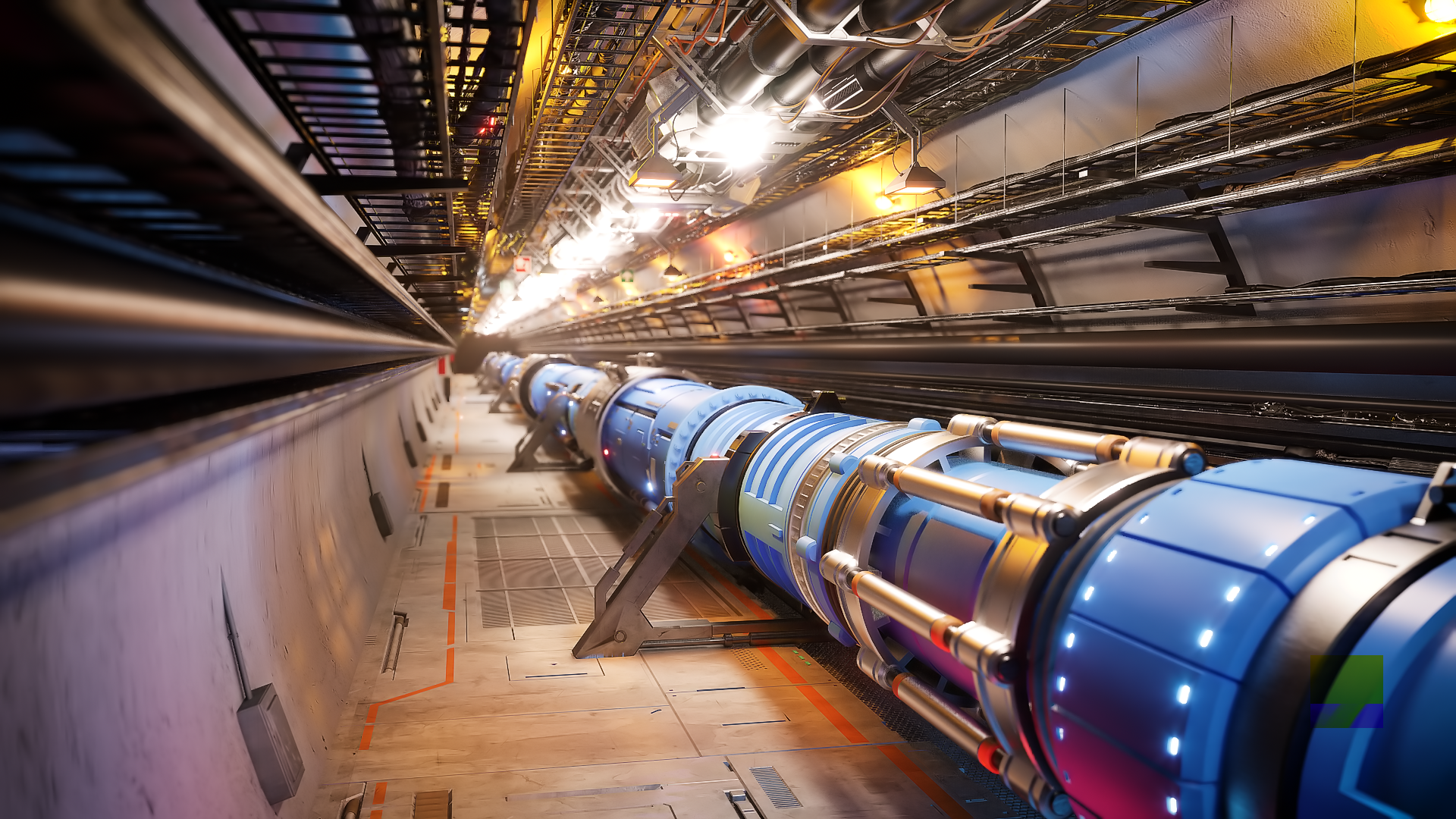
The Future Circular Collider is a next-generation particle accelerator proposed to succeed the existing LHC when its operations conclude around 2041.
The concept envisions a circular tunnel of approximately 90 to 100 kilometres in circumference. Its design outlines two main phases:
- FCC‑ee: An electron–positron collider designed as a ‘Higgs factory’ to explore electroweak particles with precision.
- FCC‑hh: A later-stage proton–proton collider operating at energies around 100 TeV — many times the current LHC’s energy — opening the door to entirely new physics beyond the Standard Model.
Beyond particle physics, the FCC is intended to drive breakthroughs in accelerator, superconducting, and detector technologies, with potential societal and industrial spin-offs.
Study background and timeline
The feasibility effort follows the 2020 update of the European Strategy for Particle Physics (ESPP), which called on CERN and its partners to investigate a future hadron collider with a centre-of-mass energy of at least 100 TeV, beginning with an electron–positron Higgs factory phase.
CERN formally launched the study in 2021 under oversight from independent expert bodies, and the final report was issued on 31 March 2025. The November Council session marks a key review of the documentation submitted and sets the stage for future decision points.
Council conclusions and path forward
In its deliberations, the Council reaffirmed CERN’s ambition to remain the global hub for cutting-edge accelerator science and judged that the FCC would serve as a visionary platform addressing major outstanding questions in particle physics, such as precision studies of the Higgs boson and exploring physics beyond the Standard Model.
The Council welcomed the financial modelling work already undertaken, including funding scenarios and early pledges, but called for further work on territorial implementation (since the tunnel would straddle the France–Switzerland border), environmental impact, cost uncertainties, risk management, and the communication of scientific and societal benefits.
Importantly, the conclusions state that the FCC Feasibility Study provides the basis for the project to continue and that the funding scenarios and pledges so far provide the foundation for securing the full financial commitments required for approval. A final decision on whether to build the FCC is expected around 2028.
A new era in particle physics research
The LHC, launched in 2008, remains the world’s most powerful particle collider. But once it ends around 2041, the field needs a successor if Europe is to maintain leadership in high-energy physics.
By achieving much higher energies or dramatically enhanced precision at lower energies, the Future Circular Collider could open new frontiers: illuminating dark matter, exploring mass-generation mechanisms beyond the Higgs boson, or revealing entirely new forces or particles.
The technologies required – super-high-field magnets, advanced detectors, new cryogenics, massive civil-engineering works – would stimulate innovation beyond pure science.
With the feasibility study reviewed and endorsed for continuation, CERN’s Member States will now engage in further preparatory work: refining cost estimates, securing commitments from national agencies and industry, advancing site and civil-engineering planning, and describing the project’s full societal case.
Concurrent with this, the ESPP is undergoing its next update. Recommendations will be developed in December 2025 at a community-driven meeting in Ascona, Switzerland, feeding into a formal Council decision in May 2026.
The FCC case will feature prominently. Following that, the Council aims for a build-versus-no-build decision around 2028.
If approved, construction could start in the early 2030s, with initial operation planned for the mid-2040s when the LHC programme ends — ensuring continuity in Europe’s high-energy physics leadership.
While numerous technical, fiscal, and environmental questions remain to be settled, the momentum is now unmistakable: Europe is preparing for the next leap in accelerator science, and the FCC sits centre stage.