Back in February, Dr Emma Guthrie stepped into the role of CEO at the Hydrogen Energy Association. Here she examines a year of accelerated learning, relentless collaboration and hard-won progress in UK hydrogen.
If there’s one message I’d underline after my first year as CEO of the HEA, it’s this – hydrogen in the UK is no longer a technology of tomorrow. It is being delivered today.
Across our membership, we see real projects moving from feasibility to steel in the ground, refuelling corridors taking shape, mobile supply for construction, clean power at festivals and film sets, and first-of-a-kind production plants maturing.
Yet the second message is just as important – delivery at scale now depends on clear, confident policy and investment signals.
In short, if the UK wants to lead, we need to move from pilots to programmes – quickly.
So, what is the state of the nation on UK hydrogen right now? What has HEA has been doing alongside members to unblock progress? And how can we convert momentum into markets in 2026 and beyond?
A sector stepping out of the lab
If you visit our UK Hydrogen Project Map , you’ll see a living tapestry of activity nationwide – production, distribution, end-use, and enabling technologies.
Among member highlights illustrating the breadth and practicality of what’s happening now are N-Gen Energy Solutions and Hygen Energy, who signed a Low Carbon Hydrogen Agreement with the UK Government in July 2025 for a new hydrogen production and refuelling facility in Bradford, located at the former Birkshall Gas Holder site.
The project will start production towards 12.5 tonnes of hydrogen daily from early 2028, enough to power 800 buses.
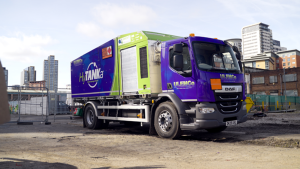
We can also highlight ULEMCo’s HyTANKa, a mobile hydrogen supply and refuelling vehicle designed to support the decarbonisation of construction and other off-grid sectors.
The platform enables flexible, autonomous refuelling of hydrogen equipment, addressing one of the construction sector’s biggest barriers to decarbonisation: having access to on-site refuelling infrastructure. HyTANKa is a fully compliant, road-legal vehicle, powered by hydrogen itself, that delivers a practical replacement for diesel bowsers.
Then there is GeoPura Hydrogen Power Units (HPUs), which is demonstrating how hydrogen power delivers clean, reliable energy across multiple sectors.
GeoPura’s HPUs replace diesel generators and supplement the grid, unlocking additional capacity and accelerating the delivery of major projects.
From powering large-scale events such as Latitude and the Isle of Wight festivals to film productions including Downton Abbey, GeoPura’s zero-emission technology is reducing carbon and improving air quality wherever dependable off-grid power is required – including major construction and long-term infrastructure projects.
Meanwhile, Fuel Cell Systems, based in Hungerford, Berkshire, is at the heart of the UK’s first hydrogen-powered freight corridor.
The company is delivering hydrogen refuelling infrastructure along the M4 between London and Bristol, supporting a government-funded project that will put 30 hydrogen HGVs on the road by summer 2026.
And finally, there is HiiROC, which has developed a breakthrough process called Thermal Plasma Electrolysis (TPE), producing low-carbon hydrogen and solid carbon without releasing CO2.
This modular, scalable technology is more energy-efficient than conventional electrolysis and can use waste industrial gases as feedstock. The result: clean hydrogen alongside a carbon co-product that can be used in tyres, inks, plastics, asphalt and concrete.
These are not abstract ‘someday’ examples. They’re operational or advancing rapidly. They create jobs, build UK capability and, crucially, prove hydrogen wins on uptime, payload, range, cold-weather performance, off-grid operation and system resilience.
Where we are still stuck
Despite the progress, members repeatedly tell us the same blockers remain – infrastructure gaps, policy uncertainty, first-mover cost premiums, skills bottlenecks, and inconsistent cross-departmental signals.
And so, over the last year, HEA has focused on converting that feedback into coordinated action.
With the Road Haulage Association (RHA) and Construction Plant-hire Association (CPA), the HEA is actively engaging with the government, urging a twin-track approach for hard-to-electrify applications (HGVs, coaches, specialist plant, emergency fleets, rail segments).
Our joint recommendations were clear. We wish to see progress on a national hydrogen refuelling roadmap, including 12–13 strategic stations on key corridors and back-to-base hubs to get fleets moving.
We suggested demand signals (targets) to crowd-in private investment and ensure security of supply, along with transitional cost-bridging mechanisms to close the fuel gap versus diesel while the market scales.
We also called for support for all viable hydrogen powertrains (including hydrogen ICE) under ZEV and related policies.
We cannot afford to plan on a single technology outcome for heavy vehicles across the land transport sector.
The UK requires a portfolio approach that protects productivity, hedges system risk, and avoids expensive grid upgrades in constrained locations.
Alongside this, we have recognised the inclusion of ammonia in the UK Hydrogen Strategy.
With organisations across energy, ports, maritime, and energy-intensive industries, we recently urged the government to explicitly integrate low-carbon ammonia into the revised Hydrogen Strategy.

Ammonia is a direct decarbonisation lever in existing industrial chains (chemicals, refrigeration, water treatment, fertilisers) and a pragmatic maritime fuel opportunity as shipowners consider investment in ammonia-capable vessels.
It’s also a storable, transportable energy carrier making it ideal for peaking power and moving renewable energy from surplus to demand centres.
Hydrogen’s value chain doesn’t end at the electrolyser. Carriers such as ammonia will be a vital part of the UK’s energy security and export proposition.
Moreover, a broad approach to supporting a range of low-carbon production pathways for hydrogen, as well as considering the important connection with hydrogen derivatives, will benefit the sector as a whole.
Convening the ecosystem
None of our work has impact if we do not keep the government at the table in discussions.
This year, our HEA Annual Conference returned to Westminster for its 20th year with the theme Invest, Innovate, Implement, helping to continue conversations with policymakers.
It was the first under my leadership and the strongest yet for government engagement with a keynote from the Minister of State for Industry and Net Zero, attendance by officials across DESNZ, HMT and DfT and the Department for Business & Trade on the exhibition floor.
The signal from industry was unequivocal – scale faster, invest smarter, give long-term certainty. Meanwhile, the response from the government was positive – more projects moving through HAR, a strategy refresh ahead.
But we must now match ambition with acceleration.
Our 2026 conference, planned for 9 July 2026, will keep that pressure constructively focused on delivery.
Listening harder
Ahead of this conference, we believe the UK hydrogen narrative needs more than anecdotes. It needs data.
That’s why we launched the State of the Hydrogen Nation survey in October – a sector-wide ‘health check’ on business confidence, skills, investment, policy clarity, barriers to growth and market outlook.
The results will underpin the HEA’s first State of the Hydrogen Nation report, publishing in early 2026, and our intention is to make this an annual benchmark – authoritative, independent, and useful to industry and policymakers.
Responses are currently being collated and will shape evidence-based recommendations to the government on what to fix, fund and fast-track.
This work will blend with that undertaken by our working groups, member roundtables and policy engagement over the last year, which shows there’s real alignment on the big picture:
- Hydrogen’s comparative advantage grows as duty cycles lengthen, loads get heavier, temperatures get colder, and the use-case goes off-grid or mission-critical (where uptime matters most).
- UK capability is real – from electrolysers to storage, powertrains, safety systems and balance-of-plant. The pipeline is rich.
- The economic case strengthens rapidly with scale and utilisation (for both stations and fleets). ‘Thinly spread’ will not deliver value; clustered deployment along freight corridors and back-to-base hubs will.
- Skills are pivotal. We need to upskill the existing workforce, attract new talent and build vocational routes – across engineering, operations, safety and maintenance – now, not later.
What we don’t yet have – consistently across the UK – are the bankable, ten-year signals that de-risk investment at pace, and an infrastructure plan that lets private capital get on with building.
Policy priorities for 2026
Based on member input and our policy work to date, HEA will continue to advocate for a practical, bankable framework focused on four outcomes.
The first is the infrastructure that you can finance. Our hydrogen refuelling roadmap needs to enable targeted, corridor-based and hub-based deployment with blended finance models, and our sector needs planning and clarity to compress timelines.
The second is the markets we can bank on. We need to move swiftly from allocation rounds to predictable pipelines and address the early fuel cost delta to unlock fleet commitments. From here, we can implement demand signals that build a secure domestic supply base and encourage long-term offtake.
Third is a full-value-chain mindset, something we have long championed at HEA thanks to our broadchurch membership. We need to be treating hydrogen and its carriers as a system and incentivise integrated projects where production, logistics, end-use and skills come together – especially in industrial clusters and along freight routes.
Finally, we should be pushing skills and safety at scale by funding rapid training pathways with industry-recognised standards. To do this, the government needs to back national centres of excellence for hydrogen safety, storage, and heavy-duty applications – so UK know-how becomes an export in its own right.
On top of all this, a tired debate persists for 2026 – batteries versus hydrogen. In practice, we need a range of solutions to support our energy transition.
Passenger cars, urban delivery vans and many depot-based fleets will electrify successfully.
But for high-utilisation heavy vehicles, specialist off-road machinery, emergency fleets and off-grid operations, hydrogen’s refuelling speed, range, payload and cold-weather resilience are decisive – and the system cost (grid reinforcement, downtime, lost payload) becomes the hidden variable. The UK must keep options open, backed by transparent total-system analysis.
What we’ve built together
I’m very proud of what the HEA team and our members have achieved in my first year as CEO.
We have elevated on-the-ground delivery through our UK Hydrogen Project Map and member showcases – evidence that resonates with policymakers – and convened cross-sector coalitions to keep heavy transport options open and to recognise ammonia’s role in a modern hydrogen strategy.
We have deepened our two-way dialogue with Government, bringing DESNZ, HMT, DfT and DBT into the same rooms as project developers, investors and technology providers and the State of the Hydrogen Nation survey is set to ground our recommendations in sector-wide evidence.
We are also growing the HEA community, bringing in new members across production, distribution, components, end-use and services; academia; and regional alliances – so our voice continues to reflect the full value chain.
By the time we publish the first State of the Hydrogen Nation report in early 2026, I hope to see a revised Hydrogen Strategy that aligns cross-departmental policy signals and helps us develop a confident, investable UK proposition that attracts private capital because the rules are clear, and the pipeline is visible.
Hydrogen is here – and growing. The question for 2026 is whether the UK chooses to match delivery with decisive policy and investment, so we lead not just in projects, but in markets, skills, and exports.
That’s the challenge I’m setting for my second year – and the invitation I extend to all of you.
We can do this. The ingredients are here, the projects are real, and the capability is domestic.
Please note, this article will also appear in the 24th edition of our quarterly publication.