The 5G-HUB project enables resilient 5G services through TN–NTN integration and seamless vertical handover.
The increasing dependence of modern societies on digital services and secure communications makes the need for resilient, ubiquitous network infrastructures – capable of guaranteeing service continuity even under extreme operational conditions – increasingly evident. In particular, mission-critical services intended for domains such as public safety, civil protection, emergency management, defence, and humanitarian operations require levels of reliability, availability, and quality of service that are significantly higher than those of traditional commercial communications. Within this scenario, the 5G-HUB project is positioned as a European initiative aimed at exploring and demonstrating new approaches to the integration of terrestrial and satellite networks, with the goal of enabling truly continuous and resilient 5G Mission-Critical (MCx) services.
What is the 5G-Hub project?
The 5G-HUB project is embedded in the broader framework of the European GOVSATCOM (Governmental Satellite Communications) strategy, which represents one of the fundamental pillars of the European Union’s space policy for ensuring secure, reliable, and sovereign governmental communications. GOVSATCOM was conceived to address the need to coordinate and federate existing and future European satellite resources, making them available to institutional users through centralised management mechanisms, common policies, and guaranteed service levels. In the long-term, this vision will be fully realised with the next-generation European satellite system IRIS² (Infrastructure for Resilience, Interconnectivity and Security by Satellite) – a multi-orbit constellation including Low-Earth Orbit (LEO), Medium-Earth Orbit (MEO), and Geostationary Orbit (GEO) satellites – which will form the backbone of European secure communications over the coming decade.
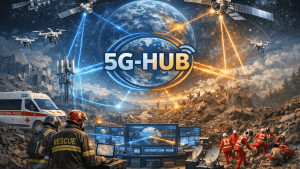
Within this strategic context, 5G-HUB acts as an enabling project, focusing on the integration of 5G Terrestrial Networks (TN) and 5G Non-Terrestrial Networks (NTN). The underlying rationale is that no single access technology can, by itself, satisfy all the requirements of MCx services across every operational scenario. Terrestrial networks provide high capacity, low latency, and wide availability in densely populated areas, but they are vulnerable to infrastructure failures, congestion, or physical destruction during natural disasters or crisis situations (Fig. 1). Satellite networks, by contrast, ensure global coverage, rapid deployment, and independence from local infrastructure, but they face intrinsic limitations in terms of latency, capacity, and cost. The synergistic integration of TN and NTN enables the strengths of both domains to be combined to achieve a robust system.
The partners of the 5G-HUB project are: Università degli Studi di Siena (project coordinator), Centre Tecologic de Telecomunicacions de Catalunya, Hisdesat Servicios Estrategicos, Hispasat, Indra Sistemas, Indra Espacio, Onesource, Telecom Italia Spa, Fundacio Pro-Activa Open Arms, and Associazione della Croce Rossa Italiana.
The project is financed by EUSPA, the EU Agency for the Space Programme.
An integrated approach
The distinctive contribution of the 5G-HUB project lies precisely in the realisation of an integrated TN–NTN system capable of supporting service continuity for mission-critical applications through vertical handover mechanisms that are transparent to end users and applications. Vertical handover refers to the ability to transfer an active communication session from one access technology to another – for example, from a terrestrial 5G network to a satellite-based 5G network – without perceptible service interruption. This requirement is crucial for applications such as emergency communications, MCx services, telemedicine, operational coordination, and situational awareness, where even short disruptions may have serious consequences.
From an architectural perspective, 5G-HUB adopts a systemic approach that combines multiple innovative elements. A central role is played by the GOVSATCOM-HUB (G-HUB), conceived as a satellite resource broker capable of federating capacity from multiple satellite operators and dynamically allocating it according to the needs of authorised users. The 5G-HUB project extends this paradigm by including the terrestrial 5G ecosystem, thereby creating a truly integrated environment where resources can be managed in a coordinated manner.
To enable service continuity across TN and NTN, the project introduces an innovative functional element, commonly referred to as the Smart Gateway, which operates both on the user side and on the emergency management side. This component is responsible for monitoring the connectivity conditions of the user terminal and managing traffic redirection during vertical handover phases. A key aspect of this solution is its ability to preserve user IP addresses and application sessions during the transition between networks, avoiding the need for reconnections. In this way, service continuity is ensured even in the presence of radical changes in the underlying radio access technology.
Innovation in 5G-HUB is not limited to the access layer but also extends to network management. The project extensively leverages the principles of network softwarisation, virtualisation, and cloud-native design, in line with the evolution of 3GPP standards for 5G and beyond. Network functions, in both the terrestrial and satellite domains, are conceived as virtualised and disaggregated components that can be dynamically orchestrated according to service requirements. This approach makes it possible to activate NTN resources only when needed, reducing operational costs and improving overall system efficiency – an aspect of particular relevance in the GOVSATCOM context, where satellite resources are valuable and must be carefully managed.
Another important element is the development of integrated TN–NTN user terminals, capable of operating on both terrestrial 5G networks and satellite links across different frequency bands (i.e., Ku and X). Such terminals represent a fundamental technological prerequisite for enabling vertical handover and making integration between the two domains truly transparent. Within the 5G-HUB project, these terminals are envisioned as flexible platforms, based on software-defined solutions, capable of adapting to a wide range of operational scenarios.
From an application perspective, 5G-HUB is strongly oriented toward the practical validation of the proposed solutions through demonstrations (demos) in realistic scenarios (Figs. 1 and 2). The project’s demos are designed to reflect typical operational situations faced by governmental and humanitarian services, such as large-scale emergency management (e.g., an earthquake scenario) or medical support at sea. These demonstrations therefore provide not only technical value, but also strong conceptual validation, showing how the GOVSATCOM approach can translate into tangible benefits for institutional users.

In the context of the IRIS² system, the relevance of the 5G-HUB project becomes even more strategic. This future European LEO constellation is intended to provide secure, resilient, and high-performance communications to support both governmental users and strategic commercial applications. However, the true value of IRIS² lies not only in the space infrastructure itself, but also in its effective integration with terrestrial networks and service management systems. 5G-HUB anticipates and experiments precisely with these integration mechanisms, providing valuable insights into how European LEO resources can be optimally exploited within a 5G-based ecosystem.
The networks of the future
Looking ahead, the results of the 5G-HUB project contribute not only to technological development but also to the definition of best practices, architectural models, and potential inputs to future standardisation activities. The lessons learned within the project may therefore influence future 3GPP Releases to further evolve the TN-NTN integration.
In conclusion, the 5G-HUB project can be regarded as a technological and conceptual bridge between terrestrial 5G networks and next-generation governmental satellite communications. Through innovation in TN–NTN integration, support for vertical handover, and the demonstration of service continuity for mission-critical applications, 5G-HUB makes a significant contribution to the creation of a European ecosystem of secure, resilient, and interoperable communications, fully aligned with the GOVSATCOM vision and the strategic ambitions of IRIS².
Acknowledgements

This publication is supported by the 5G-HUB research project, which has received funding from the European Union’s Horizon Europe research and innovation programme under grant agreement No. 101180143. Views and opinions expressed are those of the authors only and do not necessarily reflect those of the EU or EUSPA.
Please Note: This is a Commercial Profile

This work is licensed under Creative Commons Attribution-NonCommercial-NoDerivatives 4.0 International.
Please note, this article will also appear in the 25th edition of our quarterly publication.