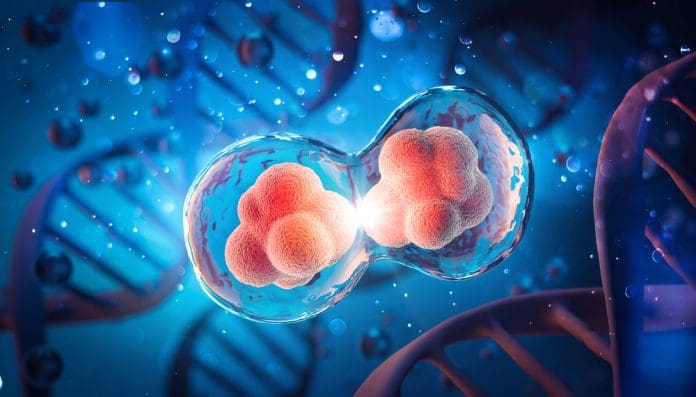
For decades, biologists have wrestled with a fundamental mystery of life: how cells manage to copy their DNA during cell division without spinning into chaos.
Every day, trillions of cells in the human body divide, each one duplicating its entire genetic blueprint with astonishing precision. If this process ran unchecked, cells would quickly exhaust their resources, accumulate errors, and trigger disease or death.
Now, researchers believe they have identified a crucial built-in safety mechanism that keeps DNA replication – and therefore cell division – firmly under control.
Why DNA replication needs strict timing
Cell division is not a single action but a tightly choreographed sequence that unfolds over roughly 24 hours.
Before DNA copying even begins, cells must manufacture all the proteins and molecular components required for replication and stockpile them in advance. Launch replication too early, too late, or too often, and the system collapses.
Without precise regulation, cells would start copying DNA repeatedly and wastefully, a scenario molecular biologists describe as ‘replication catastrophe.’
This failure mode stresses cells, damages the genome, and can ultimately halt cell division altogether – or push cells toward cancerous behaviour.
The search for a natural limiter
Over the last few decades, mounting evidence suggested that cells must possess a limiting factor — a molecular brake — that prevents uncontrolled DNA replication during cell division. The challenge was identifying what that brake actually was.
The breakthrough came from researchers studying how DNA strands are completed during replication. One side of the DNA molecule is synthesised in many short segments known as Okazaki fragments.
These fragments must be carefully processed and stitched together to form a continuous strand, a step essential for successful cell division.
This finishing process depends on a ring-shaped protein called PCNA, which acts like a clamp, holding key replication proteins in place and coordinating their activity.
PAF15: A built-in brake for cell division
The researchers discovered that this stitching phase has an intrinsic limit in healthy cells, controlled by a protein called PAF15. Rather than accelerating replication, PAF15 does the opposite: it restricts how much DNA processing can occur.
Cells produce only a limited supply of PAF15. Once that supply is used, DNA replication must stop. In effect, PAF15 acts as a molecular countdown timer that ensures replication proceeds only within safe boundaries, protecting genome integrity and preventing replication catastrophe.
Notably, PAF15 is found only in higher organisms, including humans, suggesting it is a relatively recent evolutionary adaptation to manage the complexity of advanced cell division.
When the system breaks down in cancer
In cancer cells, this finely balanced system looks very different. Tumours thrive by pushing cell division into overdrive, copying DNA faster and more aggressively to fuel uncontrolled growth.
To support this, cancer cells often produce much higher levels of PAF15, allowing replication to continue beyond normal limits.
This adaptation may help tumours grow, but it also exposes a weakness. By targeting the replication control system involving PAF15, scientists believe it may be possible to destabilise cancer cells while sparing healthy ones selectively.
New possibilities for cancer treatment
Current cancer therapies often aim to slow cell division, but they rarely eliminate cancer cells entirely. The discovery of PAF15’s role in regulating cell division opens the door to a different strategy: deliberately disrupting DNA replication so severely that cancer cells cannot survive.
Future research will focus on studying this mechanism in cells taken directly from cancer patients. By understanding how tumour cells depend on altered replication controls, scientists hope to design treatments that exploit this vulnerability.
A fundamental discovery with far-reaching impact
At its core, this finding answers a question that has puzzled scientists for nearly 60 years: why doesn’t DNA replication spiral out of control every time a cell divides?
By revealing how cell division is naturally limited at the molecular level, the research points toward promising new approaches in the fight against cancer.