Researchers from Kiel University, Helmholtz-Zentrum Dresden-Rossendorf and Rostock University are developing quantum simulations that help to predict the properties of warm dense matter and inertial fusion plasmas.
Fusion is the process of fusing two light atomic nuclei into a heavier one, producing tremendous amounts of energy that powers the heat and radiation of stars such as our Sun. For decades, scientists have tried to achieve fusion in laboratories on Earth using various concepts. In December 2022, for the first time, net energy gain was achieved in a fusion experiment at the National Ignition Facility (NIF) in the US,¹ raising enormous hopes to meet the dramatic increase in energy consumption of mankind that is expected for the coming decades. Fusion would be a secure and clean energy source, complementing solar and wind energy, and the ambitious goal of a fusion power plant triggered huge government investment as well as private capital allocation in many countries over recent years.

Inertial confinement (or laser) fusion (ICF), which was used at the NIF, facilitates fusion by compressing a mix of deuterium and tritium with high-power lasers to enormous pressures (more than 100 times the density of solid bodies). The fuel starts as a cryogenic solid, becomes liquid, gaseous and reaches a hot, dense plasma state where fusion reactions set in, rapidly producing huge amounts of energy within a few picoseconds (a millionth of a millionth of one second).
The challenge of simulating dense quantum plasmas and ICF
While theory and simulation of high-temperature plasmas, as they are relevant, e.g., for the description of magnetic fusion applications, have achieved a nearly comprehensive understanding of these systems, the situation is very different in inertial confinement fusion plasmas; here, reliable simulations must take into account simultaneously a plethora of effects such as laser-matter interaction, shock propagation, and nuclear reactions. During the initial stages of the compression path, both the fusion fuel and the surrounding ablator have to traverse the warm dense matter (WDM) regime² in a controlled way, i.e., without seeding strong inhomogeneities that lead to any instability. WDM, which combines properties from the well-known solid, liquid and plasma phases of matter without being fully equal to any of them, is very remarkable in its own right and naturally occurs in a great variety of celestial objects,³ including giant planet interiors, white dwarf atmospheres, and the outer layer of neutron stars. From a theoretical perspective, its rigorous theoretical description is extremely challenging3,4 as it must capture holistically the intricate interplay of effects such as Coulomb coupling between the charged electrons and nuclei, quantum delocalisation and degeneracy effects, strong thermal excitations, and often also partial ionisation. Nevertheless, the pressing need to understand these extreme states of matter has driven the development of a diverse arsenal of methods, including (see Vorberger, J. et al.² for a comprehensive overview):
- Chemical models
- Radiation hydrodynamics
- Quantum hydrodynamics
- Semiclassical and wavepacket molecular dynamics (MD)
- Average atom models
- Density functional theory MD (DFT-MD)³, see Fig. 2
- Time-dependent DFT
- Fixed Node Quantum Monte Carlo (RPIMC) simulations
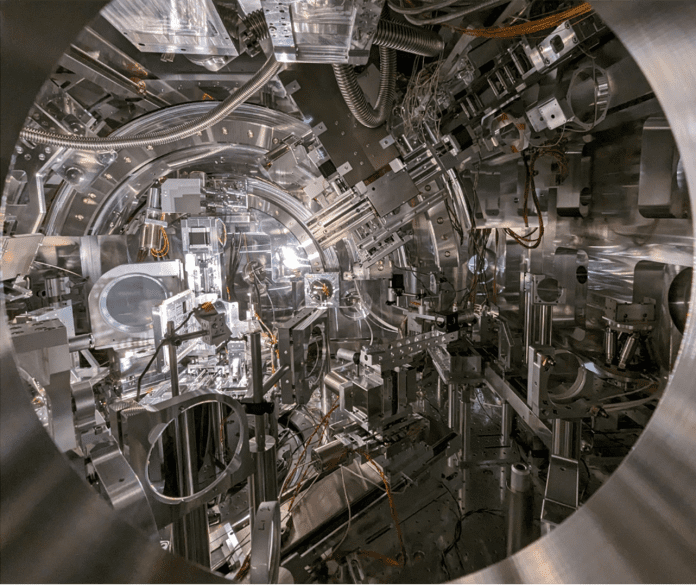
However, these simulations rely on a variety of assumptions and approximations and, therefore, have limited predictive capability. At the same time, there has been dramatic progress in experiments creating and diagnosing WDM in laboratories around the world (e.g., LCLS, NIF, Omega and the Sandia Z-machine in the USA; Laser Megajoule, European XFEL and GSI/FAIR in Europe; SACLA and Shengguang-II in East Asia), which, in turn, necessitates accurate theory and simulations. An important example is the High Energy Density (HED) instrument at the European XFEL — arguably the most advanced x-ray source in the world — in Schenefeld, Germany. Here, extreme states of matter can be generated using two state-of-the-art optical laser systems (DiPOLE and ReLaX), operated by the Helmholtz International Beamline for Extreme Fields (HIBEF, see Fig. 1). In combination with the XFEL, the set-up allows for high-repetition pump-probe experiments that facilitate measurements and diagnostics with unprecedented accuracy, providing unique insights into the behaviour of warm dense matter and beyond. The high level of precision that can be reached by averaging over potentially thousands of shots in turn poses similarly strong demands to the corresponding theoretical description, which has sparked new developments in first principles simulations — simulations that are directly based on the fundamental equations of quantum theory — and novel model-free methodologies for the interpretation of experiments.⁵
Recent breakthroughs in first principles simulations
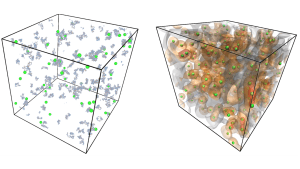
The dearth of reliable theoretical results for warm dense quantum plasmas has changed dramatically due to important advances in first principles simulations achieved by the authors and their co-workers.2,6 Specifically, the list of first principles methods includes:
- Fermionic Path Integral Monte Carlo simulations⁷ (FPIMC, see Fig. 2) for thermodynamic and spectral properties
- Configuration Path integral Monte Carlo (CPIMC)
- Implementation of advanced (semi-local and hybrid) and explicitly thermal exchange-correlation functionals for DFT⁸
- Implementation of high-temperature and stochastic DFT methods⁹
- Improved quantum kinetic equations10
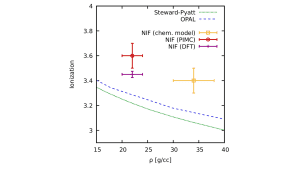
As a case in point for the impact of these developments, we mention a recent X-ray scattering experiment with strongly compressed beryllium at the NIF11: the original analysis based on a traditional chemical model yielded a mass density of ⍴=34±4 g/cc, whereas our new first principles FPIMC and DFT-MD simulations independently and consistently give a substantially lower value of ⍴=22±2g/cc,⁷ see Fig. 3. These efforts clearly highlight the virtuous cycle between state-of-the-art experiments and simulations that acts as a powerful driver for new developments on both. The tremendous value of first-principles calculations as a benchmark for other models is further illustrated in Fig. 4, where we show the ionisation degree of carbon — a key ablator material in ICF experiments — as a function of mass density in the high temperature regime.⁸ Evidently, existing models and data tables diverge towards strong compression, making reliable DFT/PIMC results non-optional to establish a proper baseline.
At the same time, it is important to acknowledge remaining key limitations: these novel, highly accurate methods are extremely computationally costly and, consequently, are limited to small length and short time scales; cutting-edge results for the nanophysics of WDM and related extreme states of matter are thus not sufficient to comprehensively describe the full temporal and spatial evolution of an ICF experiment. In contrast, some of the simpler and computationally less costly methods that were listed above can deal with the experimental scales, but they are missing the required reliability and accuracy.
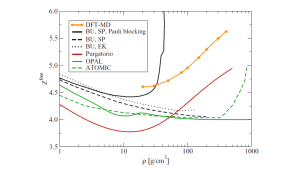
Bethkenhagen et al, Phys. Rev. Res. 2, 023260 (2020)⁸.
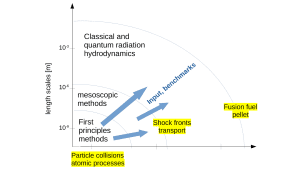
The proposed solution (Fig. 5)
A possible solution to this conundrum is given by a smart combination of a variety of different simulations, as was first proposed in⁶ and is being developed further by us. The starting point is given by equilibrium quantum Monte Carlo simulations, the most accurate method available. It can be used as an unassailable benchmark and to improve other first principles methods, most notably density functional theory. The latter constitutes the most successful approach for large-scale calculations of a wealth of material properties, including equation of state, heat conductivity and opacity. These properties, in turn, enter as input for simpler methods (see Fig. 5), leading to an improved description of ICF applications on the relevant time and length scales. For the simulation of nonequilibrium processes, on the other hand, the role of the first principles starting point is taken over by non-equilibrium quantum kinetic theory⁹. This concept requires the development in parallel of each of the complementary simulation tools and should, ultimately, allow for predictive ICF simulations in the near future.
References
- Abu-Shawareb, H. et al. (2024), Achievement of Target Gain Larger than Unity in an Inertial Fusion Experiment, Phys. Rev. Lett. 132, 065102
- Vorberger, J. et al. (2026), Roadmap for warm dense matter physics, Plasma Phys. Control. Fusion, arXiv:2505.02494
- Graziani, F. et al. (Eds.) (2014), Frontiers and Challenges in Warm Dense Matter, Springer
- Bonitz, M. et al. (2020), Ab initio simulations of warm dense matter, Phys. Plasmas 27, 042710
- Dornheim, T. et al. (2022), Accurate temperature diagnostics for matter under extreme conditions, Nature Commun. 13, 7911
- Bonitz, M. et al. (2024), First principles simulations of dense hydrogen, Phys. Plasmas 31, 110501
- Dornheim, T. et al. (2025), Unraveling electronic correlations in warm dense quantum plasmas, Nature Commun. 16, 5103
- Bethkenhagen, M. et al. (2020), Carbon ionization at gigabar pressures: An ab initio perspective on astrophysical high-density plasmas, Phys. Rev. Res.², 023260
- Fabian, M.D. et al. (2019), Stochastic density functional theory, WIREs Computational Molecular Science 9, e1412
- Bonitz, M. (2016), Quantum Kinetic Theory, 2nd ed. Springer
- Döppner, T. et al. (2023), Observing the onset of pressure-driven K-shell delocalization, Nature 618, 270-275
Please Note: This is a Commercial Profile

This work is licensed under Creative Commons Attribution-NonCommercial-NoDerivatives 4.0 International.
Please note, this article will also appear in the 25th edition of our quarterly publication.