6G Flagship is leading innovative research and collaborative testing for next-generation 6G technologies, fostering partnerships between academia and industry to drive advancements in wireless communication.
Finland is home to just over five million people, yet it leads one of the world’s most ambitious 6G programmes. 6G Flagship, the first dedicated 6G research programme anywhere, has established the University of Oulu as a reference point for anyone asking what 6G could be. The programme sits within Finland’s national Flagship framework and is supported by the Research Council of Finland, aligning long-term research with the country’s innovation policy.
Finland inside SNS JU
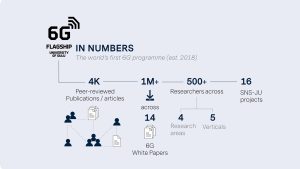
“When people ask how the University of Oulu and 6G Flagship connect to Europe’s 6G work, I point them to the Smart Networks and Services Joint Undertaking,” says Professor Ari Pouttu, Director of 6G Flagship. “SNS JU is where Europe brings the strands together. Through 6G Flagship, our teams at the University of Oulu are right in the middle of it. We help drive the system view in Hexa-X-II, and we contribute to shared experimentation through 6G-SANDBOX, 6G-XR, and Sunrise-6G. Beyond those, our researchers are active across the portfolio. On our side alone, the University of Oulu is already listed in 16 SNS JU projects, from AI-native radio and terahertz to edge programmability and trustworthy design. The point is to move ideas out of papers and into shared European platforms that industry can use.”
Finland’s ecosystem
When companies in Finland want to see how products behave in future networks, they can turn to 6G Flagship. The facilities complement vendor testbeds by providing a neutral academic setting where SMEs and large companies can trial ideas with researchers.
For smaller firms, this type of access can be decisive. Startups use the test network to observe how ideas behave in conditions close to real deployments, refine designs, and understand how emerging standards will affect their business. “When you are a start-up, you cannot afford to build your own test environment,” says Ari Pouttu. “We make it possible to test in realistic conditions and learn quickly, which can be the difference between an idea surviving or failing.”
Larger companies collaborate with researchers on challenges that demand high performance and reliability. “The role of our testbeds is to give both big and small players the chance to experiment side by side with us,” Pouttu notes. “That flow between research and industry gives Finland agility. We don’t wait for commercial 6G networks before testing solutions. And we move what we discover directly into European projects.”

Strategic research areas
Behind 6G Flagship’s public image of test networks and European projects lies the daily work of more than 500 researchers. The programme is organised around four strategic research areas that cover the entire chain: from the physics of wireless signals, to the hardware that makes them possible, to the intelligence that drives networks, and to the services that touch people’s lives.
The wireless connectivity research area, led by Professor Markku Juntti, is where the fundamental theory is developed and used to create the future wireless access and networking solutions with transceiver algorithms and system optimisation. It is a joint effort of multiple research groups with diverse backgrounds, skill sets, and methodological expertise areas. The goal is to enable connectivity with new 6G use cases such as networked artificial intelligence (AI), integrated sensing and communications (ISAC), and ubiquitous connectivity with more classical immersive communications and others.
“Our goal is to enable sustainable and resilient connectivity with networks enabling digital twinning of the physical environments and services,” Juntti explains. This work underpins Europe’s vision of networks that can serve communication and sensing, allowing real-time awareness of the environment.
Under Professor Aarno Pärssinen, device and circuit technology translate key concepts into working hardware. The group builds on more than a century of Finnish expertise in radio engineering. They research and design circuits and subsystems that can operate at frequencies beyond today’s limits. Their RF and EMC laboratories in Oulu provide testing up to 330 GHz. Pärssinen describes the trajectory: “Research should move gradually towards more complex subsystems to be tested as part of larger 6G proofs of concept.”
Associate Professor Miguel Bordallo López leads distributed intelligence. His work sits at the intersection of computer vision, artificial intelligence and wireless systems, fusing multimodal data to enable decisions at the network’s edge. For healthcare, transport and other critical sectors, this means embedding intelligence near users and sensors. “We are working to ensure that intelligence is not centralised but distributed and heterogeneous”, Bordallo López notes, “because many applications will not tolerate delay or dependence on distant servers.”
Finally, human-centric wireless services are co-ordinated by Professor Ari Pouttu himself, alongside his Director duties. Here, the focus is on the societal impact of 6G and integration with Europe’s policy goals. The test environments in Oulu and beyond allow industries to see how 6G technologies work in practice, whether in energy grids, factories or hospitals. “6G will influence how value is created across the economy,” Pouttu argues, “and we have to consider business, technology, economics and sustainability together, with users as active participants.”
The research areas show the scale of 6G Flagship. The programme spans the physics of signals, the design of devices, the distribution of intelligence, and the integration of services into daily life. Each strand feeds the others, making 6G research more of a living system than a pipeline. The next step is to test these ideas in practice – and that is the role of the 6G Test Centre.
The 6G Test Centre
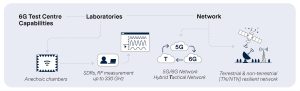
The 6G Test Centre (6GTC) in Oulu is where research concepts meet real-world conditions. It combines advanced 5G/6G commercial and tactical networks in a secure hybrid-network environment, state-of-the-art laboratories, and field testing in harsh environments on a 5G/6G-ready network. These capabilities stretch from city streets to Arctic terrain, giving researchers a spectrum of settings to test new technologies.
Inside its facilities, experiments can run at frequencies up to 330 GHz using anechoic chambers, software-defined radios, and precision measurement tools. Beyond the lab, testing extends into the OuluZone automotive and UxS test tracks, the Pyhäsalmi mining area for underground trials, and northern Finland’s harsh climate for Arctic experiments in Sodankylä, including the Sodankylä Geophysical Observatory and the Finnish Meteorological Institute (FMI) Arctic Space Centre. All of these sites are connected through a resilient 5G/6G-ready network. This combination creates a unique environment for testing technologies before commercial deployment.
The 6G Test Centre opens its doors to companies of all sizes, from start-ups to multinationals, giving them access to equipment and expertise that would otherwise be out of reach. Director Hannu Nikurautio explains: “Our hybrid 5G/6G and tactical test network, including terrestrial and non-terrestrial (TN/NTN) capabilities, together with lab facilities and environmental field-testing capabilities, form the number-one academic environment for next-generation wireless technologies in the world. You can trial a component, a subsystem or an entire network in conditions that mirror real life. That is why companies and public authorities come here.”
He recalls the step into NATO’s orbit: “When Finland joined the Alliance in 2023, the Ministry of Defence nominated Oulu and VTT’s Otaniemi campus as hosts for NATO’s Defence Innovation Accelerator for the North Atlantic (DIANA). NATO gave its approval the following year. This made the 6G Test Centre one of only two DIANA facilities in Finland, and the only one in Europe dedicated to next-generation advanced wireless networks.”
For Nikurautio, the consequence is direct: “Being part of NATO DIANA means our doors are open to innovators from across the Alliance. Start-ups can bring their dual-use products and solution ideas here for testing, evaluation, verification, and validation (TEVV) in a full-scale hybrid network with world-class, rare radio-frequency measurement equipment and state-of-the-art facilities. We can support both civilian and defence needs in the same environment.”
He emphasises the dual-use role: “Most European testbeds funded focus only on civilian applications. Here, we are structured from the beginning to serve both civilian and defence purposes. It is a secure sandbox where resilience can be tested in practice: against Arctic cold, underground conditions, or deliberate interference. That makes us unique in Europe.”
Resilience as a design principle
“A few years ago, we still believed networks could be designed on a best-effort basis,” Ari Pouttu reflects. “That era has ended. Climate change is already producing floods, fires and storms that leave whole regions cut off. Hybrid threats are growing, too. In Ukraine, mobile networks are being bombarded. In Finland, GPS jamming has disrupted 5G in the east. And across Europe, cyber-attacks on infrastructure are rising. If networks are to serve society, they must withstand shocks like these. That means resilience, not just reliability.”
Pouttu makes careful distinctions. “Reliability means a service works 99% of the time. Robustness means resisting known stresses. Resilience goes further: it adapts to the unknown, reroutes around failures and recovers quickly from disruption. We have been naïve in designing systems as if no adversary would attack them. Resilience must be designed in, not bolted on afterwards.”

That requirement changes the paradigm for 6G research. 6G Flagship is now investing in architectures that use mesh networking, distributed intelligence and local energy supply, so that no single point of failure can collapse a system. “If the grid fails, you should still be able to power base stations from local renewables,” Pouttu explains. “If one network path is jammed, you should be able to reroute through another. AI has to be part of this, detecting new threats and learning how to adapt on the fly.”
The stakes are high because communications no longer stand alone. “Power grids, healthcare, finance and transport all depend on them,” Pouttu notes. “If the network fails, the rest will follow. These cascading effects are why resilience has to be treated as part of societal sustainability. It is as vital to Europe’s security as the green transition.”
Institutions are starting to respond. The SNS JU has listed resilience among its core priorities, and 3GPP has opened discussion on how to include it in standards. But Pouttu insists that research alone is not enough. “Standardisation and regulation have not paid sufficient attention,” he warns. “Every euro invested in resilience brings four in return, according to the EU and the World Bank. The business case is there. What we need now is the political will to make resilience a requirement, not an afterthought.”
This agenda is being drawn together in the Resilience White Paper, which is now in preparation at 6G Flagship and will be launched at the 6G Resilience Summit in Oulu this November. For Pouttu, the conclusion is clear: “Digital sovereignty depends less on raw speed than on endurance. If Europe wants networks it can trust, resilience has to be at its core.”
Please note, this article will also appear in the 24th edition of our quarterly publication.