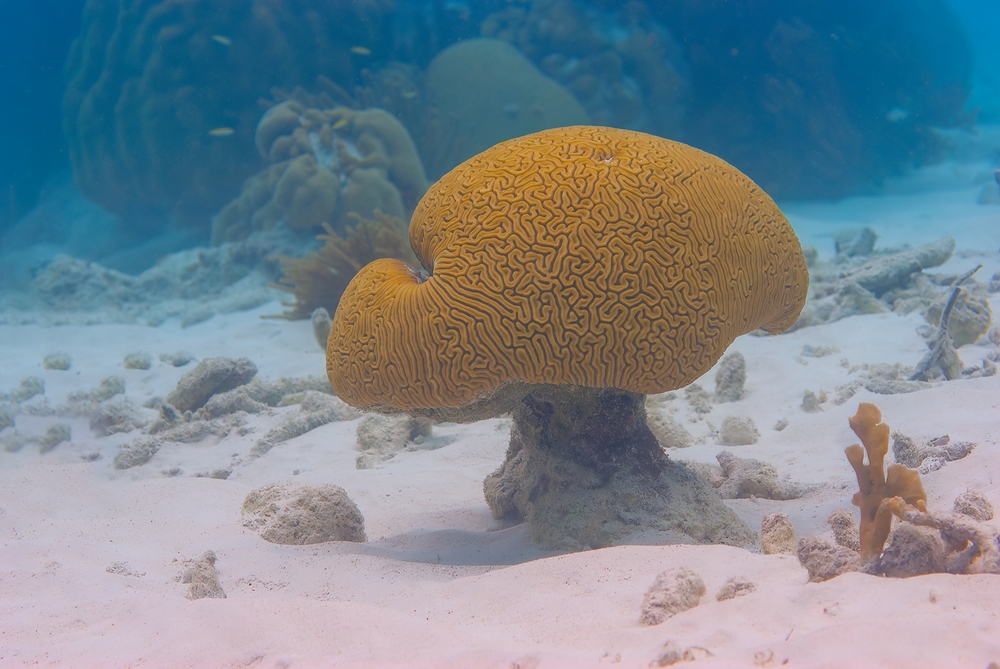
Researchers have found that brain coral in the Alcatrazes Archipelago produces around 170 tonnes of calcium carbonate annually, representing the retention of approximately 20 tonnes of carbon in mineral form.
The amount of carbon that brain coral produces and retains is equivalent to the carbon emissions from burning 324,000 litres of gasoline.
The authors analysed specimens of brain coral that have a skeleton composed mainly of calcium carbonate (CaCO3).
Using computed tomography images, the researchers calculated the annual growth rate of the colonies. They then estimated the production of 170 tonnes of CaCO3 per year.
How calcium carbonate contributes to greenhouse gas emissions
Calcium carbonate is composed of the elements calcium, oxygen, and carbon. The latter is also found bound to oxygen, forming carbon dioxide (CO2), which contributes to the greenhouse effect when released into the atmosphere as a result of the burning of fossil fuels.
Luiz de Souza Oliveira, first author of the study, explained: “We wanted to understand the growth of brain coral, so we did CT scans, in which it’s possible to observe the so-called annual growth bands.
“With this data, accumulated between 2018 and 2023, it was possible to estimate the production of calcium carbonate and, consequently, how much carbon they store and prevent from being released into the atmosphere each year.”
Tropical coral reefs, such as those in Abrolhos and Fernando de Noronha, have similar calcium carbonate production rates to those found in the area studied by the authors. However, it is not yet known why the corals in Alcatrazes do not accumulate to form reefs around the islands.
Is brain coral a carbon source or sink?
The study reveals that carbon sequestration may be another important ecosystem service provided by the Alcatrazes Archipelago brain coral. The most well-known is the protection of species, many of which are valuable for fishing.
Calculating the carbon captured in Alcatrazes is a first step toward understanding the role of subtropical coral reefs in the global carbon balance. Tropical corals, which are more exposed to light and warmer waters, can emit more carbon than they absorb due to the high respiration rate of the organisms living there.
However, the fact that they do not form large reefs and that their rocky portions are largely covered by macroalgae that absorb CO₂ through photosynthesis may cause subtropical environments, such as Alcatrazes, to be greenhouse gas sinks, absorbing more carbon than they emit.
Additionally, corals store carbon in a mineralised form that can last for centuries or millennia. This contrasts with the organic carbon generated by photosynthesis, which is quickly reintegrated into the atmosphere through the respiration of living beings and the decomposition of organic matter.
Large quantities of calcium carbonate on the main island of Alcatrazes
The work of the research group also shows that, in addition to brain corals, calcium carbonate is present in large quantities in the sediments of the main island of Alcatrazes.
The residue from the breakdown of both coral skeletons and the structures of other organisms, such as mollusc shells, is deposited on the seabed and can remain there for centuries or even millennia.
“Society tends to value an area like Alcatrazes mostly for what it’s protecting from fishing. However, this environment may be providing another essential service in a context where tons of carbon are emitted every day through the burning of fossil fuels,” concluded Guilherme Henrique Pereira Filho, coordinator of the Marine Ecology and Conservation Laboratory (LABECMar) at IMar-UNIFESP.