CERN’s trailblazing plasma wakefield experiment, AWAKE, has begun its upgrade one year ahead of the rest of CERN’s accelerator complex.
The AWAKE accelerator, which explores how to make particle accelerators more compact, has become the first facility to pause operations for CERN’s third long shutdown (LS3).
While most of CERN’s accelerator complex will enter LS3 in mid-2026, AWAKE ended operations on 1 June to begin a series of significant improvements.
Unique properties of the AWAKE accelerator
Existing accelerators, such as the Large Hadron Collider, use radio-frequency fields inside metallic chambers to accelerate charged particles. Plasma – a state of matter in which some atoms are freed of their electrons – could allow higher energies to be achieved over shorter distances.
AWAKE’s acceleration technique uses a proton beam from CERN’s Super Proton Synchrotron (SPS) to create crests and troughs in a plasma’s electric field, which can then be used to accelerate particles such as electrons.
These “wakefields” can be compared to a speedboat displacing water as it travels, explained project leader Edda Gschwendtner: “This boat – the proton beam – drives wakefields behind it, electrons are injected, which surf on the waves and get accelerated. The higher the amplitude of the wakefields, the higher the energy of the electrons.”
Accelerating high-energy electrons
During its initial run from 2016-2018, the AWAKE accelerator became the first experiment in the world to demonstrate that electrons could be accelerated to multi-GeV energy levels in a wakefield driven by protons, rather than electrons or a laser.
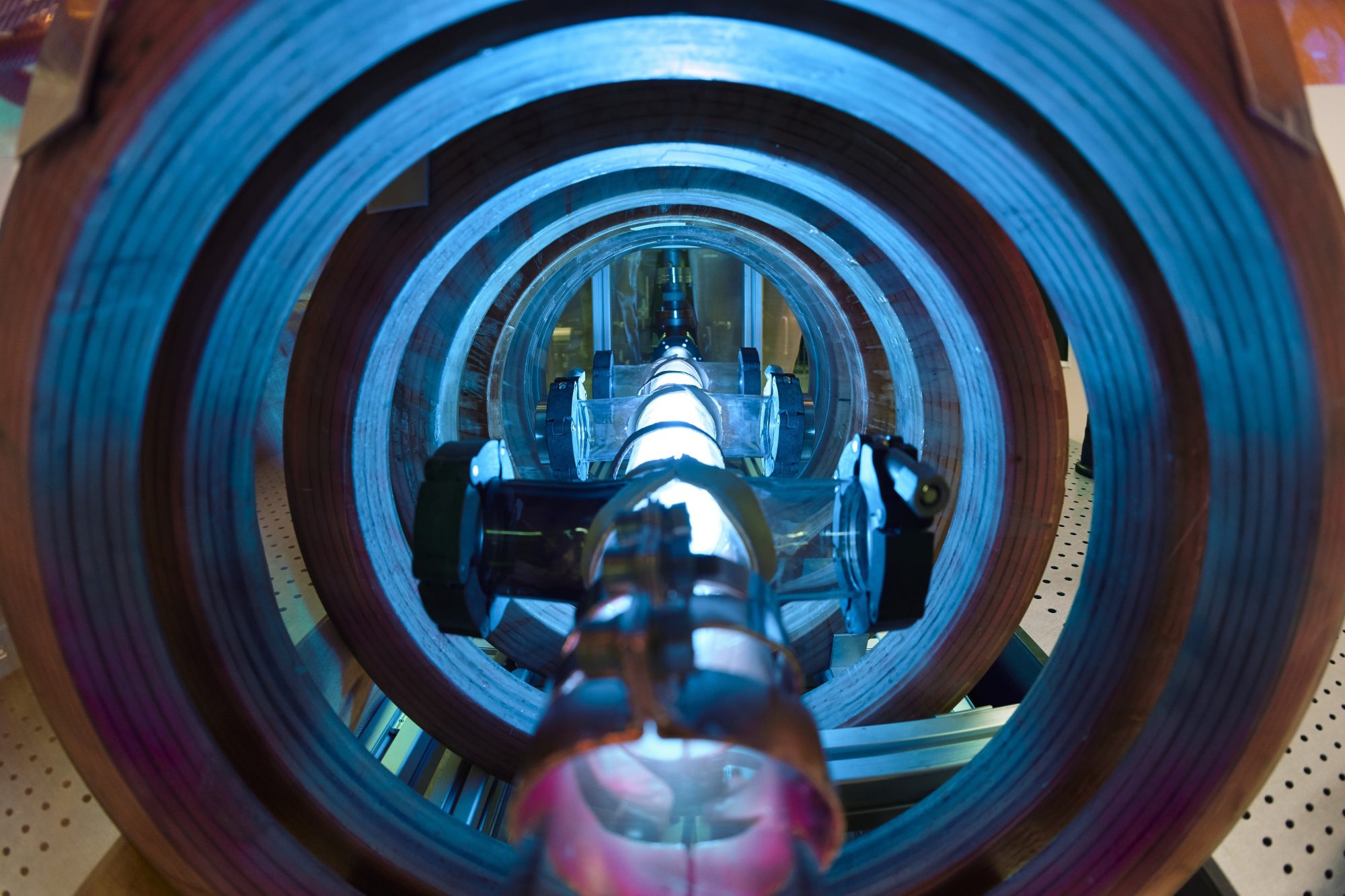
The first phase of its second run, which began in 2021 and ended on 1 June this year, showed how proton bunches drive and maintain high-amplitude wakefields over the entire 10-metre-long plasma medium.
Gschwendtner stated: “When the proton beam enters the plasma, it starts to self-modulate, meaning it produces small bunches that resonantly drive strong wakefields”.
Researchers now want to show that the quality of the electron beam can be controlled while the electrons are accelerated to a high energy, and that this process is scalable.
To facilitate this, the AWAKE accelerator needs to be upgraded, including through the installation of a new electron beam system and an additional plasma source.
The first plasma source will act as the self-modulator of the proton beam, and the second will accelerate externally injected electrons in the proton-driven plasma wakefields to 4-10 GeV over 10 metres.
Protection measures for radioactive materials
Increasing the size of the AWAKE accelerator to incorporate these changes is challenging, as it is located upstream of a chamber previously used by the CERN Neutrinos to Gran Sasso (CNGS) experiment.
CNGS involved directing an SPS proton beam onto a graphite target to produce a neutrino beam that was sent towards the Gran Sasso laboratory in Italy.
This process made the target and its shielding material highly radioactive, so their dismantling and removal require dedicated protection measures. The complex process is now underway to make room for the expanded AWAKE experiment, and a new building to house and treat the dismantled CNGS material has already been constructed.
When will the AWAKE accelerator upgrades be completed?
To spread the demands on CERN’s workforce, the dismantling and removal process is scheduled to be largely completed before other experiments enter LS3 in July 2026.
The improved version of AWAKE will then be constructed before the start of the SPS proton run in 2029, when tests of the new setup will commence.
AWAKE’s goal, to accelerate particles to far higher energies over a far shorter distance, will then be one step closer to realisation.