Cleaning up PFAS pollution has long challenged environmental engineers, but a solution may be emerging from an unexpected field.
Instead of relying on filters or chemical additives, researchers are turning to particle accelerators and the destructive power of an electron beam.
By harnessing high-energy electrons, scientists believe they can dismantle some of the most stubborn synthetic pollutants, offering a fundamentally new way to treat contaminated water and soil.
The global PFAS challenge
PFAS compounds, often called “forever chemicals,” are found in groundwater, rivers, and soils worldwide.
Their chemical stability allows them to resist natural degradation and accumulate in the environment, posing risks to human health.
Traditional filtration systems capture these chemicals but do not destroy them, creating a lingering disposal problem.
Electron beam technology offers a way to go beyond containment, targeting PFAS molecules directly and breaking them down into harmless components.
High-energy electrons meet environmental cleanup
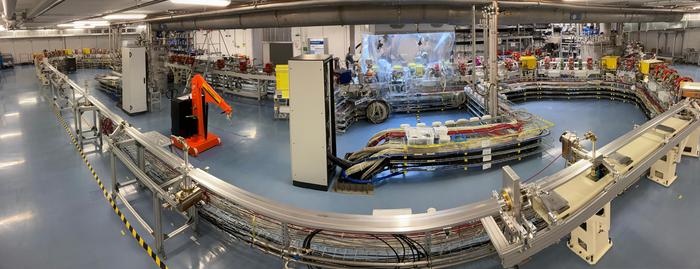
At the forefront of this approach is a superconducting radio-frequency (SRF) photoinjector, an advanced type of particle accelerator.
By generating a continuous high-power electron beam, this system can deliver precisely the energy required to trigger radiolysis – the chemical breakdown of PFAS molecules.
Researchers at the Helmholtz-Zentrum Berlin (HZB) have demonstrated that this technology is capable of effectively fragmenting PFAS compounds under controlled laboratory conditions.
The electron beam’s adjustable energy and power levels make it highly adaptable. Different PFAS chemicals respond differently to radiation, and fine-tuning the beam allows scientists to optimise the chemical yield for maximum destruction.
This flexibility gives the technology an edge over conventional methods, which are often one-size-fits-all and less efficient at dealing with complex mixtures of PFAS.
Towards practical, on-site treatment
One exciting prospect is a compact, container-sized electron beam treatment unit.
Such a system could be deployed directly at contamination hotspots, like the former Berlin Tegel Airport, reducing the need for costly infrastructure and transportation of contaminated water.
Initial analyses suggest that, with further development, electron beam technology could achieve operational costs comparable to existing filtration systems while offering the significant advantage of actual chemical destruction.
By combining accelerator physics with environmental engineering, researchers are turning a tool traditionally associated with fundamental science into a practical solution for one of today’s most persistent pollutants.
Electron beam water treatment has the potential to revolutionise PFAS cleanup, offering a faster, more complete, and environmentally sustainable approach than ever before.
A future powered by electrons
While commercial application is still in development, the study confirms that electron beam technology is more than a theoretical exercise.
Its adaptability, efficiency, and scalability make it a promising candidate for tackling forever chemicals wherever they accumulate, signalling a new era in pollution remediation.