
The EU-funded FLEX-SCALE project is pioneering optical network technologies that will enable unprecedented data speeds while dramatically reducing energy consumption for next-generation 6G telecommunications infrastructure.
As global data traffic continues to surge exponentially, our telecommunications networks face unprecedented challenges. The ongoing rollout of 5G is already pushing current infrastructure to its limits, while the upcoming 6G era will demand even more from our networks, requiring not just faster speeds but significantly improved energy efficiency.
Enter FLEX-SCALE, an ambitious EU-funded project that is tackling these challenges through groundbreaking research on optical network technologies. Launched in January 2023 and running until December 2025, the project represents almost an €8m investment in Europe’s telecommunications future under the EU’s HORIZON-SNS-JU-2022 programme.
Professor Ioannis Tomkos, FLEX-SCALE’s project coordinator from the University of Patras, Greece, explains: “FLEX-SCALE advances disruptive research on complementary optical x-haul network technologies for Optical Switching Nodes and their Transceiver Interfaces. We’re enabling flexible capacity scaling of 1 Tb/s rate per interface, 10 Tb/s capacity per link, and 10 Pb/s throughput per optical node.”
Driving innovation through advanced photonics
The heart of FLEX-SCALE’s innovation lies in its pioneering use of ultra-high bandwidth photonic and plasmonic technologies, combined with the efficient exploitation of optical spatial and spectral switching – a combination of UltraWide-Band Spectral and Spatial Lanes Multiplexing (UWB/SDM).
These advanced technologies enable the transmission and routing of information using light signals through optical fibres, but with unprecedented capacity and energy efficiency. The project aims to achieve record-breaking energy consumption below one picojoule per bit, around 100 times more efficient than current technologies.
Tomkos notes, “Today’s networks consume enormous amounts of energy in electronic processing systems. Our approach replaces or bypasses these power-hungry systems with photonic integration and optical transparency, dramatically reducing both energy consumption and costs.”
This focus on energy efficiency and sustainability is particularly crucial as the telecommunications industry works to reduce its environmental footprint. By 2030, it’s estimated that the ICT sector could account for up to 20% of global electricity consumption without significant efficiency improvements.
Creating next-generation network architectures
FLEX-SCALE isn’t just developing individual components – it’s reimagining the entire architecture of telecommunications networks to support the demanding requirements of 6G applications.
A key innovation is the Multi-Granular Optical Node (MG-ON), which converges both Ultra-Wide-Band Spectral and Spatial Lanes Multiplexing. This novel node incorporates a Wave-Band Selective Switch (WBSS) capable of handling massive amounts of data with unprecedented spectral flexibility and large optical switching radix.
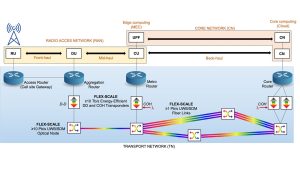
The project is also developing advanced, energy-efficient networking by creating plasmonic-based optical Digital-to-Analogue converters (oDACs). These innovative components will help replace costly and power-consuming electronic processing systems with more efficient optical alternatives having simplified binary driving electronics.
A pan-European collaborative effort
The FLEX-SCALE consortium is comprised of industrial technology leaders and renowned academics from institutions across Europe. The team includes experts in transformational transceivers, optical switches, network planning, operation algorithms, and protocol development.
Tomkos proudly states: “Our consortium spans the entire value chain. From fundamental research to commercial applications, we have the expertise needed to deliver on our promises and extend Europe’s leadership in 6G x-haul.”
The project builds on Europe’s strong tradition of leadership in optical communications, aiming to strengthen the continent’s position in this strategically important field as global competition intensifies.
Looking toward a 6G future
As the project reaches its midpoint, FLEX-SCALE has already achieved significant milestones. Recent tests have demonstrated transmission systems operating at 140 GBd across S-C-L-Band, enabled by ultra-high bandwidth plasmonic platform.
At a recent presentation at ECOC 2024 in Frankfurt, the team showcased their progress and engaged with other industry leaders. The project continues to advance toward its ambitious goals, with final demonstrations planned for late 2025.
The innovations developed by FLEX-SCALE will likely begin appearing in commercial telecommunications infrastructure by the end of this decade, just as 6G deployments begin to ramp up. The project’s technologies promise to be game-changers for the industry, enabling a new generation of applications that require extremely high bandwidth, ultra-low latency, and unprecedented reliability.
Tomkos concludes: “FLEX-SCALE isn’t just about building faster networks, it’s about creating the sustainable, energy-efficient foundation that will power our digital society for decades to come.”
For telecom operators, equipment manufacturers, and ultimately, everyday users, the benefits will be transformative – bringing us closer to a world where digital experience is seamlessly integrated into every aspect of our lives, all while significantly reducing the environmental impact of our increasingly connected world.
Please note, this article will also appear in the 23rd edition of our quarterly publication.