
Maciej Sibiński from Tallinn University of Technology highlights the role of flexible photovoltaics in security and rescue systems today and their potential for the near future.
Today, certain extreme situations and activities – such as distant wilderness travels, extreme sports activities, terrorist attacks, pandemics, wildfires and military conflicts – are becoming more and more prevalent in our lives, posing a significant threat and accelerating the demand for innovative solutions. Very often, fast and accurate rescue, proper treatment, or effective operation in these conditions is now associated with modern electronic equipment that can deliver fast communication, proper diagnosis, and enhanced capabilities. However, achieving this relies on a stable, robust and safe energy source, which can be challenging to obtain.
Drawbacks of traditional firefighting operations
Let’s take a closer look at the practical example of modern firefighting operations. Traditionally, fire brigades worked inside buildings or in the field independently under the command of experienced team leaders, according to the actual situation and capabilities. However, dynamic situation shifts, such as unexpected building collapses, temperature rises, and poisonous gases, pose serious threats to the safety of these operations. In addition, working in foggy conditions or in a poisonous chemical cloud can impact situational judgment. Factors such as being overtired, stressed or overlooked can also affect decision making. So, how can we effectively address these challenges?
Real-time monitoring to enhance firefighters’ safety
Let’s assume that the health status of each firefighter is constantly monitored according to the blood pressure, heart rate, oxygen content, skin temperature or even the sweat intensity and composition. Also, their surrounding area and movement parameters are controlled according to the outer temperature level, localisation, elevation, acceleration, body position, and movement speed. The presence of any poisonous gas or acid is immediately reported, together with other information, by an electronic head-up display on his visor. Moreover, the constant connection with the rest of the group and the central command unit is continuously provided. Not only is each team member better informed and prepared for unexpected events, but the whole work of the fire service is more effectively and safely commanded. Furthermore, any incoming threat, may it be a rapid temperature surge or deteriorating condition of a firefighter themselves, is evident to the commanding officer, who may decide to withdraw the person from the situation.
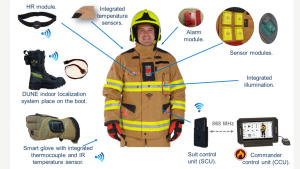
Is it possible to obtain all of this information in real-time without any special measurement setup? The answer is yes – by the miracles of today’s smart textiles and electronic microsensors. All necessary sensing equipment can be fully integrated within inner and outer garments in the form of microchips or flexible foil sensing stripes, or even single threads incorporated into fabrics. Even the transmission antenna is available in the form of a screen-printed circuit on the back of a jacket.
Aside from fire departments, other emergency services and rescue teams can benefit from these systems. The acceleration/motion sensor installed in the worker’s reflective vest may automatically report all possible fall accidents to the central system, which dramatically shortens the rescue intervention time.
Flexible photovoltaics: A reliable energy source
To make all of these systems operational, the electric energy delivery is absolutely necessary. Whilst batteries may be the obvious first thought as a power source, their heavy weight, toxicity and uncomfortable, rigid construction are serious drawbacks for textile applications. Luckily, flexible photovoltaics can be an ideal solution.
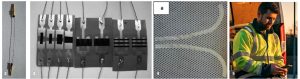
Fig. 3: Electronic elements printed on polymer foil samples³
Fig. 4: Broadband antennas printed directly on fabric⁴
Fig. 5: Smart reflection vest with acceleration sensor
Flexible photovoltaics can be easily integrated with different types of textiles, including boat sails, tent covers, backpacks or firefighting outer garments and even regular clothes. Producing this integration technology is not an easy task, since its demands are not only high flexibility and resistance to abrasion, but also humidity resistance – as well as during standard washing cycles. Nevertheless, some thin-film PV technologies, including Sb2S3 and Sb2Se3 cells developed at Tallinn University of Technology’s Laboratory for Thin Film Energy Materials group, offer this perspective.
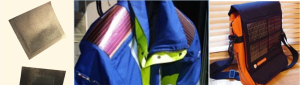
Future technology development is necessary, but the potential benefits for outdoor wearable systems’ power supply are extremely promising. The first products based on thin-film photovoltaics in these applications are already penetrating the market niche. Soon these enhanced clothes may become the focal point of our personal electronics.
Acknowledgement
The work was supported by EU Horizon 2020 project 952509-5GSOLAR
References
- T. Blecha, R. Soukup, Petr Kaspar, A. Hamácek, J. Řeboun “Smart firefighter protective suit – functional blocks and technologies” Proc. 2018 IEEE International Conference on Semiconductor Electronics (ICSE) 11-13 March 2018, Barcelona, Spain
- M. Sibiński, M. Jakubowska, M. Słoma, “Flexible temperature sensors on fibers” Sensors Volume 10, Issue 9, 2010, pp 7934-7946
- S. Bielska, M. Sibiński, A. Łukasik, “Polymer temperature sensor for textronic applications” Materials Science and Engineering B: Solid-State Materials for Advanced Technology Volume 165, Issue 1-2, 25 2009, pp 50-52
- I. Nowak, Ł. Januszkiewicz, I. Krucińska ”Comparison of the Parameters of Textile Antennas Manufactured Using Three Techniques: Magnetron Sputtering, Ink-Jet Printing and Embroidery” FIBRES & TEXTILES in Eastern Europe FTEE, 32(1), 2024 pp. 1–7
- https://swanholmtech.com/
Please note, this article will also appear in the 24th edition of our quarterly publication.