Research co-funded by Guardian Metals has revealed the expected demand for tungsten as innovation in nuclear fusion reactors accelerates.
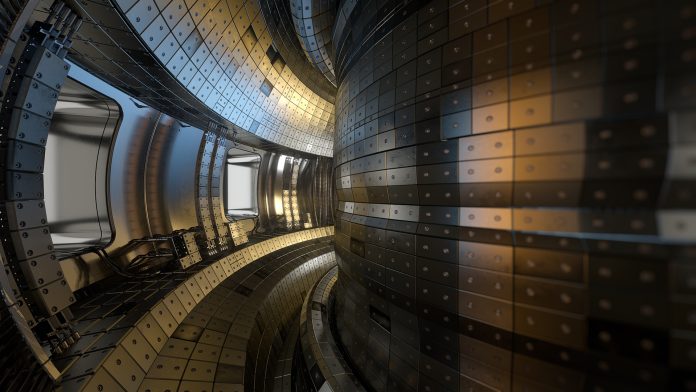
Guardian Metals has co-funded a research project, titled ‘Materials Selection for Fusion Breeder Blankets’, which forms part of Oxford Sigma’s collaboration with the UK Atomic Energy Authority (UKAEA). This study is the first scientific paper to directly quantify the amount of tungsten that is expected to be required in nuclear fusion technology in the context of a tungsten supply chain.
The study predicts, in the scenarios analysed, if global tungsten production stays stagnant for the roll out of 500MWth and 2000MWth scale fusion reactors, the fusion industry will require 100% of global production by 2056 and the global tungsten production would need to grow by 10 to 16 times from its current level by the end of the century.
For context, over its full 40-year lifespan, a single 2,000 MWth ARIES-ST reactor would need approximately 2.6 times the tungsten currently consumed in the US every year for all use cases. The results strongly underpin the need for new mined sources of the metal to meet the growing future demand from fusion technology.
The study was co-funded partially by Guardian Metal with technical method and analysis conducted by the company’s partners Oxford Sigma Ltd (Oxford Sigma). Oxford Sigma is a fusion technology company dedicated to addressing energy security and climate change. Its mission is to accelerate the commercialisation of fusion energy by providing advanced materials technology, innovative materials solutions, and comprehensive fusion design services.
Key data points:
• Tungsten is a leading candidate for both plasma facing and shielding in both spherical and D-shaped tokamaks, given its core properties including high melting point, high thermal conductivity, high neutron shielding and low sputtering yield (loss of material when hit with energetic particles).
- Two specific reactor designs were studied, the results of which have concluded that:
o ARIES-ST reactor over 40fpy (full power-years) at 500MWth (megawatt thermal) consumed 4,231 tonnes of tungsten and 29,034 tonnes at 2,000MWth.
o EU-DEM01 reactor over 40fpy at 500MWth consumed 3,945 tonnes of tungsten and 9,554 tonnes at 2,000MWth.
- Given that current global consumption is approximately 100,000 tonnes per annum, the study models that global tungsten supply is a founding cornerstone issue for a future fleet of fusion power plants.
The full study can be found at:
E. Day-San, G.C. Blackett, M. Dornhofer, A.K. Manduku, M.D. Anderton, L. Tanure, T.P. Davis, ‘Supply and demand of tungsten in a fleet of fusion power plants’, Fusion Engineering and Design, https://doi.org/10.1016/j.fusengdes.2025.114881
Please note, this article will also appear in the 23rd edition of our quarterly publication.