Bioenergy Europe explains how bioenergy with carbon capture and storage could hold the key to Europe’s energy transition.
Achieving net-zero greenhouse gas emissions by 2050 remains one of the European Union’s most formidable challenges. While cutting fossil emissions is essential, the latest scientific evidence and policy modelling converge on a critical conclusion: carbon dioxide removals (CDR) must complement emission reductions to achieve climate neutrality. The forthcoming revision of the EU Climate Law will once again bring the debate on industrial removals to the fore, with growing recognition that durable, verifiable carbon removal technologies will be indispensable to meeting Europe’s long-term objectives.
BECCS: A proven pathway to carbon-negative energy
Bioenergy with carbon capture and storage (BECCS) occupies a unique position in the CDR portfolio. It combines renewable bioenergy from sustainably managed biomass with technologies that capture and permanently store biogenic CO₂ emissions. The underlying principle is rooted in the natural carbon cycle: as biomass grows, it removes CO₂ from the atmosphere through photosynthesis. When that biomass is used to generate energy, capturing and storing the emitted CO₂ effectively withdraws carbon from the atmosphere on a net basis.
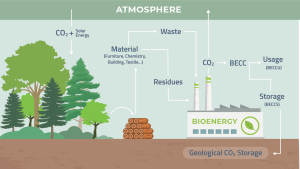
Unlike many negative-emission concepts still under development, BECCS builds on commercially mature technologies that are already deployed in multiple industrial settings. Its dual benefit, providing renewable energy and delivering permanent removals, makes it one of the few scalable solutions capable of delivering near-term climate benefits while supporting Europe’s decarbonisation and energy security objectives.
Quantifying the potential: 80 Mt CO₂ by 2040
The European Commission’s Impact Assessment Report on Europe’s 2040 Climate Target and Path to Climate Neutrality by 2050 estimates that 80 million tonnes (Mt) of industrial CO₂ removals per year by 2040 will be required to stay on course toward net-zero. A recent study by BEST – Bioenergy and Sustainable Technologies GmbH shows that this target is not only realistic but achievable with existing assets.
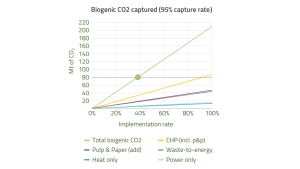
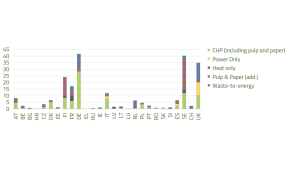
According to the study, retrofitting just 38% of existing biomass installations with BECCS would already enable the EU to reach the 2040 objective. Expanding implementation to 50% of current facilities could yield around 105 Mt CO₂ yr-¹ of durable removals. These figures illustrate that Europe’s industrial carbon removal ambition is technically within reach, provided enabling conditions are established.
Building on an established framework
The EU has already taken key steps to create a supportive policy environment. The Renewable Energy Directive (EU/2023/2413) strengthens sustainability and greenhouse gas performance criteria for biomass (Article 29), providing a solid governance basis for integrating BECCS within the existing renewable energy framework. Many bioenergy plants operate close to large industrial clusters and coastal CO₂-storage hubs, making retrofitting with carbon-capture systems a cost-effective and rapid deployment pathway.
As experience accumulates and transport-and-storage infrastructure expands, learning curves are expected to lower costs further, mirroring trends seen in wind and solar over the past decade. The co-location of biomass power or CHP facilities within industrial clusters presents opportunities for shared CO₂ networks, waste-heat utilisation, and joint logistics, further improving project economics.
Removing policy and financial barriers
Despite its technological readiness, BECCS deployment is still constrained by regulatory and financial fragmentation. Project developers face complex permitting, unclear eligibility rules, and patchy access to funding. Addressing these obstacles will be essential to unlock the sector’s potential.
To unlock BECCS’ potential, the first step is ensuring predictable and consistent implementation of existing EU legislation, avoiding the regulatory uncertainty that deters investment. Funding schemes should be simplified and targeted instruments introduced to de-risk early projects, for example through Contracts for Difference or Carbon Removal Purchase Agreements.
In parallel, the development of a harmonised EU certification framework for carbon removals, Carbon Removal and Carbon Farming Regulation (CRCF) marks a major advance. By defining transparent accounting methodologies and monitoring, reporting, and verification (MRV) standards, the CRCF lays the foundation for credible, tradable carbon removal credits. Although refinements will be needed, its inclusive process has established a solid scientific and policy baseline. Early implementation is crucial to provide the long-term certainty investors require.
Infrastructure: The backbone of scale
Even the most efficient capture technologies cannot deliver removals without reliable CO₂ transport and storage infrastructure. The absence of integrated pipeline networks and accessible geological storage remains a bottleneck for large-scale deployment. Prioritising shared CO₂ transport and storage hubs, particularly within industrial regions such as the North Sea basin, the Baltic, and the Mediterranean corridor would significantly reduce costs through economies of scale.
Public-private partnerships will be vital in developing this infrastructure, along with clear liability rules and transparent permitting procedures. Ensuring interoperability with future carbon-transport networks under initiatives like the TEN-E Regulation will further support a single European market for captured carbon.
National action and public engagement
While EU-level policies set the direction, Member States must play a decisive role in implementation. Integrating BECCS deployment objectives into National Energy and Climate Plans (NECPs) will help mobilise domestic funding, align infrastructure planning, and attract private investment.
Equally important is the social dimension. Public awareness of BECCS remains limited, and misconceptions about biomass sustainability persist. Transparent communication and education initiatives are essential to build trust. Demonstrating that BECCS uses sustainably sourced residues and by-products, not feedstocks competing with food or biodiversity, will help ensure societal acceptance and policy continuity.
Distinguishing permanent removals from emission reductions
As Europe designs its post-2030 climate architecture, it will be critical to establish separate targets for permanent carbon removals distinct from gross emission reductions. This ‘like-for-like’ principle ensures that fossil CO₂ emissions are counterbalanced only by durable storage solutions, maintaining environmental integrity and preventing double counting. Recognising BECCS as a dedicated category of industrial carbon removal aligns with this approach and supports the credibility of corporate and national net-zero claims.
Science-based carbon negativity
From a carbon-accounting perspective, the climate benefit of BECCS stems from the biogenic origin of the carbon. During biomass growth, CO₂ is absorbed from the atmosphere and stored in organic matter. When the same carbon is later captured and stored in geological formations for centuries or millennia, the overall result is net carbon removal.
This process differs fundamentally from conventional carbon capture on fossil sources, which merely prevents new emissions. Lifecycle assessments (LCAs) consistently show that, when biomass feedstocks comply with EU sustainability criteria, BECCS can achieve net-negative emissions of 700–900 kg CO₂ per MWh of electricity or heat generated, depending on capture efficiency and storage permanence.
Moreover, BECCS installations can contribute to grid stability by providing dispatchable renewable energy, complementing intermittent sources such as wind and solar. This dual functionality, firm renewable energy and durable carbon removal, positions BECCS as a cornerstone technology for a resilient, low-carbon energy system.
Delivering results with existing assets
The quantitative findings of the BEST study illustrate a pragmatic reality: Europe does not need to build an entirely new fleet of facilities to meet its removal targets. By upgrading roughly one-third of current biomass capacity, the EU could deliver the 80 Mt CO₂ yr-¹ removals envisaged for 2040. Expanding deployment to half the facilities would yield around 105 Mt CO₂ yr-¹, offering a significant safety margin for meeting climate goals.
These projections assume mature capture technologies, average capture efficiencies above 90%, and access to appropriate storage capacity, conditions that are already achievable in Europe today. They confirm that large-scale BECCS deployment is not a distant vision but a near-term economic and policy challenge.
A pragmatic and immediate solution
Among available carbon removal options, BECCS stands out for its readiness, scalability, and cost-effectiveness. It can be implemented using existing industrial assets and supply chains, leveraging Europe’s strong bioenergy base and technical expertise.
By supporting BECCS through coherent policy frameworks, predictable certification, and dedicated infrastructure, the EU can bridge the gap between ambition and implementation. Doing so would reaffirm Europe’s leadership in climate innovation, strengthen its industrial competitiveness, and contribute decisively to the 2040 carbon removal target.
In short, BECCS is more than a concept, it is a proven, science-based solution that turns renewable energy into a vehicle for negative emissions. With strategic co-ordination and investment, Europe can transform today’s bioenergy fleet into tomorrow’s carbon-negative power system, combining sustainability, security, and technological leadership on the path to climate neutrality.
Please note, this article will also appear in the 24th edition of our quarterly publication.